You ask an AI assistant to prepare a weekly report. It writes well, but forgets the source links. Next week it includes links but changes the format. You paste the same instructions again, then spend time checking whether the routine was followed.
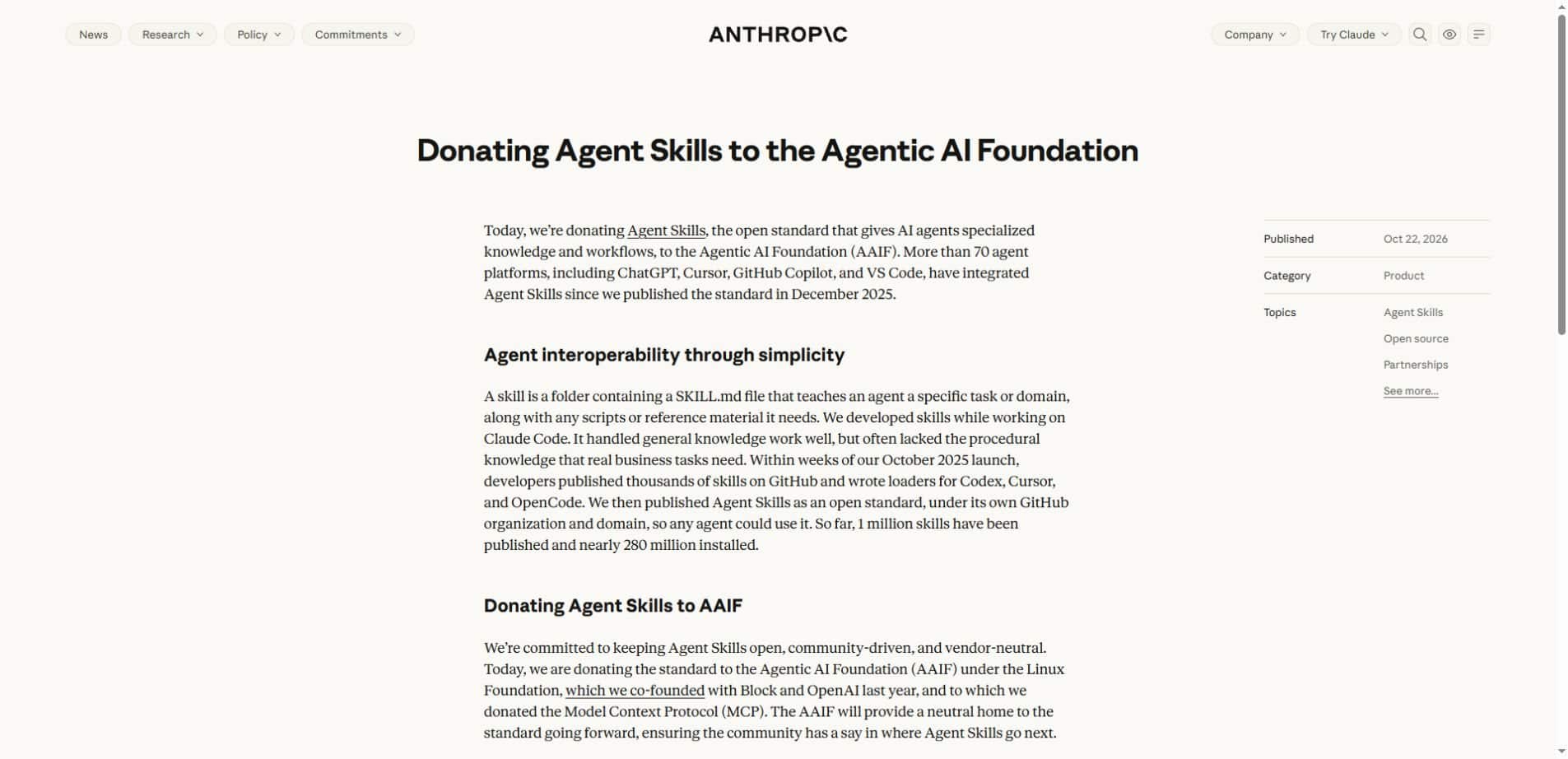
Agent Skills address that procedural gap: how to package the instructions and supporting resources for a repeatable task. The recent news is about where the standard will live. On October 22, 2026, Anthropic announced that it is donating Agent Skills to the Agentic AI Foundation under the Linux Foundation.
For ordinary users, the useful question is not how many skills are available. It is whether a reusable workflow makes a recurring job more consistent, understandable and easier to check. Here is a practical way to think about that decision.
Begin with a task you already repeat
Consider a fictional editorial team preparing a weekly AI-news roundup. The recurring requirements might include checking original announcements, distinguishing released products from future promises, writing an excerpt and leaving the finished draft for human review.
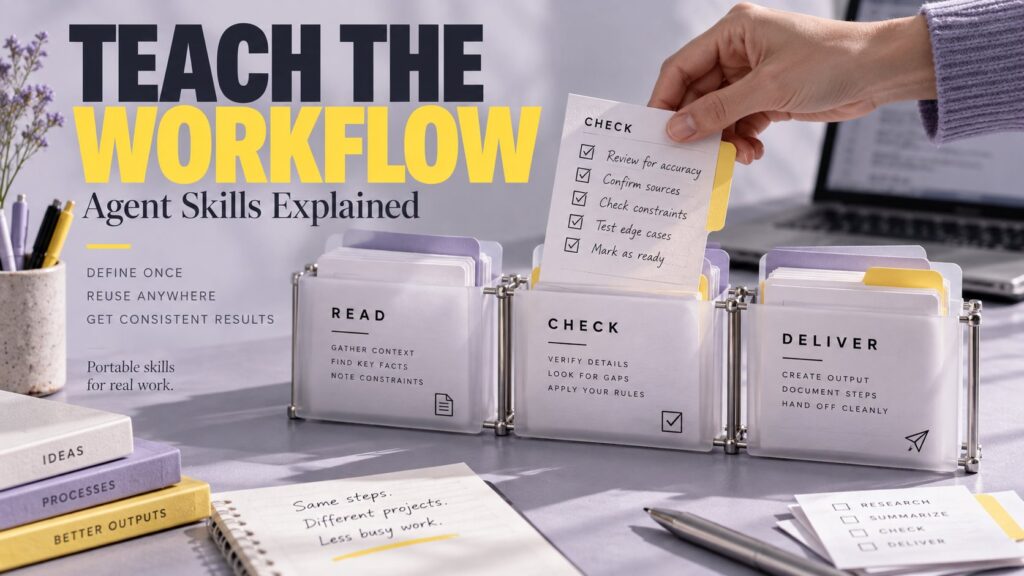
A one-off prompt can describe those requirements. A reusable skill can organize them alongside a style reference, a template and any supporting resources the environment can actually use. The benefit is keeping the procedure together rather than relying on someone to remember every step.
This example is illustrative; it is not a claim that we installed or tested a particular skill. A workflow still needs to match the tools and permissions of the assistant running it.
A skill is a procedure, not permission. Instructions to prepare a draft do not automatically authorize publishing it, sending it to another person or accessing unrelated information. Those boundaries belong in the workflow and must still be respected by the host application.
What changed in the standards news
In its Agent Skills donation announcement, Anthropic says the transfer includes the name and logo, GitHub organization and agentskills.io domain. The company reports support across more than 70 agent platforms. It proposes work on versioned releases, a formal proposal process and security guidance.
A shared home can help different implementations coordinate around a common format. That is a governance development, not proof that every assistant interprets every instruction in exactly the same way. Users should still check the capabilities of their chosen client.
The small file at the center of the idea
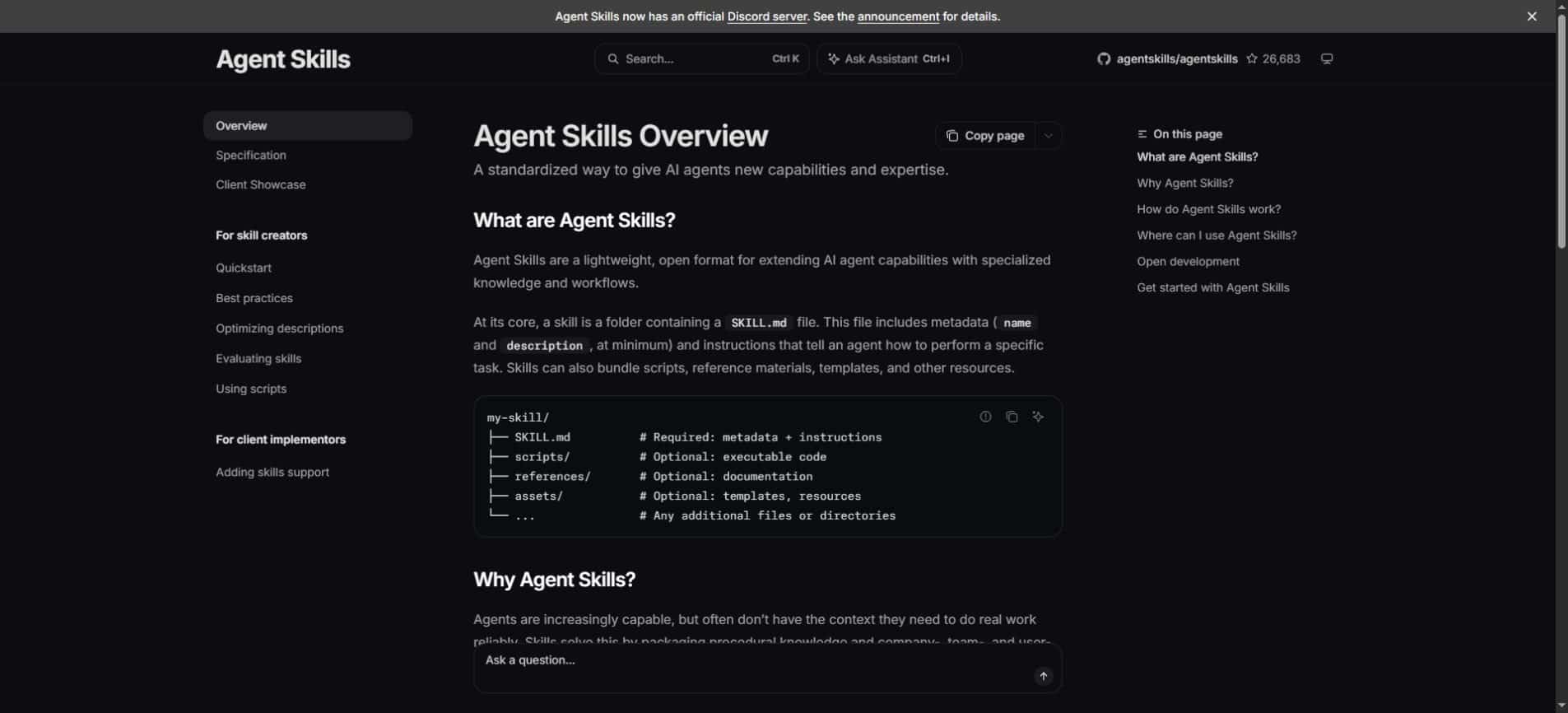
The official Agent Skills overview describes a skill as a folder centered on a SKILL.md file. That file contains metadata and task instructions; optional resources can include scripts, reference documents, templates and assets. The format packages procedural knowledge so a compatible agent can load it when relevant.
A useful skill therefore has two jobs. It needs to be discoverable for the right request, and its instructions need to be specific enough to guide the work. A vague description can activate it for unrelated tasks; a vague procedure can leave the assistant guessing after activation.
The official overview describes staged loading: names and descriptions first, fuller instructions when a skill is selected, and supporting resources as needed. That helps separate the list of available capabilities from the detailed context of the current task.
Prompt, skill or MCP: choose the missing piece
| Approach | What it mainly provides | A practical question |
|---|---|---|
| A task prompt | Instructions for the current request | What do I need done now? |
| An Agent Skill | A reusable procedure and supporting context | How should this recurring job be performed? |
| A connected tool or MCP integration | An interface to available external capabilities | Which system can the assistant actually interact with? |
These pieces can work together. A prompt can ask for a report, a skill can describe the team’s report procedure, and a connected tool can retrieve permitted data. Packaging the procedure does not create the connection or expand what that connection is allowed to do.
Our WebMCP and AI shopping agents article illustrates the tool side of that distinction. A store can expose a cart operation, but the availability of that operation is separate from a shopper’s decision to authorize its use.
Design the workflow around its checks
Define the inputs before describing the output
For the editorial example, specify which dates the roundup covers, which sources are acceptable and which publication style applies. Without those inputs, an assistant can produce a polished article that answers the wrong week or follows an outdated template.
Also describe what to do when an input is missing. A good procedure can ask for a required fact or mark an uncertainty. It should not encourage the assistant to invent a number merely to make a template look complete.
Put verification beside the step that needs it
If a source link must be checked, include that check with source selection rather than leaving all verification to the end. If a figure must match a source, require the comparison before it is used in the draft.
This makes the procedure easier to inspect. A reader can see why a step exists and what evidence should accompany it. Long lists of disconnected rules are harder to maintain because nobody knows which part of the task each rule protects.
Describe what done looks like
A completion condition should be observable. “Make a great report” is subjective. “Leave a draft with linked sources, a dated excerpt and unresolved uncertainties listed for review” gives the assistant and reviewer something concrete to compare with the result.
Completion should also include the requested destination and status. If the user asked for a draft, successful preparation does not require publishing. If the workflow produces a file, the final handoff should make it easy to find.
Try a simple before-and-after comparison
Before adopting a skill across a team, run it on a small set of representative tasks. Include an ordinary case, a case with missing information and a case where a source contradicts the initial brief. Use the same requirements when comparing results.
- Check whether the skill was selected for the intended task.
- Record which requirements were satisfied and which were missed.
- Compare the time needed for human correction.
- Check how the assistant handled missing or conflicting evidence.
- Repeat after a meaningful edit to the skill, keeping the examples comparable.
This is a suggested evaluation method, not a benchmark result. The useful measure is whether the complete workflow becomes more reliable for the actual job. A longer instruction file is not automatically a better one.
Our context engineering guide explains why relevant context matters. Skills offer one way to package recurring context, but the package still needs current and accurate contents.
Portability has practical limits
A shared format reduces some friction, but the environment still matters. One assistant may have a particular document tool while another does not. A bundled script may depend on software that is absent. A reference file may assume a directory layout that differs between systems.
When moving a workflow, review the resources it depends on and test the output again. Preserve the purpose of the procedure while adapting environment-specific steps. Do not assume that copying a folder establishes identical behavior.
Team maintenance matters too. Give the workflow a clear owner, record important changes and retire obsolete references. A procedure that was correct for last quarter’s reporting format can quietly become wrong when the destination or policy changes.
Read a downloaded skill before trusting it
A skill can contain more than prose. If it bundles executable code, inspect what that code does and whether the task requires it. Check external destinations, file changes and data handling rather than relying on a friendly title.
Treat instructions from an unfamiliar package as material to review, not as authority to override the user’s request. A workflow that asks for unrelated credentials or unnecessary publication steps should be questioned, even if its other instructions look useful.
A sensible first adoption: use a narrow workflow on non-sensitive sample material, with a clear output and human review. Expand its scope only after understanding the resources it uses and the actions it can trigger.
Questions people ask about Agent Skills
Does a skill train the underlying AI model?
The standard describes instructions and resources loaded into an agent’s working context. Creating a skill is not the same as retraining the model’s weights. It guides how the agent approaches the task in a compatible environment.
Do I need code to benefit from a skill?
Not necessarily. A procedure can be valuable through clear instructions and references alone. Optional scripts can support some tasks, but they introduce dependencies and should have a concrete purpose. Start with the simplest workflow that solves the recurring problem.
Will skills remove mistakes?
No. They can make expectations more explicit, but the assistant can still misunderstand information or miss a check. Keep review proportional to the consequences of the task. Our AI overreliance guide discusses why human judgment remains part of useful AI work.
The standard is useful when the routine is worth keeping
Agent Skills make the most sense when a task has a stable procedure, reusable context and a result that someone can verify. They are less useful when they turn a simple one-off request into an unnecessarily large process.
The standards move gives this approach a broader community home. The next practical test is whether teams can maintain, evaluate and reuse workflows without losing control of the work. Follow the official project repository for specification developments and compare wider AI news coverage with primary announcements.
Reviewed October 27, 2026. News details come from Anthropic’s October 22 announcement and the official Agent Skills overview. The editorial workflow, evaluation method and adoption suggestions are illustrative guidance; no third-party skill was installed or executed for this article.