
What happens when an AI model becomes a teacher for a competing system without its developer’s permission? That question is behind the latest Anthropic distillation defenses, announced on October 12, 2026. The update concerns the extraction of model capabilities, rather than a new chatbot feature.
In its research announcement, Anthropic says early evidence suggests its measures reduced data harvested by distillers by around 90–99%. The company also acknowledges trade-offs and says it does not know how long the improvement will last. Those qualifications are essential to understanding the news.
Reviewed October 13, 2026: Reported effectiveness figures come from Anthropic’s own measurements. This article explains the announcement and its practical context; it is not an independent security audit or a hands-on benchmark.
The short version: what changed?
Anthropic describes three layers: restricting how protected reasoning can move, detecting extraction attempts and making persistent attempts harder. It reports fewer reasoning tokens exposed on its own platform. This measures a particular form of extraction, not all possible copying of AI capabilities.

For everyday users, the news is mainly about the infrastructure behind the service. For developers, the relevant question is whether their application preserves conversation history correctly and handles blocked or rejected requests clearly. A defense can improve protection while still creating integration work.
Distillation is a technique; an attack is a use of it
Ordinary AI model distillation trains a student model using signals from a teacher. It can be an authorized way to create a smaller or more specialized model. Calling every use of the technique an attack would confuse the method with the circumstances in which it is used.
An unauthorized extraction campaign attempts to reproduce capabilities through access that the provider has not permitted for that purpose. The dispute is about authorization, scale, safeguards and how access is obtained. A normal request to explain an answer is not, by itself, evidence of such a campaign.
The distinction also matters when discussing open models. Open weights describe how model parameters are made available; they do not establish where training data came from. Likewise, a proprietary model is not automatically safe or trustworthy. Each claim needs its own evidence.
Why reasoning data receives attention
A final answer shows an outcome. A detailed intermediate transcript may offer additional training signals about how a model approaches a task. That makes the handling of reasoning data a separate issue from simply serving useful answers to users.
There is also a difference between a user-facing explanation and a model’s protected internal reasoning. A useful explanation can state assumptions, show a calculation and cite evidence without exposing every internal step. Users should judge the explanation by whether it helps verify the result.
For example, a trustworthy spreadsheet answer should identify the relevant cells, show the arithmetic and flag missing data. An extremely long narrative does not make an incorrect number correct. Verifiable work is more useful than treating the length of an explanation as a quality score.
How to interpret the 90–99% claim
The reported reduction is encouraging evidence for Anthropic’s chosen measure, but it is not a claim that unauthorized distillation has ended. The research focuses on extracted reasoning data observed on its platform. It cannot be turned into a universal success rate for every provider or attack.
A security measurement also depends on its baseline and what the monitoring system can observe. Changes in attacker activity, routing or techniques can affect the picture. That is why the company’s warning about future adaptation belongs alongside the headline number.
| Question | Careful interpretation |
|---|---|
| What improved? | Anthropic reports less reasoning data extracted under its measurement. |
| Is this independent proof? | No. The figures are provider-reported results. |
| Does it cover every attack? | No universal claim follows from the reported measure. |
| What matters next? | Durability, attacker adaptation and impact on legitimate workflows. |
The right follow-up questions are specific: what was counted, over which period, on which systems, and what evidence would show that attackers adapted? Readers do not need to dismiss the result to recognize its limits.
What preserved thinking means for developers
Anthropic’s preserved thinking documentation explains rules for reusing earlier thinking blocks. Relevant checks depend on the model, account and conversation context. An integration that changes earlier context can invalidate later blocks rather than simply continuing as before.
This is a practical compatibility issue for applications that assemble their own API requests. A product may rewrite its system instructions, change available tools, shorten an old tool result or rebuild saved history. Those operations can be meaningful changes even when the visible chat appears unchanged.
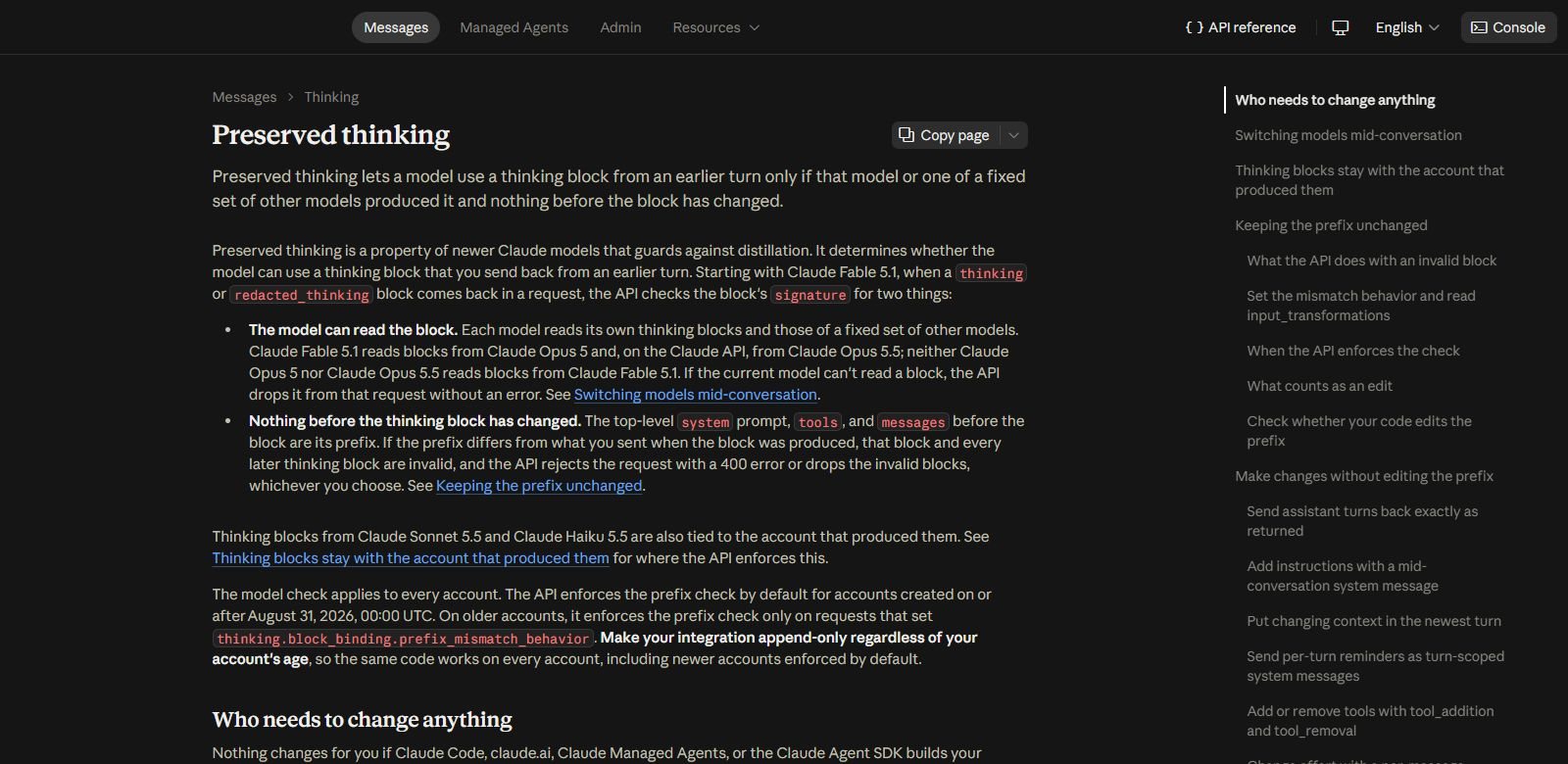
A clean engineering response starts with understanding the documented rules, not suppressing every error. Record enough information to diagnose the cause while avoiding unnecessary storage of private user content. Make the user-visible failure understandable and preserve the original task when recovery is possible.
An integration checklist worth keeping
- Map who builds requests: Identify whether your own code, an SDK, a gateway or another service assembles conversation history.
- Check history changes: Review summarization, tool updates, prompt rebuilding and restored sessions.
- Test model transitions: Do not assume every model can reuse every earlier thinking block.
- Review failure handling: Distinguish invalid requests from refusals, rate limits and temporary service failures.
- Monitor total usage: Repeated retries can add cost without improving the result.
- Keep a representative test case: Use a small multi-turn task with a tool response and a saved-session restart.
These checks are useful even when a provider’s defense is not the original cause of an issue. They reveal where an application transforms context and where important assumptions live. That makes future model migrations easier to diagnose.
A realistic example: the assistant that changes tools
Imagine an assistant helping a team organize documents. It starts with a fixed set of tools, then the application adds a new connector halfway through the conversation. The application might rebuild the original request with a different tool list while retaining earlier thinking blocks.
To the user, this can look like the same conversation. To a system that binds reasoning to prior context, the reconstructed request may be different. The example illustrates why application developers must follow the supported method for changing context rather than assuming the visible transcript is the entire request.
Useful test scenario: Start a short task, complete one tool round, save the session and resume it. Then exercise your documented tool-change and context-management paths. Confirm that failures are explained and that recovery does not silently change the task.
This is an integration test, not a test of how to evade a safeguard. The goal is to keep legitimate workflows compatible with the provider’s documented behavior and to avoid confusing users with repeated unexplained retries.
The trade-off: stronger protection can add friction
Anthropic acknowledges that some developers needed integration updates, benign requests can occasionally be blocked and certain safeguard-blocked requests are charged. Developers should consult current documentation and billing rules for their own configuration instead of assuming every failure is free.
False positives matter even when they are uncommon. If a legitimate user is blocked, the application needs a clear recovery path. That could mean correcting malformed history, clarifying a supported task or directing the user to assistance. It should not mean repeatedly sending the same failing request without a limit.
This connects with context engineering: an AI application must manage instructions, evidence, tools and state deliberately. Reliability depends on that surrounding design as well as the model’s capabilities.
What this news means for ordinary AI users
Most people do not need to change how they ask normal questions because of a model-protection announcement. Continue to request clear explanations, sources and checks that help you evaluate the answer. Focus on evidence rather than trying to obtain hidden internal transcripts.
If an AI tool stops working after an update, record the visible error and the task you were attempting. Avoid sharing private documents or credentials in a public support report. A reproducible example with non-sensitive material is usually more useful than a large dump of conversation data.
When choosing a service, consider how it communicates limitations and handles failure. A provider’s security claims are one part of the picture; output quality, data controls, availability and support also affect whether the tool fits your needs.
Questions readers are asking
Are distillation attacks the same as normal model distillation?
No. Distillation is a training method. An attack refers to unauthorized extraction of capabilities. Authorization and how the data is obtained are central to the distinction.
Did Anthropic stop all distillation attacks?
The announcement does not establish that. It reports a reduction in observed reasoning extraction and explicitly leaves open how durable the gains will be.
Does this mean Claude answers are now more accurate?
No direct accuracy improvement follows from this announcement. Protecting reasoning data and producing correct answers are different objectives. Important outputs still need verification.
Do all API developers need to rewrite their apps?
Not necessarily. The impact depends on how requests and thinking blocks are handled. Check the current preserved thinking documentation and test the parts of your integration that modify or restore context.
Can users still ask for explanations?
Yes, a useful request can ask for assumptions, a concise explanation, calculations or sources. That is different from trying to extract protected internal reasoning. Evaluate the explanation against observable evidence.
The next evidence to watch
The important question is whether the reported improvement persists as attackers adapt, while legitimate applications remain usable. Further measurements and transparent documentation will help readers assess both the effectiveness and the cost of the defenses.
For developers, the immediate task is concrete: understand your conversation pipeline, test supported context changes and make errors visible. For users, keep asking for evidence you can check. Neither group benefits from treating a single security statistic as the whole story.