Finding the best AI for research in 2026 is no longer as simple as choosing the chatbot that produces the longest answer.
Modern AI research tools can search the live web, investigate hundreds of sources, analyze PDFs, compare conflicting evidence, search peer-reviewed literature, work with private documents, generate citations, run calculations and produce detailed reports.
But they are not equally good at all of those jobs.
After reviewing current product documentation, independent research benchmarks and recent feedback from real users, our overall assessment is that ChatGPT Deep Research is one of the strongest all-purpose research environments, particularly when a project combines web research, files and complex synthesis. Perplexity Research is particularly strong for fast, citation-first web research. Gemini Deep Research has an important advantage for users working with Google Search, Gmail and Drive. Claude Research is compelling for careful long-form analysis, while Elicit and Consensus are better suited to academic literature than ordinary general-purpose chatbots.
For a broader comparison of general-purpose assistants rather than dedicated research modes, see our Best AI Chatbot comparison.
There is no AI system that should be trusted without verification.
The best AI for research ultimately depends on what you are researching, which sources count as acceptable evidence, whether freshness matters, whether you need academic literature or the general web, and how much control you need over the research process.
Last reviewed: September 2026
Editorial note: AI products, models, limits and prices change frequently. Product capabilities in this article were checked against provider documentation available at the time of review. Company claims are identified as vendor claims, while public user comments are treated as anecdotal feedback rather than statistically representative customer surveys.
Best AI for Research: Quick Comparison

| AI research tool | Best for | Main advantage | Main consideration |
|---|---|---|---|
| ChatGPT Deep Research | Best overall mixed-source research | Web, files, source controls and detailed synthesis | Detailed investigations can take time |
| Perplexity Research | Fast web research | Excellent source visibility | Heavy users may encounter research limits |
| Gemini Deep Research | Google ecosystem | Search, Drive, Gmail and Notebook integration | Source quality still needs checking |
| Claude Research | Deep analysis and synthesis | Strong reasoning across complex information | Research can consume usage faster |
| Elicit | Scientific research | Academic evidence and systematic reviews | Less useful for general internet research |
| Consensus | Academic paper discovery | 220M+ paper database and strong filters | Does not replace reading the studies |
| Gemini Notebook | Your own research sources | Excellent source-grounded workflows | Results depend heavily on source quality |
| Grok | Real-time social research | Direct web and X research | Not my first choice for systematic academic work |
The table above is an editorial guide by use case, not a claim that one tool wins every possible research benchmark.
How We Compared the Best AI Research Tools
There is an important problem with articles claiming to identify the best AI for research: “research” can mean very different things.
Finding the current price of a product is research.
Comparing twenty industry reports is research.
Conducting a systematic literature review is research.
Analyzing ten company PDFs is research.
Investigating what people are saying about a newly launched technology is also research.
Those jobs require different capabilities.
For this comparison, we considered:
- Ability to find current information
- Source visibility
- Citation quality
- Ability to investigate multiple sources
- Control over source selection
- Uploaded-document support
- Academic research support
- Long-context analysis
- Research planning
- Data-analysis capabilities
- Ease of verification
- Speed
- Real user experiences
- Independent benchmark evidence
We also distinguish between what companies claim about their own tools and what independent benchmarks or users report.
That distinction is important for trustworthy review content.
1. ChatGPT Deep Research — Best AI for Research Overall
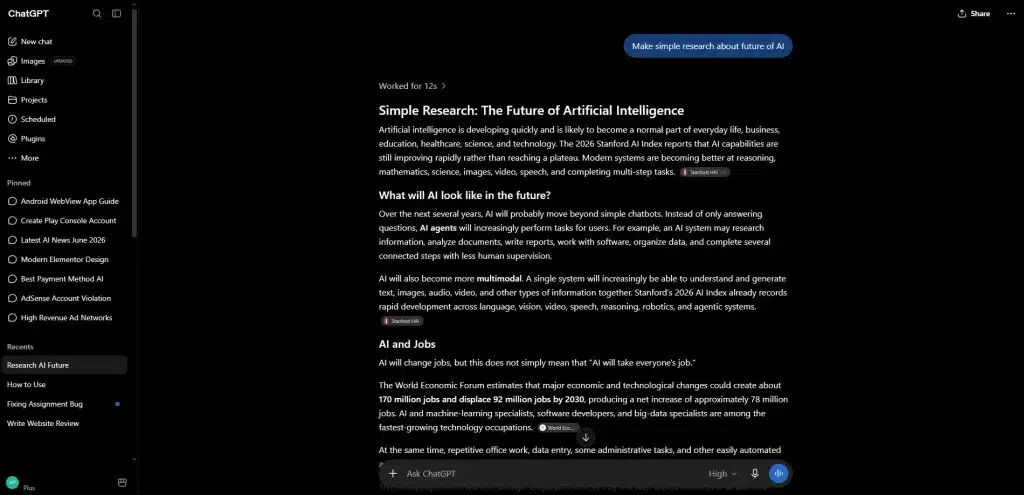
Best for: Complex investigations, professional reports, market research, product comparisons, uploaded files and research involving several different source types.
ChatGPT Deep Research is more than ordinary web search.
According to the current official documentation, Deep Research can create a proposed research plan, let the user modify that plan, work with additional source context, restrict or prioritize specific websites, show progress during research and produce a structured report containing citations or source links. Reports can also be downloaded in formats including Word, PDF and Markdown.
You can read the current feature details in the official OpenAI Deep Research documentation.
Why ChatGPT Deep Research Is Our Overall Choice
Its biggest advantage is flexibility.
A single project can potentially combine:
- Public web sources
- Uploaded reports
- Selected websites
- Complex reasoning
- Comparative analysis
- Structured writing
- Source verification
Consider the difference between these prompts.
A simple prompt:
Which payment processor is best for an AI company?
A stronger research request:
Compare five payment providers for a generative AI SaaS company operating internationally. Prioritize each company’s official acceptable-use policy, fees and supported countries. Identify whether generative AI is explicitly permitted or restricted, clearly separate confirmed information from uncertainty, and finish with a risk comparison.
The second prompt asks the research system to answer a decision problem rather than merely generate information.
Source Control Is Especially Valuable
One of the most useful current features is the ability to tell Deep Research which websites to prioritize or restrict.
For example, when researching regulation, you could prioritize:
- Government agencies
- Regulators
- Legislation
- Official standards organizations
instead of letting an AI rely heavily on SEO articles summarizing those primary sources.
For high-quality research, that difference matters.
What OpenAI Says
OpenAI describes Deep Research as appropriate for multi-step questions that require information from several sources to be gathered, compared and synthesized.
Its documentation also explicitly tells users to review citations and make sure sources support the claims before using or sharing the final report.
That warning is worth following regardless of which research system you use.
What Real Users Say About ChatGPT Deep Research
User feedback is not universally positive, but many users value the detail of its final reports.
In a June 2026 discussion comparing Gemini with previous ChatGPT Deep Research use, one user said they had found ChatGPT’s research output detailed, focused on the actual question and easy to tailor through instructions. The same user thought Gemini found plenty of useful sources but disliked the style of its final research writing.
That is one user’s experience, not evidence that ChatGPT is universally superior.
It does highlight an important difference between research systems:
finding good information and presenting it well are separate capabilities.
Weaknesses
ChatGPT Deep Research can still:
- Select weak sources
- Misinterpret evidence
- Overstate conclusions
- Miss contradictory evidence
- Use a citation that supports only part of a sentence
Deep Research is also unnecessary for simple questions.
If you only need one fact, normal web search can be faster.
Verdict
For someone who wants one general-purpose AI research environment capable of handling many different research workflows, ChatGPT Deep Research is our current overall recommendation.
That is an editorial recommendation based on feature breadth, not a claim that it wins every independent benchmark.
2. Perplexity Research — Best for Fast, Citation-First Web Research
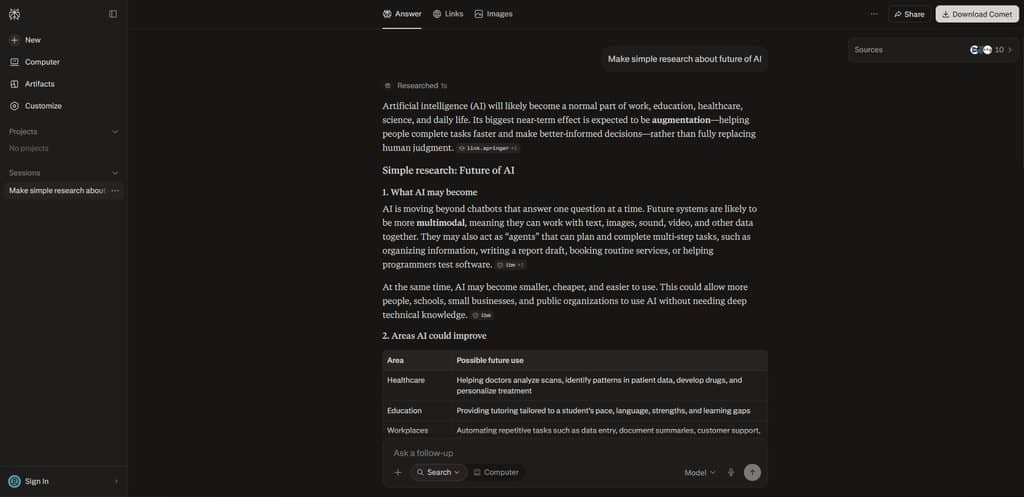
Best for: Current information, source discovery, technical research, product comparisons, market research and questions where you want to inspect sources quickly.
Perplexity has always been unusually research-focused.
Instead of treating web search as an optional addition to a chatbot, searching and citing sources are central to the product.
Perplexity says its Research mode performs dozens of searches, reads hundreds of sources and iteratively decides what to investigate next before synthesizing a report.
Read the official Perplexity Research Mode documentation for its current capabilities.
Why Perplexity Is Excellent for Web Research
Perplexity naturally encourages this workflow:
Read claim → inspect citation → open original source
That is much healthier than treating a chatbot answer as the source itself.
Its newer Advanced Deep Research system can also work with uploaded documents, browse additional sources and use a code environment for calculations and data analysis.
See the Advanced Deep Research documentation for those newer capabilities.
When Perplexity Works Particularly Well
It is a strong choice for questions such as:
What changed in Google’s AI product lineup this month?
Compare the pricing and specifications of these four products.
Find the latest primary sources discussing this policy change.
What are the major arguments for and against this technology?
For this kind of research, being able to scan citations quickly is extremely useful.
What Perplexity Says
Perplexity positions Research as a more intensive mode than ordinary Search.
Its current documentation says Research automatically selects the underlying models instead of requiring the user to manually choose one.
This means people should avoid claims such as:
“Perplexity Research always uses Model X.”
The actual model selection can be handled automatically.
What Real Users Say About Perplexity
The biggest recent criticism is not necessarily research quality.
It is usage limits.
A highly discussed April 2026 thread came from a Pro subscriber who said they unexpectedly reached a Deep Research limit and were frustrated by how difficult it was to understand the allowance. Other commenters reported similar concerns.
Another June user reported that their normal research workflow exhausted Research access sooner than expected and described the limits as disappointing for a paid user.
Those posts are anecdotal, and subscription limits can change at any time.
Check the current plan details rather than relying on historical Reddit numbers.
Weaknesses
A visible citation does not necessarily mean the citation perfectly proves the associated sentence.
Perplexity can also return:
- Secondary sources when primary sources exist
- Weak commercial sites
- Old articles
- Duplicate reporting derived from one original source
The final verification step remains yours.
Verdict
Perplexity is one of the strongest choices for fast, transparent web research.
If your main priority is finding current information and opening the underlying sources quickly, it may be preferable to a more general-purpose chatbot.
3. Gemini Deep Research — Best AI for Google Workspace Research
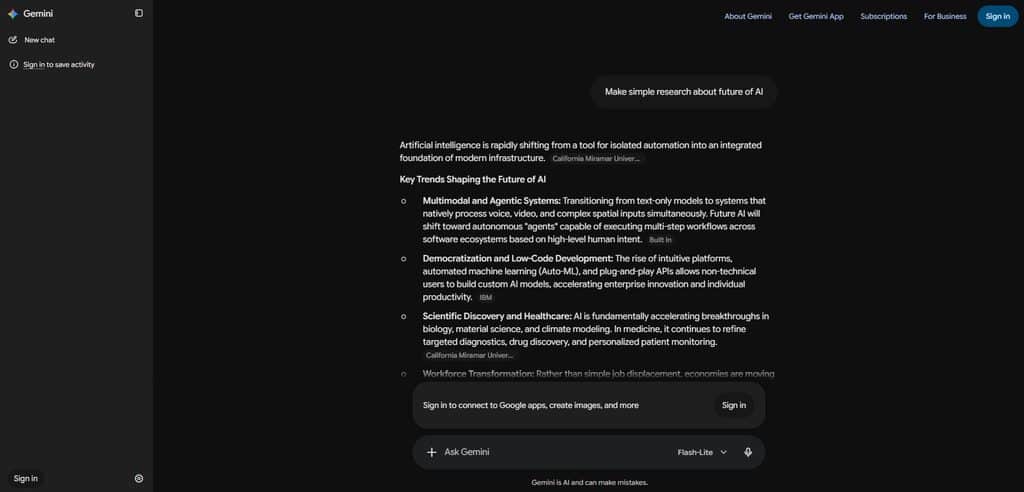
Best for: Research combining the web with Gmail, Google Drive, uploaded files and other Google information.
Gemini Deep Research has an advantage that competitors cannot easily duplicate:
Google’s ecosystem.
According to Google’s current documentation, Google Search is included as a Deep Research source by default, while users can add sources including Gmail, Drive, uploaded files and Gemini Notebook notebooks where supported. Gemini creates a research plan that can be edited before the research begins.
See Google’s official Gemini Deep Research guide for current instructions and limits.
Why Google Integration Matters
Imagine you are investigating:
Why did customer complaints increase last month?
The answer may not exist publicly.
Evidence could be spread across:
- Customer emails
- Internal Google Docs
- Reports in Drive
- Spreadsheets
- Meeting notes
- Public news
A research tool able to combine internal and external evidence can solve a very different problem from a web search engine.
What Google Says
Google says Deep Research performs real-time research, creates a research plan and analyzes many sources before producing a report.
Google’s help documentation says reports usually require roughly 5–10 minutes, although complicated research may take longer.
Reports can also be exported into Google Docs.
What Real Users Say About Gemini
Feedback is mixed.
One user comparing Gemini with ChatGPT said Gemini searched plenty of sources and generally found the right information, but they disliked its final writing style and preferred ChatGPT’s presentation.
Another user working with research-heavy material involving epidemiology and complex technical documents complained that Gemini sometimes produced polished-looking responses but dropped constraints, merged unrelated information or invented connections between sources during detailed verification.
These reports are anecdotal, but they demonstrate an important lesson:
Good formatting is not evidence of good research.
Weaknesses
Gemini’s biggest advantage diminishes if your information does not live in Google’s ecosystem.
And like every research tool, it still requires source verification.
Verdict
Gemini Deep Research is arguably the most convenient option for people whose research materials already live inside Google Search, Gmail and Drive.
4. Claude Research — Best for Nuanced Analysis
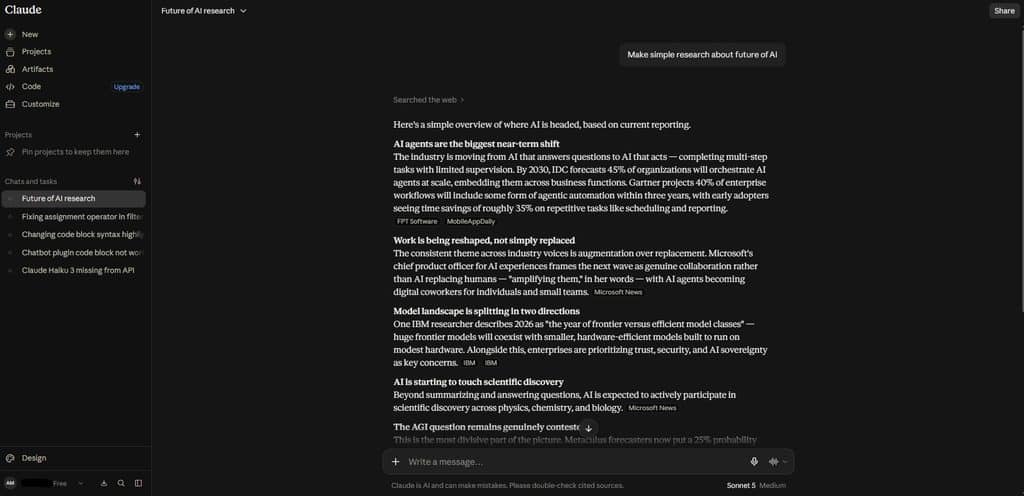
Best for: Detailed synthesis, policy analysis, long-form research, internal business research and questions involving complex competing arguments.
Claude’s Research mode conducts multiple searches that build on one another rather than performing a single lookup.
Anthropic says Claude automatically explores different angles, determines what to investigate next and can search both the web and connected internal context such as Google Workspace sources.
Read the official Claude Research documentation for the current feature description.
Where Claude Is Particularly Useful
Claude becomes interesting when finding sources is only the first step.
For example:
Analyze these six policy proposals. Identify assumptions shared by all six, areas where the authors fundamentally disagree, the evidence used to support each position, and which conclusions appear weakest.
That requires interpretation rather than simple retrieval.
What Anthropic Says
Anthropic says Research works agentically and performs several searches while systematically investigating unresolved questions. It can also work across connected internal context and the web.
Anthropic makes another useful disclosure:
Research can consume usage limits faster than ordinary Claude conversations because it retrieves multiple sources and produces comprehensive responses.
That is an important practical limitation.
Claude Science
For scientific users specifically, Anthropic introduced Claude Science in June 2026.
Anthropic describes it as a research workbench integrating scientific tools, computing resources and dozens of specialized skills and connectors, with an auditable history of how outputs were created.
Read Anthropic’s Claude Science announcement for details.
What Real Users Say
One biological-sciences researcher reported that Claude Research could consume usage very quickly and that some legitimate biology research triggered safety restrictions. Another participant suggested narrowing the research scope and approving a research plan before allowing the system to explore widely.
That advice is useful regardless of the platform:
define research boundaries before spending resources on a broad investigation.
Verdict
Claude Research is particularly strong when the difficult part is understanding and synthesizing information rather than merely finding it.
5. Elicit — Best AI for Scientific Research
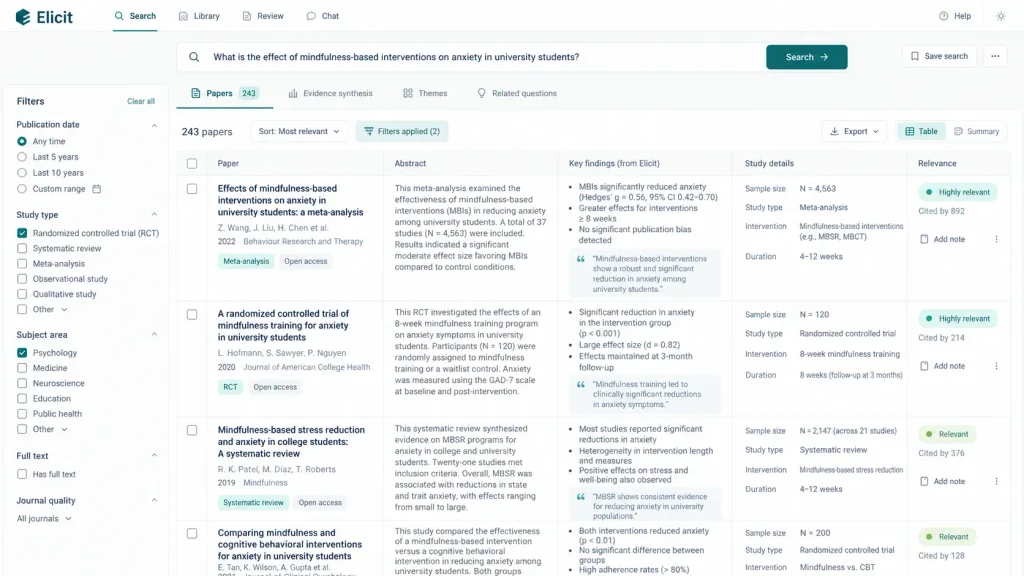
Best for: Scientific literature, systematic reviews, clinical evidence and evidence synthesis.
General-purpose chatbots search broadly.
Elicit is designed specifically for scientific research.
Elicit currently describes its platform as an AI system for scientific research, with tools for finding academic papers, extracting evidence, generating reports and performing systematic-review workflows.
Visit Elicit’s scientific research platform for the current product information.
Why Academic Researchers Need Different Tools
Suppose your research question is:
Does creatine supplementation improve cognitive performance in healthy adults?
A general web-search system could retrieve:
- Research papers
- Blogs
- Supplement stores
- Magazine articles
- Health websites
- Manufacturer marketing
That can be useful for general research.
It is not necessarily the correct evidence hierarchy for a scientific question.
A specialist platform begins closer to peer-reviewed evidence.
Systematic Review Capabilities
Elicit says its systematic-review product now supports workflows aligned with PRISMA 2020 and is designed to make stages of the process reproducible, traceable and auditable.
Its published May 2026 evaluation reports high search-recall, screening and extraction results across hundreds of Cochrane reviews. Those numbers are worth examining, but they are Elicit’s own evaluation, so they should be identified as vendor-reported results rather than universal independent proof.
Elicit Research Agent
Elicit expanded further in August 2026 with Research Agent, which the company says can gather evidence from scientific literature, public data sources, the web and uploaded internal material.
Official details are available in the Elicit Research Agent announcement.
What Real Researchers Say
A February 2026 PhD-productivity discussion included a user who said Elicit did a decent job of identifying papers from natural-language queries and was useful for getting an introduction to an unfamiliar subfield, while emphasizing that it did not replace careful reading.
The same discussion contained strong warnings from researchers that AI tools should not replace critical appraisal in formal reviews.
That distinction matters.
Elicit can help with:
finding → screening → organizing
but the researcher still needs to understand:
methods → evidence → limitations → meaning
Weaknesses
Elicit is specialized.
It would not be my first choice for:
- Breaking news
- Product comparisons
- Travel
- Social-media sentiment
- General consumer research
Verdict
For scientific and systematic literature research, Elicit is one of the most compelling specialist platforms.
6. Consensus — Best for Academic Paper Discovery
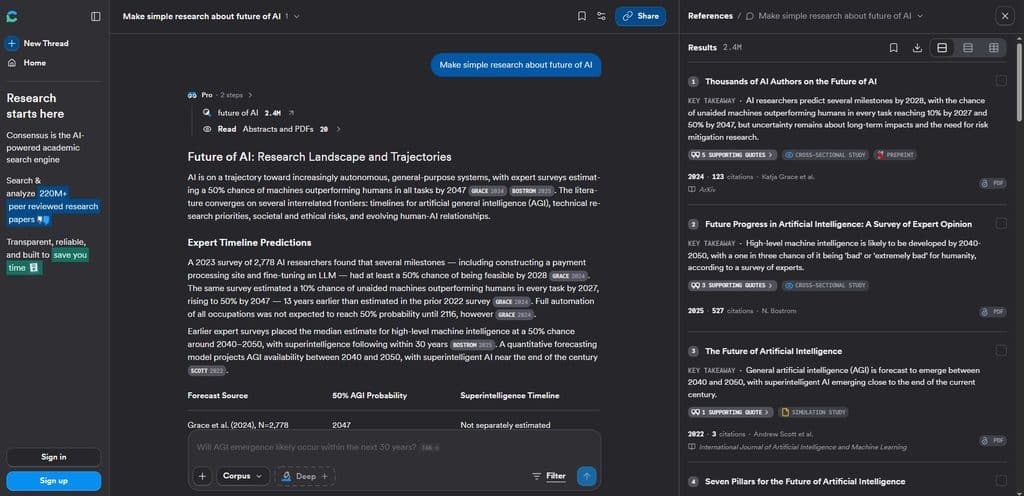
Best for: Students, academics, medical evidence questions and researchers who need to quickly locate and filter scholarly studies.
Consensus is another tool designed around academic evidence rather than the general internet.
Its current database contains more than 220 million peer-reviewed research papers, with data coming from sources including Semantic Scholar, OpenAlex, Consensus’s own scholarly-web crawl and publisher partnerships.
Read about the Consensus research database.
Why Consensus Is Useful
Consensus allows searches to be refined using research-specific factors.
Current filters include:
- Publication date
- Open-access status
- Citation count
- Journal ranking
- Study methodology
- Human vs animal studies
- Sample size
- Study duration
- Publisher
- Field
- Country
See the Consensus advanced search filters for current options.
That is fundamentally different from telling a normal chatbot:
Find some good studies.
Research Agent
Consensus launched a Research Agent in May 2026.
The company says the system can reason through multi-step questions, perform citation crawling, search by DOI or author, compare studies and perform gap analysis while grounding responses in peer-reviewed research.
See the official Consensus Research Agent guide.
What Consensus Says
Consensus says its search system first identifies potentially relevant research and then ranks results using factors including recency, citation count and journal quality.
Its medical mode also offers a narrower collection of biomedical research and clinical guidelines.
What Real Users Say
An August 2026 user who said they had been using Consensus for thesis literature-review work praised the fact that its citations corresponded to real research papers.
However, replies strongly cautioned that AI cannot provide the broader field understanding and deep interpretation that comes from actually reading the literature.
Another PhD discussion described Consensus as useful for discovering relevant newer studies but emphasized manually checking citations and context.
Verdict
Consensus is one of the best AI tools for rapidly locating, filtering and comparing academic research.
Use it to find evidence faster.
Do not let it replace reading the evidence that matters.
7. Gemini Notebook — Best for Researching Your Own Sources
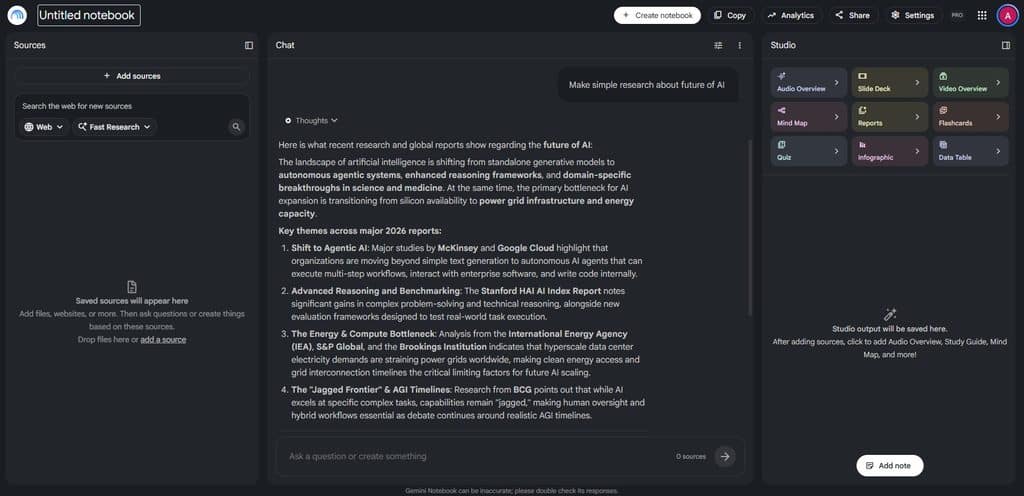
Best for: PDFs, reports, textbooks, course material, meeting notes and curated research collections.
Google renamed NotebookLM to Gemini Notebook in July 2026.
Google describes it as the same standalone research product, now more connected to the broader Gemini ecosystem, with expanded analysis capabilities including code execution in notebooks.
Read Google’s announcement: NotebookLM is now Gemini Notebook.
Why a Source-Grounded Notebook Is Different
Imagine you have collected:
- Six peer-reviewed papers
- Two industry reports
- A spreadsheet
- Interview transcripts
- Meeting notes
Your main question may no longer be:
What can the internet tell me?
It becomes:
What do these sources tell me?
That is a different research problem.
Gemini Notebook can help analyze a controlled source collection and now also includes Deep Research capabilities for discovering and importing new web sources. Google says Deep Research inside the notebook can browse up to hundreds of sites and return both a report and the relevant sources for import.
See Google’s Gemini Notebook source and Deep Research guide. Gemini Notebook Deep Research guide
What Real Users Say
One user-research interview involving a medical professional found that visible citations were particularly important for trust when working with dense professional documents.
However, recent feedback is not entirely positive.
An August 2026 university user reported that Gemini Notebook seemed less thorough after recent changes and sometimes missed important details in large collections. Other commenters described similar experiences.
Another highly discussed August post came from someone using the tool for an important research project who complained that responses appeared to include information beyond the sources they had provided when they wanted strict source grounding.
That reinforces an important rule:
When source-only research matters, verify that the answer really came from your approved source set.
Verdict
Gemini Notebook is one of the best options when your research starts with a collection of documents you already trust.
8. Grok — Best for Real-Time X and Social Research
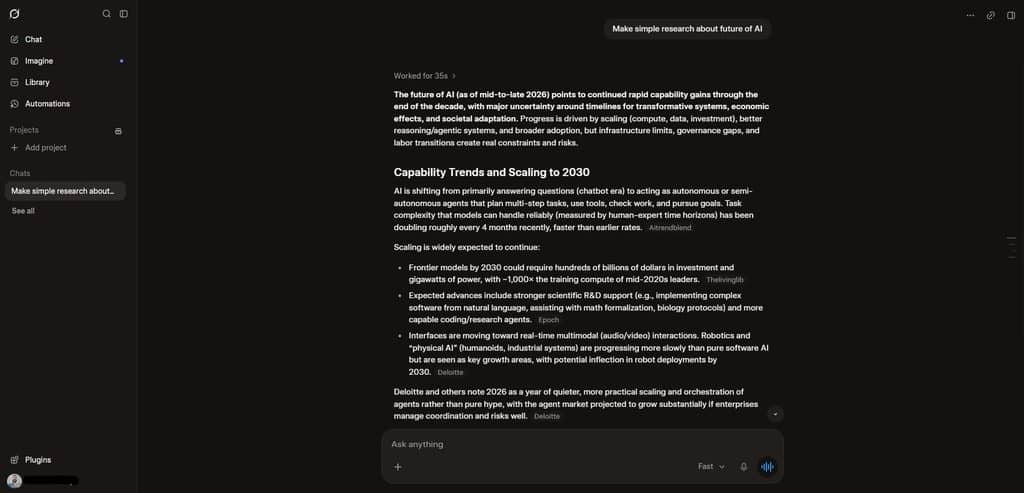
Best for: Breaking online discussions, current X posts, developer reactions, social narratives and situations where X itself is an important research source.
Grok has a research capability that academic platforms cannot replicate:
direct access to X search.
SpaceXAI’s developer documentation says X Search can perform keyword search, semantic search, user search and thread retrieval across X, allowing Grok to analyze real-time social content.
Read the official Grok X Search documentation.
When Grok Is Valuable
Imagine a new AI model launches today.
Your research question is:
What are software developers saying about this model during its first 24 hours?
Academic databases will be useless.
Even normal webpages may take time to appear in search indexes.
X can provide useful evidence about:
- Initial user experiences
- Bugs
- Reactions
- Performance claims
- Developer tests
- Company announcements
But social-media research needs caution.
X Is Evidence of Opinion, Not Automatically Evidence of Fact
If 10,000 X users say:
Product X is broken.
that is meaningful evidence of public reaction.
It is not automatically proof of the underlying technical cause.
Use social information to understand what people are reporting, then verify factual claims elsewhere.
Verdict
Grok is particularly useful as a supplementary research tool when real-time X discussion matters.
It is not my first recommendation for systematic academic literature analysis.
What Independent Research Benchmarks Say
Provider documentation tells us what products can do.
Independent benchmarks can help us understand how well different systems perform under standardized conditions.
But one benchmark should never decide the whole ranking.
The September 8, 2026 snapshot of DeepResearch Bench listed Claude Opus 4.6 at 55.3% and Claude Sonnet 4.6 at 54.9% at the top of the published results available in that benchmark. The benchmark’s results come from its own leaderboard or third-party evaluators rather than model providers.
Explore the DeepResearch Bench leaderboard here. DeepResearch Bench leaderboard
DeepResearch Bench itself was created to evaluate difficult research-agent tasks across multiple fields, including both research-report quality and citation behavior.
Why This Does Not Automatically Make Claude the Universal Winner
A benchmark evaluates a defined set of tasks under a defined methodology.
Real research may also depend on:
- Your private documents
- Google Workspace integration
- Academic database access
- Speed
- Citation interface
- Source filtering
- Cost
- Research limits
- Specialized scientific workflows
For that reason, our overall recommendation and the current benchmark leader are not necessarily the same thing.
That is a more defensible conclusion than pretending one score settles the entire question.
Best AI for Academic Research
Academic research is one area where I would not rely entirely on a general chatbot.
A stronger workflow is:
Elicit or Consensus → literature discovery
Gemini Notebook → organize selected papers
Claude or ChatGPT → compare arguments and help interrogate evidence
Human researcher → critically evaluate the studies
Researchers in recent PhD discussions repeatedly recommend AI for discovery and organization while warning against outsourcing critical appraisal.
For traditional scholarly searches, researchers should also consider databases such as Google Scholar and PubMed alongside AI tools.
AI can accelerate academic research.
It does not eliminate research methodology.
Best AI for Market Research
For market research, ChatGPT Deep Research and Perplexity are particularly useful.
Perplexity is excellent at rapidly gathering current external sources.
ChatGPT becomes especially useful when the task must move from:
finding → comparing → reasoning → recommending
For companies, Gemini can have an additional advantage if business evidence already lives in Gmail and Drive.
If you are exploring how AI can be integrated into broader company workflows, see our guide to using an AI chatbot for business.
Best AI for Students
There is no single best research tool for every student.
For understanding your own course documents, Gemini Notebook is compelling.
For academic evidence discovery, Consensus and Elicit are stronger.
For general web research, Perplexity can be convenient.
For detailed explanations and synthesis, Claude or ChatGPT may be preferable.
Students should always follow their university or school’s rules regarding AI-generated work.
Best AI for Scientific Research
For scientific research, start with evidence-focused tools.
Elicit and Consensus provide important advantages over general-purpose search because their workflows are centered on scholarly research.
Claude Science is also becoming particularly interesting for computational scientific work.
But no AI-generated scientific summary should replace the underlying studies.
The principle is simple:
The paper is evidence. The AI’s summary of the paper is not the original evidence.
Best AI for Research Coding and Data Analysis
Research increasingly involves programming and data work.
An AI may help with:
- Python
- R
- Statistical analysis
- Data cleaning
- Visualization
- Reproducible workflows
- Experiment scripts
If coding is a substantial part of your research, our Best AI for Coding guide compares dedicated coding models and development tools in more detail. Best AI for Coding
Always inspect AI-generated analytical code before trusting its results.
A script can run successfully and still implement the wrong statistical method.
What Real Researchers Think About AI Research
The most interesting feedback from researchers is not necessarily:
Which tool is best?
It is:
How much research should we delegate to AI?
A February 2026 PhD discussion about literature-review tools contained both enthusiasm and serious caution.
Some users reported that tools such as Elicit and Consensus can make it considerably easier to locate and organize relevant papers.
Others emphasized that researchers still need to read the literature repeatedly and perform their own critical appraisal.
A separate literature-review discussion captured the concern more directly: one commenter warned that relying on AI summaries can prevent researchers from forming the mental connections that often generate new research ideas.
This does not mean:
Don’t use AI.
It means:
Use AI to reduce mechanical research work without outsourcing the intellectual work that makes research valuable.
How to Use AI for Research Safely
Research prompts sometimes contain information that should not be uploaded to an external AI provider.
Examples include:
- Unpublished research data
- Confidential interviews
- Personally identifiable information
- Patient information
- Private company documents
- Embargoed manuscripts
- Credentials
- API keys
Before uploading research material, review the provider’s privacy terms and your institution’s rules.
For practical privacy, security and verification guidance, read our How to Use AI Chat Safely guide. How to Use AI Chat Safely
Why AI Citations Still Need Verification
A citation makes an AI response look more trustworthy.
Unfortunately, citation formatting and citation accuracy are not the same thing.
Several problems are possible.
The citation may:
- Exist but not support the claim
- Support only half of a compound statement
- Contain older information
- Be a secondary source
- Misrepresent a study
- Repeat information originating from another article
- Be less authoritative than an available primary source
For example:
If an AI says:
“A study found a 35% improvement.”
do not stop at the citation.
Open the paper.
Check:
- What improved?
- Compared with what?
- How was it measured?
- How many participants were included?
- Was the difference statistically significant?
- Does the AI’s interpretation match the authors’ actual conclusion?
Research is not citation collection.
It is evidence evaluation.
How to Write Better AI Research Prompts
A weak prompt is:
Research solar panels.
A much stronger prompt is:
Compare residential solar-panel economics in California, Texas and Florida in 2026. Use current government incentives, utility information and manufacturer specifications as primary sources wherever possible. Separate upfront cost, annual savings, payback period and important uncertainties. Do not use installer marketing claims as evidence unless independently verified.
This prompt defines:
- Subject
- Geography
- Date
- Evidence hierarchy
- Comparison criteria
- Restrictions
- Required output
For academic research, specify:
- Research question
- Population
- Date range
- Study design
- Inclusion criteria
- Exclusion criteria
- Preferred databases
- Desired evidence quality
Better research prompts do not need to be unnecessarily long.
They need to remove ambiguity.
Use More Than One AI for Important Research
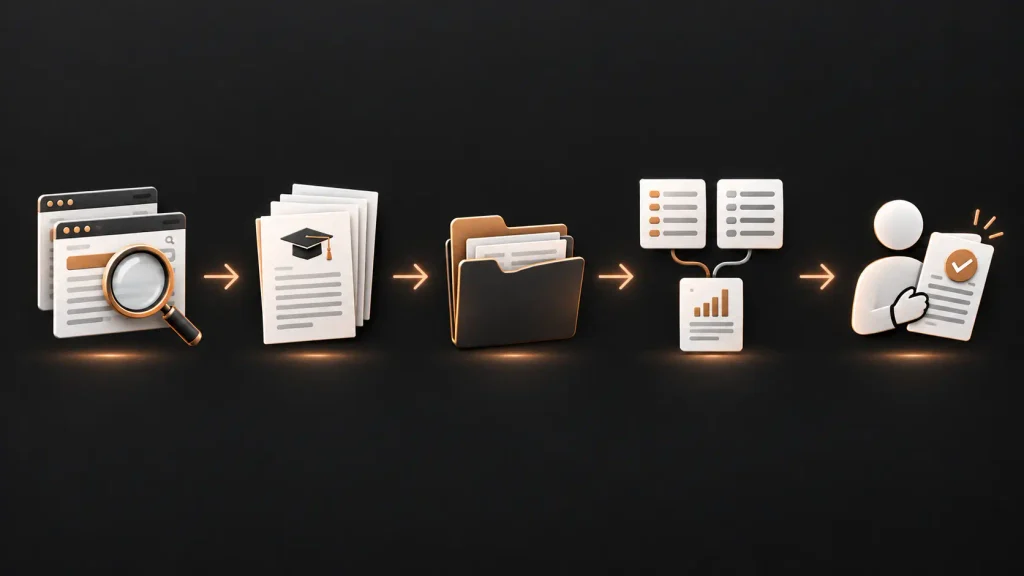
For serious projects, a multi-tool workflow may be stronger than trying to find one perfect AI.
For example:
Perplexity → discover current web sources
Elicit / Consensus → find academic studies
Gemini Notebook → organize trusted papers
Claude / ChatGPT → compare and synthesize arguments
Human → verify the final evidence
The important point is that AI tools should be used according to their strengths.
Using Unlimited AI for Research
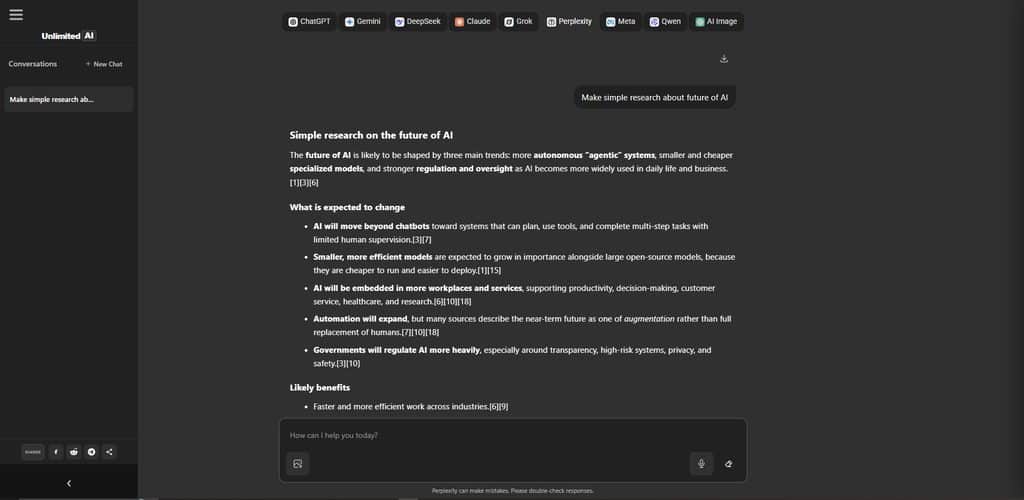
Unlimited AI Chat provides access to several AI assistant options from a single interface, making it useful for comparing how different models interpret the same research question. Try Unlimited AI Chat
For example, ask several assistants:
Explain the strongest arguments for and against nuclear power expansion. Separate factual claims from opinion and identify claims that should be independently verified.
Then compare:
- Which assumptions differ?
- Which important facts are missing?
- Where do models disagree?
- Which answer is overly confident?
- Which claims need primary-source verification?
This is particularly useful because disagreement between models can reveal where further research is needed.
However, a normal chat interface should not automatically be described as equivalent to dedicated tools such as Deep Research.
Dedicated research systems can include additional:
- Web-search loops
- Research planning
- Source controls
- Document retrieval
- Code execution
- Report-generation processes
Unlimited AI is therefore useful for research assistance and model comparison, while specialist research agents may be preferable for exhaustive investigations.
If you want to understand how AI chat systems differ more generally, our Conversational AI guide explains how modern conversational systems work.
Can AI Replace Google Scholar?
No—not completely.
AI research tools make discovery easier, but traditional academic databases remain important.
Researchers may still need:
- Reproducible queries
- Database-specific filters
- Citation exports
- Controlled indexing
- Search histories
- Subject-specific coverage
- Transparent inclusion criteria
AI should complement scholarly databases rather than make researchers forget they exist.
Can AI Write a Literature Review?
It can generate text that looks like one.
That is not the same as producing a strong academic literature review.
A genuine review requires understanding:
- Methodology
- Conflicting evidence
- Research gaps
- Theoretical disagreement
- Evidence quality
- Bias
- Relationships between studies
A June 2026 PhD discussion about the growing number of literature reviews included researchers expressing concern that AI-assisted review production can become shallow when the underlying papers are not actually evaluated.
Use AI for:
- Discovery
- Organization
- Initial comparison
- Note processing
- Identifying possible gaps
Do not automatically delegate your scientific judgment.
Should You Cite AI as a Research Source?
Usually, cite the original source the AI helped you find.
If an AI tells you:
Study X found Y.
Open Study X.
Verify Y.
Then cite Study X.
The AI helped you find evidence.
It is not necessarily the evidence itself.
Universities, journals and publishers can have different rules for disclosure of AI assistance, so always follow the applicable policy.
Can AI Research Be Trusted?
A better question is:
Can I verify this research?
Even sophisticated research agents can:
- Miss sources
- Misinterpret evidence
- Prefer popular information
- Use outdated sources
- Misread a table
- Infer causation from correlation
- Combine separate claims incorrectly
Research output should therefore remain provisional until important claims have been checked.
Frequently Asked Questions
What is the best AI for research in 2026?
For broad multi-source research, our overall recommendation is ChatGPT Deep Research because of its combination of web research, source controls, uploaded context and structured synthesis. However, Claude currently performs extremely strongly on the independent DeepResearch Bench, while Perplexity, Gemini, Elicit and Consensus can be better choices for specific research workflows.
Is Perplexity better than ChatGPT for research?
It depends on the task. Perplexity is particularly strong for fast, citation-first web research. ChatGPT Deep Research is especially useful for longer mixed-source investigations and structured reports.
Is Gemini good for research?
Yes. Gemini Deep Research is particularly attractive when you need to combine Google Search with Gmail, Drive, uploaded files or Gemini Notebook sources.
Is Claude good for research?
Yes. Claude Research performs iterative searches and can research both the web and supported connected internal sources. Anthropic notes that research sessions can use account limits faster than ordinary conversations.
What is the best AI for academic research?
For academic discovery and evidence synthesis, Elicit and Consensus are among the strongest specialist options because their workflows are built around scholarly literature rather than the general web.
What is the best AI for literature reviews?
Elicit is particularly useful for structured evidence and systematic-review workflows. Consensus is useful for discovering and filtering papers. Both should be paired with direct reading and critical appraisal of important studies.
What is the best AI for researching PDFs?
Gemini Notebook is particularly useful for working with a curated source collection. ChatGPT and Claude can also analyze documents depending on the workflow and account features.
What is the best AI for current web research?
Perplexity is one of the strongest dedicated options for current web research with visible citations. ChatGPT Deep Research and Gemini Deep Research are also strong choices.
Can AI research tools hallucinate?
Yes. A research system can still make factual errors, misunderstand sources or associate a citation with a claim the source does not fully establish.
Is AI research allowed at university?
Policies vary by institution, department, course, supervisor and journal. Check the rules that apply to your work before using AI for graded or published research.
Can I use AI research for medical or legal decisions?
AI can help locate and organize information, but high-impact medical, legal, financial and safety decisions should be verified using authoritative evidence and qualified professionals where appropriate.
Final Verdict: What Is the Best AI for Research?
The best AI for research depends on the kind of research being performed.
Best overall mixed-source research: ChatGPT Deep Research
Best for fast web research: Perplexity Research
Best for Google Workspace: Gemini Deep Research
Best for nuanced synthesis: Claude Research
Best for systematic scientific research: Elicit
Best for academic paper discovery: Consensus
Best for your own source collection: Gemini Notebook
Best for current X research: Grok
There is an important additional finding from independent testing: the September 2026 DeepResearch Bench snapshot currently places Claude Opus 4.6 at the top of that particular benchmark.
This illustrates why the answer cannot simply be:
“Tool X is best at everything.”
Research involves discovery, retrieval, analysis, synthesis, verification and judgment.
Different tools excel at different stages.
The strongest workflow is often:
AI discovery → source selection → AI-assisted synthesis → original-source verification → human judgment
The final step remains essential.
Research and Editorial Transparency
This article uses information from official documentation published by OpenAI, Perplexity, Google, Anthropic, Elicit, Consensus and SpaceXAI, alongside independent benchmark information and public user discussions.
Company benchmarks and performance claims are identified as vendor-provided evidence rather than presented as independent proof.
Reddit posts and other community discussions represent individual experiences. They are included to show what real users report, but they are not statistically representative customer surveys.
This comparison is based on published documentation, independent benchmark results and public user feedback, rather than first-hand product testing by the Unlimited AI Editorial Team.
Google recommends creating content primarily to help people rather than producing pages solely to manipulate search rankings. Its guidance also emphasizes original value, clear sourcing and first-hand evidence where appropriate.