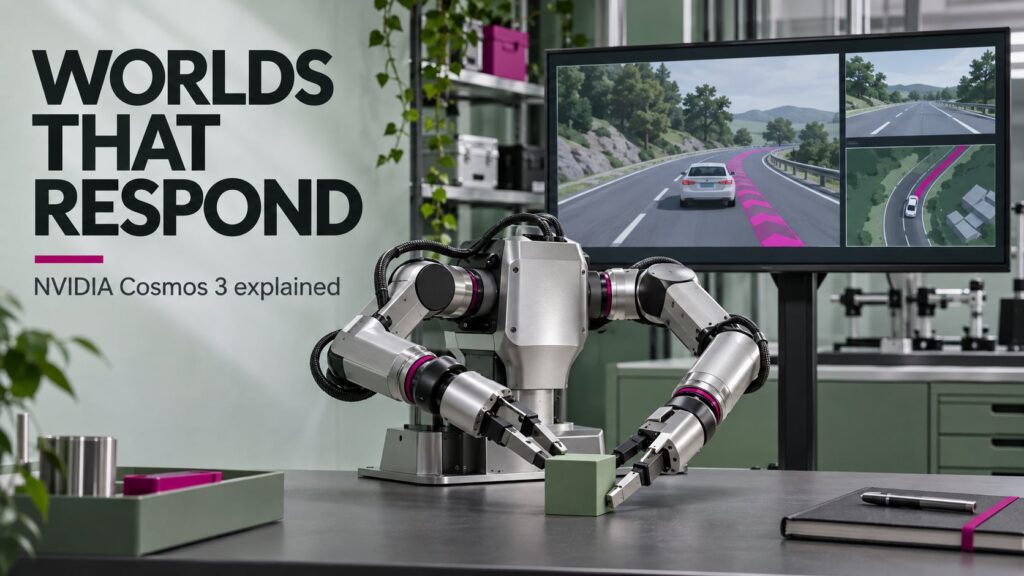
A robot reaches for a cup. The cup slips, the camera moves and the next action must change. An attractive video of that scene is useful to watch, but an interactive environment has a harder job: it must keep responding as the robot acts.
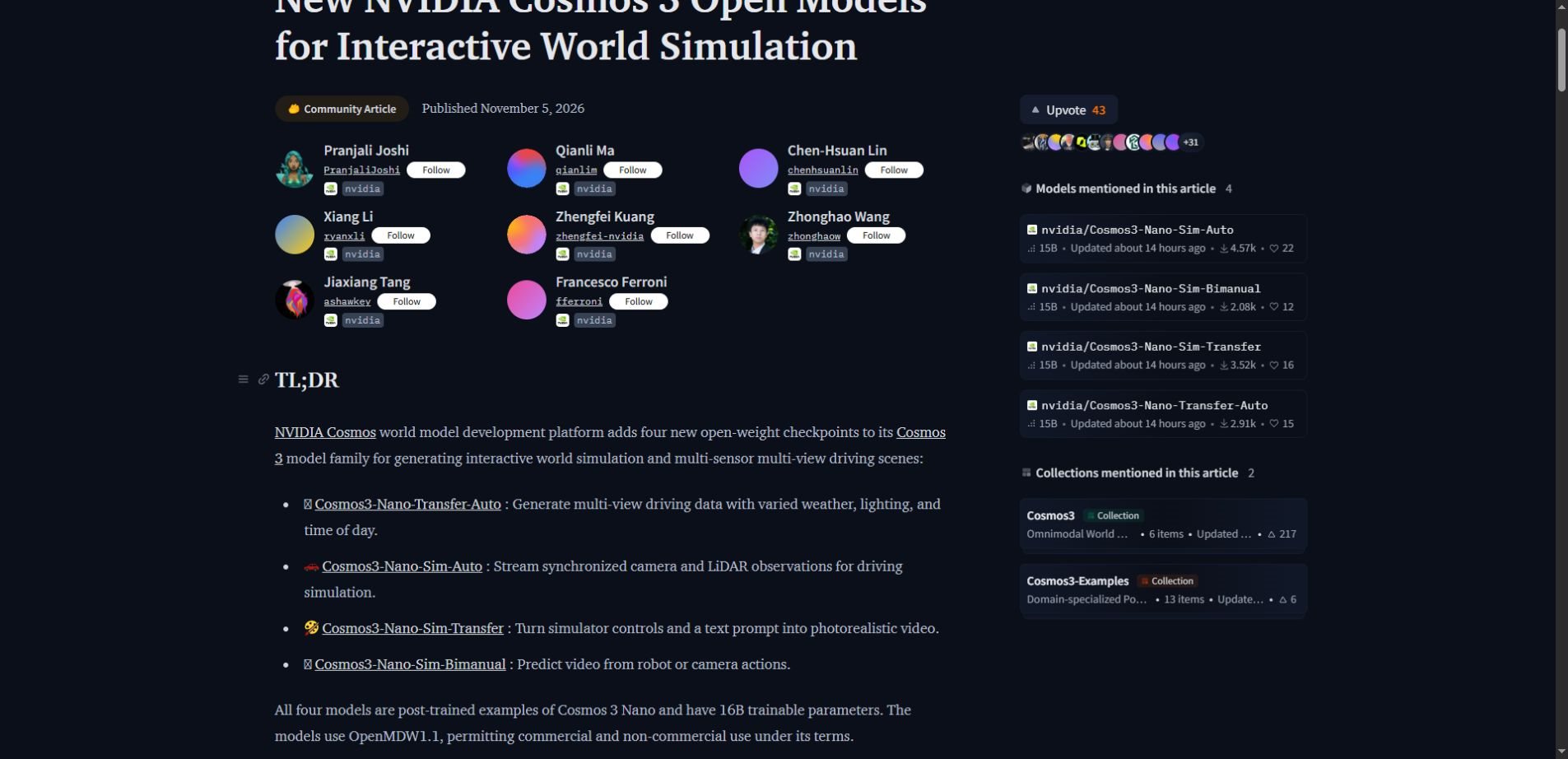
NVIDIA Cosmos 3 is part of the push to build those responsive environments for physical AI. NVIDIA’s November 5, 2026 overview describes four specialized checkpoints for driving scenes, simulator visuals and two-arm robot interactions. The interesting question is what a researcher can actually control—and what still needs independent validation.
This is an update about the Cosmos 3 simulation tools, rather than the first launch of the whole model family. The linked model cards list October 20, 2026 release dates; the November 5 technical overview brings their workflows together.
Four model names, four different jobs
The names look similar, but choosing between them changes the experiment. A team creating a dataset has different needs from a team testing a policy that must react to each new observation. A policy, in this context, is the component that chooses the next action.
| Checkpoint | Main role | Useful distinction |
|---|---|---|
| Transfer-Auto | Generate driving datasets | Offline scene variations |
| Sim-Auto | Generate driving observations interactively | Updated controls affect later chunks |
| Sim-Transfer | Render simulator controls as RGB video | The simulator retains physical state |
| Sim-Bimanual | Predict observations from robot or camera actions | Action-conditioned interaction |
Use the table as a starting point, then read the corresponding model card. Similar-looking output videos can come from very different control pipelines, and those differences matter when interpreting a result.
Driving: building a dataset versus responding to a driver
Cosmos3-Nano-Transfer-Auto generates synchronized driving video for up to 11 camera views, with support for LiDAR observations. Structured World Scenario Map controls specify the scene, while text guides appearance such as weather or lighting. Its bidirectional generation is intended for offline synthetic data.
Think of a hypothetical research team studying a road junction. It may want variations of the same layout under different lighting. A controlled dataset can help separate a visual change from a change in road geometry. That is an experimental design choice, not evidence that every generated variation is accurate.
Cosmos3-Nano-Sim-Auto takes the streaming route. It generates short chunks using previous generated history and incoming scene controls. A renderer translates driving inputs into those controls, allowing subsequent observations to reflect updated inputs. NVIDIA notes that throughput depends on hardware and configuration.
For the junction example, the difference is whether the team is making a set of clips in advance or letting an agent choose actions during a rollout. In the second case, timing becomes part of the test: an observation that arrives too late can change the behavior being measured.
Robotics: where the physical state comes from
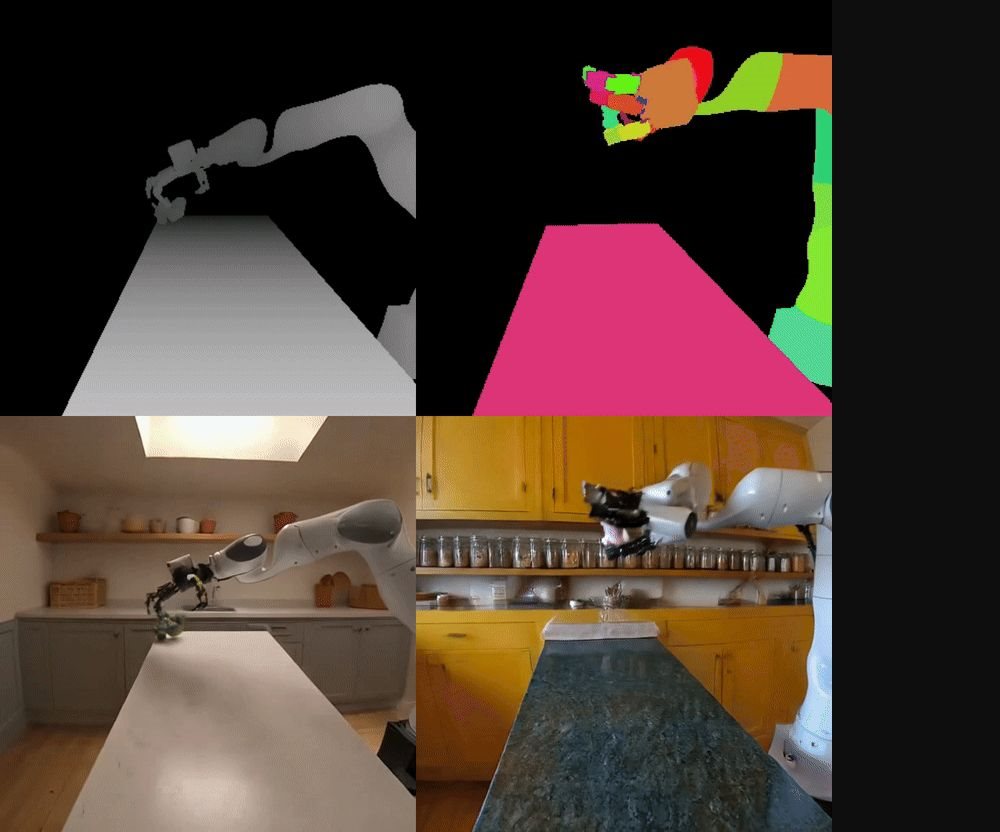
Cosmos3-Nano-Sim-Transfer generates RGB video from simulator-rendered inputs such as depth, segmentation, edges or blurred images, alongside text. The simulator remains responsible for physics and ground-truth state. The model supplies visual appearance conditioned on those controls.
A distinction worth keeping: A realistic image does not establish that the contact forces, object positions or motion are correct. In a simulator-based workflow, inspect the underlying state as well as the generated camera view.
In a hypothetical tabletop task, a physics simulator might determine whether a block falls off an edge. A visual model could make the tabletop look like wood, metal or a differently lit surface. Those are separate responsibilities. A convincing texture should not distract from an incorrect object trajectory.
Cosmos3-Nano-Sim-Bimanual instead predicts observations from an initial image and incoming robot or camera controls. It supports interleaving camera navigation with two-arm manipulation. This makes the relationship between action representation and generated observation central to the experiment.
That is useful to understand before comparing demos. Two robot videos may look equally smooth, while only one uses controls that match the target robot. A mismatch in coordinate conventions or gripper state can undermine a test even when the output is visually coherent.
Why a world model is different from a video generator
A normal video-generation task may be judged by how well the finished clip matches a prompt. An interactive world-model experiment must also ask whether the next observation follows from the chosen action and remains consistent with earlier observations.
Imagine a robot pushes a red block behind a box. When the camera moves, the block should still have a plausible position and identity. If the block disappears or reappears elsewhere, the agent may learn from a world that does not obey the intended task rules. Good-looking individual frames can conceal that failure.
For physical AI, useful evaluation therefore goes beyond image quality. The central question is whether the environment provides dependable feedback for the behavior the researcher is trying to train or measure.
This also changes how to interpret progress in learning with AI: a demonstration can help explain a concept, while a controlled experiment is needed to establish whether a method works as intended.
An experiment worth running before a large training job
Start with a narrow question. For example: does a tabletop policy keep identifying the target object when the background changes? Keep the task, camera arrangement and action sequence fixed wherever possible. Vary one relevant visual factor, then compare behavior against the original environment.
That is a proposed evaluation exercise, not a benchmark we have run. Its value is that it forces the team to define success before generating a large volume of data. Without that definition, a bigger dataset may simply produce more examples of an unnoticed failure.
Record three kinds of evidence
- Control fidelity: Does the generated observation respect the object layout and action that were supplied?
- Consistency over time: Do object identity and position remain coherent as the rollout continues?
- Task outcome: Does the policy perform the intended task, and does that performance hold on separate real or trusted reference data?
Keep a failure gallery alongside aggregate scores. A small collection of disappearing objects, inconsistent shadows or delayed responses can reveal problems that a single average hides. Include difficult cases deliberately rather than selecting only the most impressive sequences.
For comparisons, preserve the input data, model version, generation settings and evaluation criteria. If the team changes the data pipeline and the policy at the same time, it becomes harder to tell which change affected the outcome.
The practical costs are bigger than the download
NVIDIA’s overview describes the four checkpoints as post-trained Cosmos 3 Nano examples with 16 billion trainable parameters, using OpenMDW1.1. Open weights make inspection and adaptation possible, but license terms, compute requirements and the surrounding software still matter.
The published Bimanual setup specifies Linux, an NVIDIA GPU, Docker and NVIDIA Container Toolkit. Its reported test configuration used a GB200; that should not be read as a statement of minimum memory requirements. Check the exact workflow before planning a local run.
Beyond inference, budget for preparing aligned controls, validating input sequences, storing outputs and reviewing failures. An inexpensive generation run can become expensive if every clip needs substantial manual repair or if the data cannot answer the research question.
A sensible first milestone is a small reproducible run with known inputs and understandable outputs. Increase scale only after the team can explain what a failure looks like and how it will be detected.
What to read before trying the tools
Start with the NVIDIA-authored overview on Hugging Face and the model card for the specific checkpoint you need. The Cosmos 3 examples collection links the model downloads, while the technical report provides the deeper methodology.
If you are planning an experiment, use clear context and explicit constraints in your brief: define the environment, controllable inputs, expected outputs and failure criteria. A precise brief helps both the researchers reviewing the result and any assistant helping organize the work.
Questions people are asking
Did Cosmos 3 launch on November 5?
The article discussed here was published on November 5, 2026. The four linked model cards give October 20 release dates for these checkpoints. It is more accurate to describe this as a recent technical overview of the simulation tools than the first launch of Cosmos 3.
Can these models replace real-world testing?
A generated environment can support an experiment, but its usefulness depends on how faithfully it represents the task. Treat simulated performance as one piece of evidence. Separate validation is needed before drawing conclusions about behavior outside that environment.
Is Sim-Transfer the physics engine?
No. In the documented Sim-Transfer workflow, the simulator retains the physical state and ground truth. The model generates visual observations from simulator controls. Keep those responsibilities separate when analyzing an output.
Are open weights the same as free deployment?
No. Access to weights does not remove hardware, storage, integration or evaluation costs. Review the model license and the requirements of the chosen inference path before committing resources.
The result that would matter
The strongest outcome is not simply a more cinematic simulated world. It is a controlled environment that exposes a useful failure, supports a better comparison or helps a researcher test a specific hypothesis about an agent’s behavior.
Cosmos 3’s specialized checkpoints offer several routes toward that goal. Choose the route by the evidence you need: offline data variation, interactive driving observations, simulator-conditioned appearance or action-conditioned robot video. Then judge the output by what the task requires, alongside how convincing it looks.