TomTom and DeepRoute.ai announced a new automated-driving partnership on October 12, 2026. The collaboration brings location data into an AI driving system, putting a familiar question back in focus: if a car can interpret its surroundings, why does it still need a map?
The answer is about context. Seeing the road immediately ahead and understanding the wider road network are related tasks, but they are not identical. This announcement is a useful example of how AI systems can combine different sources of information instead of relying on one impressive capability.
Last reviewed: October 12, 2026. This article covers the announcement and explains its implications. Unlimited AI has not tested the demonstration vehicle. Examples below are explanatory scenarios, not verified performance results.
What TomTom and DeepRoute.ai announced
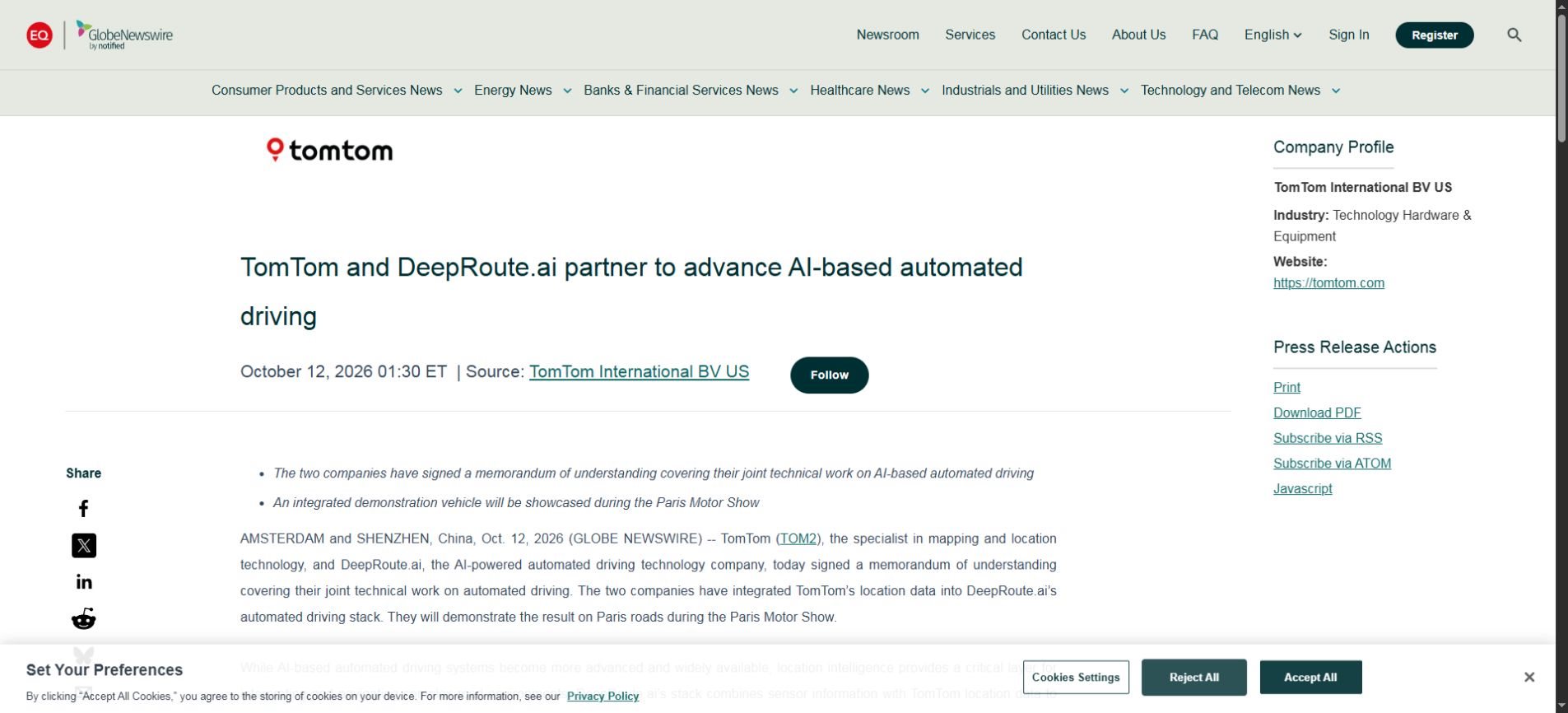
According to TomTom’s announcement distributed by GlobeNewswire, the companies signed a memorandum of understanding for joint technical work. TomTom location data has been integrated into DeepRoute.ai’s automated-driving stack, with an integrated vehicle planned for demonstrations on Paris roads during the Paris Motor Show.
The release connects that work to advanced L2+ and L2++ functions and expansion into different markets. It describes location intelligence as a way to provide road layout, local rules and wider context alongside sensor information.
A memorandum and a demonstration are important development milestones. They are not, by themselves, a retail launch. The release does not give readers a consumer price, a complete list of supported cars, or a date when this integrated system becomes available in their country.
The key distinction: this is a technology partnership and demonstration announcement. It should not be read as permission to stop supervising a driver-assistance system.
Why an AI driving system still benefits from maps
Imagine approaching a junction that is partly hidden behind a large vehicle. A camera can help identify visible objects, lane markings and signals. A map can provide additional context about the network beyond the immediate view. Those information sources answer different questions.
That does not make a map an unquestionable authority. Roads change. Construction can move a lane, temporary signs can alter access, and traffic conditions can create an exception to the usual route. A useful system must handle disagreement rather than assume that every input is current.
The practical design question is therefore not simply “maps or AI?” It is how information is combined, how uncertainty is represented, and what the vehicle does when available evidence is incomplete or contradictory.
Three information layers to understand
A simple way to read announcements like this is to separate observation, context and action. These are conceptual layers for explanation; the companies have not published a full implementation architecture in this announcement.
| Layer | Question it helps answer | Important limitation |
|---|---|---|
| Live observations | What appears to be happening nearby? | Visibility and interpretation can be imperfect. |
| Location context | How does this road connect to the wider network? | Stored information can be outdated. |
| Planning and control | What action should the system take? | Good inputs alone do not prove a safe decision. |
For everyday readers, this distinction prevents a common misunderstanding. Better map data does not automatically solve perception, and better perception does not automatically solve decision-making. The complete system has to be assessed together.
L2+, L2++ and “self-driving”: read the labels carefully
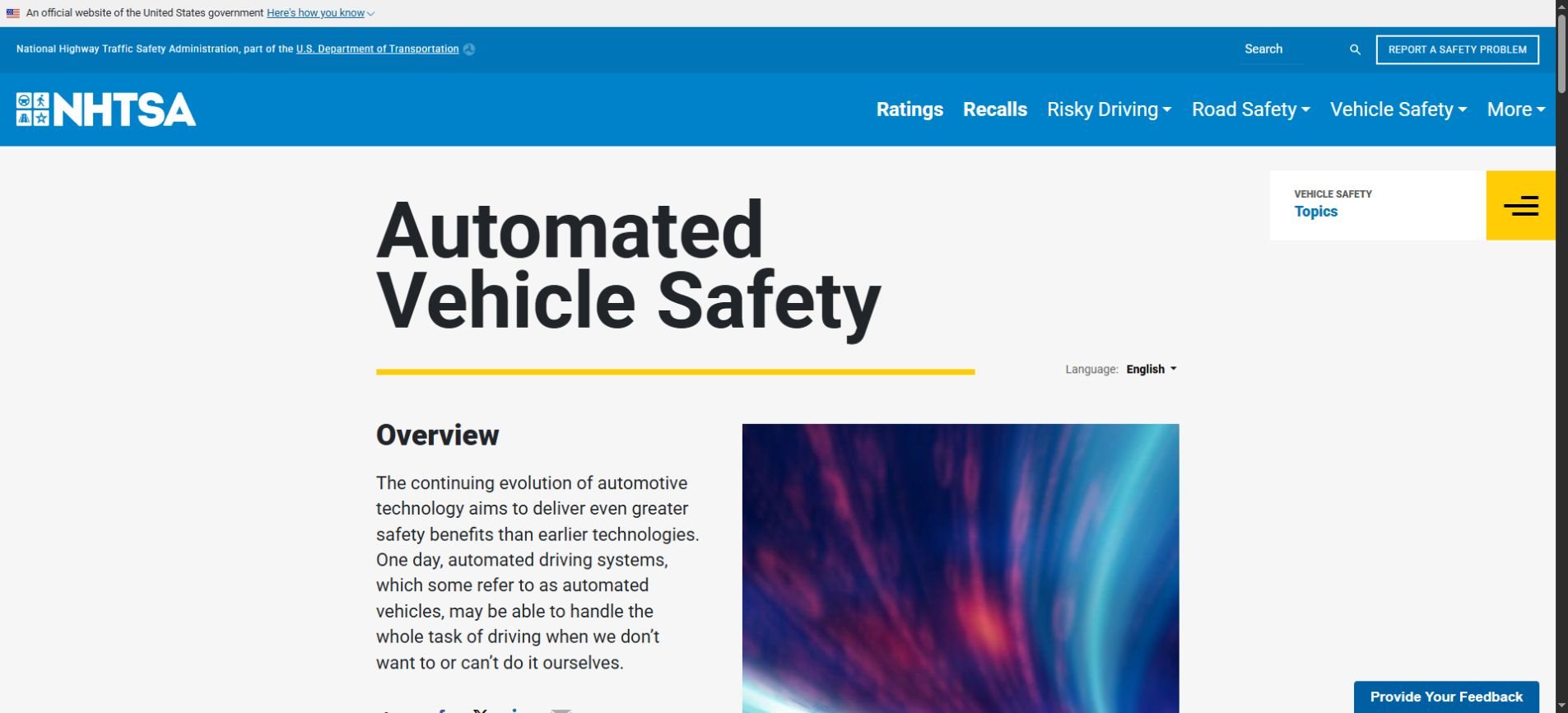
The NHTSA automated-vehicle safety guide distinguishes levels of driving automation and emphasizes the need to understand driver responsibilities. Its framework lists Levels 0 through 5. Terms such as L2+ and L2++ in a company announcement should not be treated as separate official levels or proof of unrestricted autonomy.
For a buyer, the useful question is concrete: what must the person in the driver’s seat do while the feature is active? A system name can sound more capable than its operating conditions allow. Read the manufacturer’s instructions for the exact vehicle and market.
Also ask where the feature works. A capability demonstrated on one route does not establish that it works on every road, in every weather condition or under every traffic pattern. The conditions in which a system is designed to operate matter as much as its headline description.
Why crossing borders is a difficult AI problem
A road network is more than a collection of lines on a screen. Intersections, signs, lane conventions and local driving patterns can differ. The same-looking scene may require a different interpretation in another place.
Consider a hypothetical software team moving a driving feature from one region to another. Testing a translated dashboard would be only a small part of the job. The team would also need to understand local road situations and determine whether the feature’s limits are communicated clearly.
This is why regional validation matters. A successful demonstration can show that an integration is functioning in the demonstrated setting. It cannot substitute for evidence covering the range of situations that real customers will encounter.
For readers following AI generally, the broader lesson is familiar: an intelligent system still needs appropriate context. More capable pattern recognition does not remove the need to check whether the information and assumptions fit the environment.
What would make a demonstration convincing?
A polished video can be informative, but it often leaves important questions unanswered. If the aim is to understand a system’s readiness, look for the conditions of the test and the limits of what it demonstrates.
- Route and conditions: was the route fixed, and what weather and traffic were present?
- Human involvement: what supervision was required, and were interventions reported?
- Operating boundaries: which situations were excluded from the demonstration?
- Repeatability: can performance be assessed across varied routes and repeated runs?
- Evidence: are there documented methods and results beyond selected highlights?
- Availability: is there a named production vehicle, region and release plan?
These are editorial evaluation questions, not claims that the partners have failed any specific test. The announcement is a starting point for following the work. More detailed evidence would be needed to make a strong judgment about production performance.
What this means for drivers today
The immediate takeaway is to avoid making a purchase decision from the partnership headline alone. Check whether a feature is actually offered on the model you are considering, whether your region is supported, and which functions are included in the relevant software version.
Ask for the driver manual or official feature documentation rather than relying only on a sales description. Find the explanation of supervision, operating limits and what happens when the feature becomes unavailable.
Updates deserve attention too. A feature can change through software, while eligibility may depend on hardware or a subscription. Confirm the specific terms for the vehicle instead of assuming that a partnership applies to every product carrying one of the brands.
Why this story matters beyond cars
AI is increasingly being connected to systems that have a real operating environment. The challenge is not only generating a plausible answer; it is connecting observations, reference information and decisions in a way that can be checked.
Our EmbeddingGemma 2 explainer looks at a different example: relating information across media for retrieval. The tasks are different, but both illustrate why a useful AI application depends on the surrounding information workflow.
That comparison has limits. A search system returning an irrelevant file and a driving system making an incorrect maneuver have very different consequences. Evidence and safeguards must match the application, not merely the popularity of the model behind it.
Questions to watch after the Paris demonstration
The next useful developments would be more specific than another broad promise about AI. Named production integrations, operating conditions, validation methods and regional availability would help readers understand what is moving from demonstration toward a usable product.
It would also be useful to see how the partners describe changes in road information. How quickly a system receives updates and handles uncertain context can matter more in practice than an attractive visualization of a map.
Until those details are public, separate what has been announced from what remains unknown. That approach lets readers follow the technology without turning a development milestone into an unsupported claim about readiness.
Frequently asked questions
Is the TomTom–DeepRoute.ai partnership a new car launch?
No new retail vehicle launch is specified in the announcement. It covers joint technical work, an integration and a planned demonstration. Consumer availability needs separate confirmation from the relevant manufacturer.
Does this mean a car no longer needs a driver?
No. The announcement’s L2+ and L2++ language does not establish unrestricted driverless operation. Follow the instructions and supervision requirements for the exact system and vehicle.
Can an AI system rely only on map information?
A map is a source of context, not a complete description of everything currently happening on a road. Temporary changes and moving road users are reasons to examine how a system handles live information and uncertainty.
What is the difference between navigation and automated driving?
Navigation helps identify a route. Automated-driving functionality concerns parts of the driving task itself. A vehicle can have advanced navigation without that establishing its ability to control the vehicle safely in a particular situation.
Where can I read the original information?
Read the original TomTom announcement for the partnership details and NHTSA’s guide for general automation terminology. Manufacturer documentation remains the source for a particular vehicle’s features and limits.
The takeaway: context matters as much as capability
TomTom and DeepRoute.ai’s collaboration is a timely example of AI meeting location intelligence. The interesting question is how the combined system performs under clearly defined conditions, rather than whether one headline sounds like the arrival of fully autonomous driving.
Follow the demonstration, look for concrete deployment details, and keep the distinction between assisted driving and driverless operation clear. That is the most useful way to interpret this stage of the story.