AI networking is becoming part of the AI story because a fast processor is only useful when the right data reaches it on time. The connections between users, applications and computing systems can influence how responsive an AI service feels—and how efficiently its infrastructure operates.
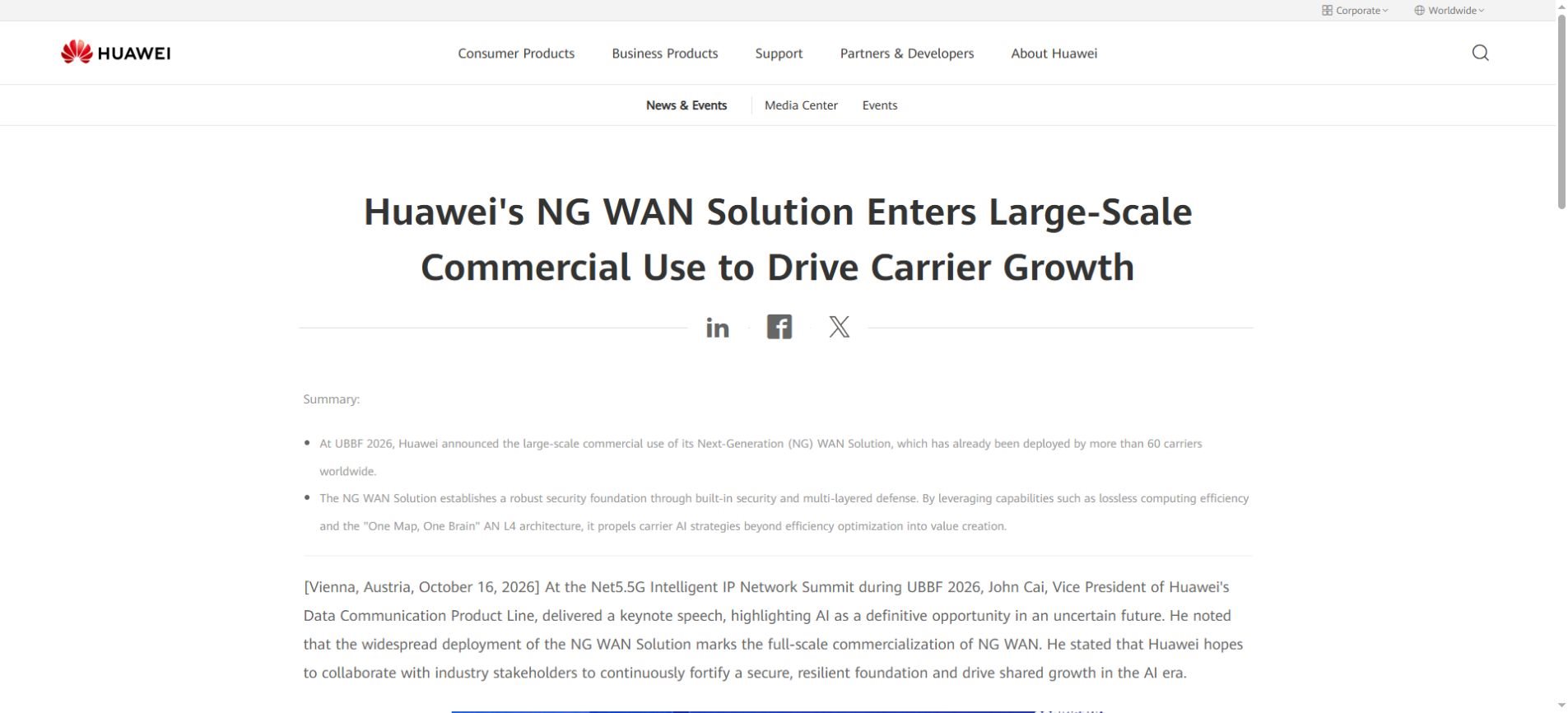
Today’s news comes from Huawei, which announced wider commercial deployment of its Next-Generation WAN solution on October 16, 2026. The announcement is a useful starting point for understanding a less visible part of AI: the infrastructure that carries requests, moves data and keeps services connected.
Reviewed October 16, 2026. This article separates Huawei’s announcement from general networking explanations. Deployment counts, benchmarks and security results in the release are vendor-reported claims. We have not independently tested the solution.
The news in one minute
In its official UBBF 2026 announcement, Huawei says more than 60 carriers worldwide have deployed its NG WAN solution. The company describes three priorities: security across network layers, efficient connectivity for computing workloads and greater automation of network operations.
Huawei also describes its “One Map, One Brain” architecture and Level 4 autonomous-network capabilities across fault handling, changes, optimization and security. That is a claim about particular operating scenarios, not evidence that every network function can run without oversight.
The release includes numerous performance and attack-detection figures, but those should not be applied to every network or workload. A fair comparison needs the test setup, traffic pattern, baseline and operating conditions. A deployment announcement alone cannot establish how much faster an individual AI app will become.
What is AI networking? Two meanings worth separating
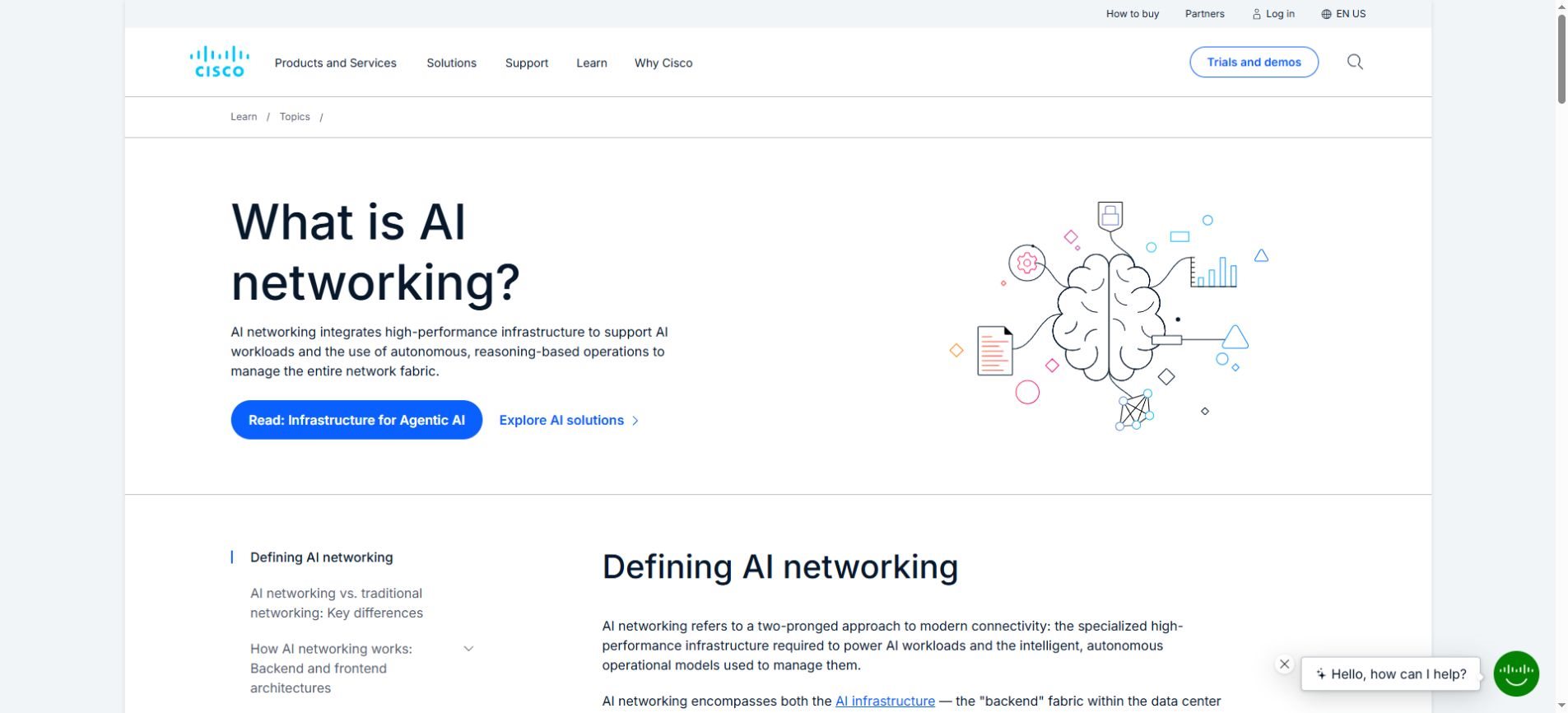
The term covers two connected ideas. Cisco’s AI networking explainer distinguishes infrastructure built to support AI workloads from AI-assisted operations used to manage networks. Keeping those meanings separate makes product announcements much easier to read.
Networking for AI
This is the connectivity that lets AI systems do their work. Inside a computing cluster, accelerators need to exchange data. Beyond the cluster, applications need to reach model services, storage and other tools. The requirements differ depending on whether the network connects nearby machines or distant locations.
Imagine several people completing one shared project. Giving each person a faster computer helps, but the project can still stall if they cannot exchange files when needed. Distributed AI has a similar coordination problem, although the precise communication pattern depends on the workload and software.
AI for networking
This is the use of AI to help operate the network itself. A system might examine measurements, highlight unusual behavior, suggest a likely cause of a fault or recommend a configuration change. Some products can also execute approved actions within defined limits.
Those abilities do not mean a chatbot should have unrestricted control of infrastructure. Useful automation needs accurate observations, permissions, validation and a way to recover when a change does not produce the intended result. The network remains a system with operational responsibilities.
Where a WAN fits into the picture
WAN stands for wide area network. It connects systems across larger geographic areas, such as offices in different cities or an organization’s sites and cloud services. A local area network covers a smaller environment; a computing-cluster network connects machines working closely together.
These boundaries matter because distance and traffic patterns change the engineering problem. A local cluster interconnect and a carrier network between cities cannot be judged by one headline speed number. Each has different demands for capacity, resilience and predictable delivery.
For background on the work performed after a request reaches a model, read our AI inference guide. Network delivery is one part of that journey; model processing, application logic and service queues also contribute to the experience.
Four measures that explain more than “faster AI”
| Measure | Plain-language meaning | Why it matters |
|---|---|---|
| Bandwidth | How much data a connection can carry per unit of time | Large transfers need enough capacity |
| Latency | The time taken for data to travel | Interactive tasks can feel slow despite high capacity |
| Packet loss | Data packets that fail to reach their destination | Recovery or retransmission can interrupt progress |
| Jitter | Variation in delivery delay | Inconsistent timing can affect time-sensitive workloads |
A connection can have high bandwidth and still have noticeable latency. Think of a road that carries many vehicles but takes a long time to traverse. Capacity and travel time describe different properties, so increasing one does not automatically solve the other.
Likewise, a large file transfer and a live interaction have different needs. The transfer may mostly need sustained throughput. An interactive assistant may be sensitive to delays before its first response and between successive steps. Measure the behavior that the application actually depends on.
Why networks matter differently for training and inference
During training
When training is distributed across multiple accelerators, communication can become part of the critical path. Devices may need to exchange intermediate information before the next stage proceeds. If some devices wait for data, simply adding more computing capacity may not deliver a proportional improvement.
That is why AI infrastructure discussions often include congestion control, traffic distribution and carefully designed interconnects. “Lossless” networking describes an engineering objective or behavior under specified conditions. It should not be read as a promise that no failure can ever occur.
During inference
Inference runs a trained model to produce an output. Some deployments use one machine for a request; others spread work across devices or call multiple services. Network requirements therefore depend on how the application is built, not just the label “AI.”
An assistant that searches documents, queries a database and generates a response has several opportunities to wait. A faster link may help one stage while leaving another unchanged. For example, reducing upload time does not automatically reduce the time the model spends generating a long answer.
What network automation should look like in practice
Consider an illustrative office network with two available routes to a cloud application. One route becomes congested. An AI-assisted operations system could identify the deterioration, compare it with other measurements and propose moving selected traffic to the other route.
A responsible workflow would check the proposal against policy, confirm that the alternative has capacity and monitor the result after the change. If performance worsens, the operator needs a rollback path. This example describes a possible workflow, not a verified demonstration of Huawei’s product.
- Observe: collect relevant measurements and confirm that the data is current.
- Explain: identify the suspected problem and the evidence supporting it.
- Validate: check the proposed action against constraints and dependencies.
- Act within scope: apply only the permitted change, with approval where required.
- Measure and recover: confirm the outcome and reverse the change if needed.
Automation can reduce repetitive work, but its usefulness depends on the whole loop. A persuasive explanation is not enough if the system inspected stale data. A technically valid change is not enough if it breaks another service or cannot be reversed.
Security claims need context, too
Networks carry sensitive business traffic and support essential services. Adding intelligent monitoring can help operators prioritize signals, but it does not remove the need for access controls, updates, incident response and independent validation. Security is an operating process rather than one product feature.
When reading a detection percentage, ask what counted as a threat, which examples were tested and how false alarms were handled. A high rate on one set of cases does not establish coverage of every possible attack. Similarly, a faster response is useful only if the response is appropriate.
Reading tip: Keep three questions beside any AI infrastructure claim: Compared with what? Under which conditions? Measured by whom? If those details are missing, treat the number as incomplete evidence rather than a universal result.
What this means for everyday AI users
You do not need to understand carrier routing to use an AI assistant. The practical lesson is that a slow response can have several causes. Your local connection, the service’s capacity, the model, the size of the request and additional tool calls can all contribute.
If one service is slow, compare a small request with a large upload and check the provider’s published status information. Avoid assuming that every delay means your internet package is inadequate. A general network announcement is not a reason to replace working equipment.
The infrastructure also extends beyond connectivity. Our AI data center energy article looks at electricity and capacity, while our Maia 300 explainer examines another part of the computing system. These constraints interact, but they are not interchangeable.
Questions to ask as the story develops
The next useful evidence will be more detailed operational results: named deployment scenarios, clear baselines, sustained measurements and explanations of what humans still supervise. Those details are more informative than a new round of broad “AI-ready” labels.
- Which applications and network segments were measured?
- Were the results from a lab, a pilot or sustained production use?
- What traffic, distance and failure conditions were included?
- Which actions were automated, and which required an operator?
- Were reliability gains maintained during congestion or equipment failure?
For organizations evaluating a service, those questions help turn an announcement into something testable. For readers following AI news, they help distinguish a promising engineering direction from an outcome that has already been demonstrated in a particular environment.
Frequently asked questions
Is AI networking the same as an AI chatbot?
No. A chatbot is an interface or application. AI networking concerns the connections supporting AI workloads and the use of AI in network operations. A conversational interface may be part of an operations tool, but it is not the entire network system.
Does Huawei NG WAN make every AI app faster?
The announcement does not establish that. An application’s response time depends on several components, and the effect of a network change depends on where its bottleneck is. Product-level performance needs to be evaluated in the actual deployment.
Does autonomous networking mean there are no engineers?
No. Automation can handle defined tasks while engineers set policy, manage exceptions, review changes and respond to failures. A stated autonomy level for selected scenarios should not be interpreted as unrestricted independence across every operation.
Is bandwidth the same as low latency?
No. Bandwidth describes capacity, while latency describes delay. A link can carry a large amount of data and still take time to deliver it. The right performance measure depends on the application and the part of its workflow being examined.
The useful takeaway from today’s announcement
AI networking is about making computing resources reachable, coordinated and manageable. Huawei’s news points to carrier interest in that infrastructure layer. The lasting question is whether a specific network delivers reliable application performance under real operating conditions—and whether operators can understand and control its automation.
Sources: Huawei’s October 16, 2026 NG WAN announcement and Cisco’s AI networking explainer. Huawei’s release supports the news reporting; Cisco provides technical background and is not an independent validation of Huawei’s claims.