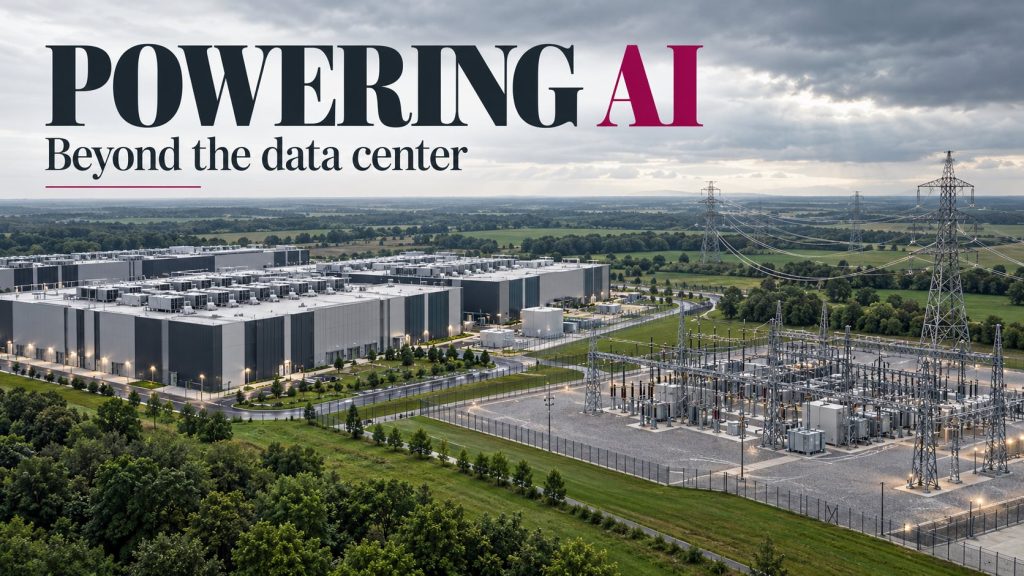
An AI answer appears on a screen, but the work behind it happens in physical buildings connected to electricity networks. AI data center energy demand is therefore about more than the efficiency of a chip. It also involves where facilities are built, when they need power and who pays for the infrastructure.
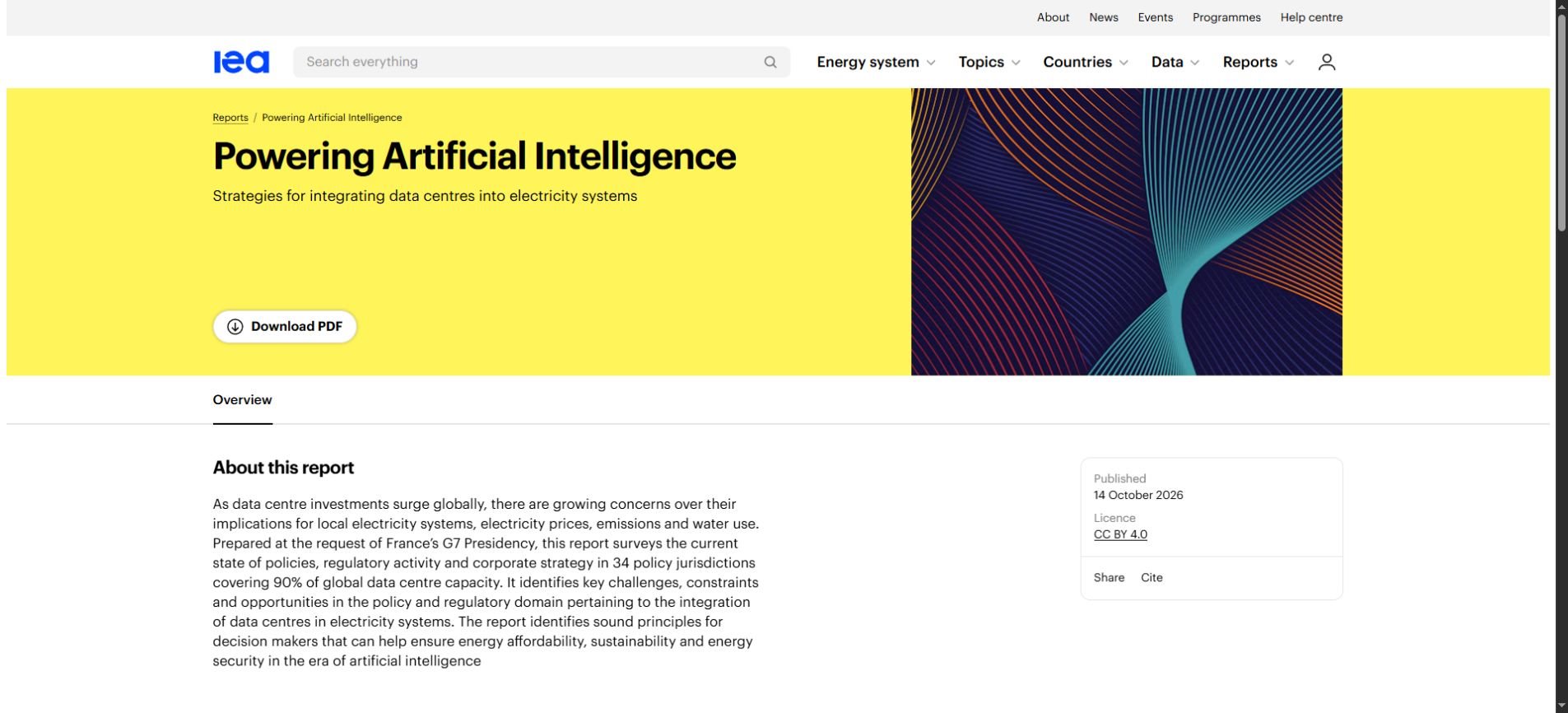
The International Energy Agency published Powering Artificial Intelligence on October 14, 2026. The report examines how data centers fit into electricity systems. This guide explains the practical questions behind the news, without turning a global report into a prediction about one household’s bill.
Reviewed October 14, 2026: The report is a policy and infrastructure analysis, not a measurement of the electricity used by your individual AI prompt. Examples below are illustrative and are not energy estimates for a specific provider.
What is new in the IEA report?
Prepared at the request of France’s G7 Presidency, the report surveys policies, regulation and company strategies across 34 policy jurisdictions covering about 90% of global data center capacity. Its focus is integrating facilities into power systems while considering affordability, sustainability and energy security.
The executive summary emphasizes uncertain demand, grid connections, flexibility, water and cost allocation. The key idea is that a data center’s impact depends on its location and operating arrangements, not only how large it is.
The three questions hidden inside “AI uses electricity”
It helps to separate three questions. How much energy does a workload consume over time? How much power must be available at a particular moment? And can the local network deliver it reliably? These questions are related, but they are not interchangeable.
Energy is accumulated consumption, commonly measured in kilowatt-hours. Power is the rate of consumption, measured in kilowatts or larger units. A facility can have a large connection capacity without using that full amount continuously.
| Term | Meaning | Question to ask |
|---|---|---|
| Power | The rate at which electricity is used | How much is needed at the same time? |
| Energy | Electricity use accumulated over time | What period does the figure cover? |
| Grid connection | The ability to receive electricity at a location | Can the local network deliver it? |
| Workload efficiency | Resources required for a defined task | Is output quality comparable? |
The difference matters when reading a headline about a proposed project. A requested connection is a planning signal. It does not establish that the facility is complete, fully occupied or running at its maximum capacity every hour.
Why a global total can hide a local bottleneck
Electricity networks serve particular places. A national system may have generation available while a specific substation or transmission corridor lacks capacity for a new large load. Building or upgrading those connections can require equipment, planning and time.
Think of a busy road leading to a warehouse. Adding stock elsewhere does not remove the traffic bottleneck at the entrance. Similarly, adding electricity generation alone does not guarantee that power can reach every new facility when required.
This is why project location matters. Nearby network capacity, other users, available land and the expected pace of growth all shape the practical challenge. Two facilities with similar computing equipment can create different local infrastructure needs.
Connection queues are not a forecast of completed buildings
The IEA warns that connection queues can include duplicate or speculative projects. Planning for too little demand can produce bottlenecks; planning for too much can leave infrastructure underused. The challenge is to distinguish credible projects from early-stage proposals.
An announced investment, a power application, a building under construction and an operating facility are separate milestones. When assessing a story, identify which milestone the evidence supports. A long list of proposals should not automatically be added together as future electricity consumption.

For businesses considering a facility, the useful questions are concrete: when does capacity become available, how does consumption ramp up and what commitments apply? For communities, it matters whether infrastructure plans account for existing users and uncertainty.
Training and everyday AI use create different workloads
Training develops a model. Inference runs a trained model to answer requests or perform tasks. Both require computing resources, but they can have different timing, performance requirements and opportunities for scheduling.
Our AI inference guide explains the basic process. A live assistant generally needs to respond promptly, while some background processing can tolerate delay. That distinction affects how much flexibility an operator can realistically offer.
It would be misleading to assume that all AI work can simply move to a cheaper hour. The operator may serve customers with response-time commitments, and moving work can involve data, networking and operational constraints. Flexibility has to be designed around the actual service.
Efficiency helps, but total demand can still grow
A more efficient model or system can perform a task using fewer resources. Yet overall demand also depends on how many tasks are requested and how ambitious they become. Lower cost can encourage wider use, so efficiency gains do not automatically imply lower total consumption.
This is not a reason to ignore efficiency. It is a reason to measure both the resources per useful result and the volume of work. A service that reduces wasted retries or routes a simple task to an appropriate smaller model can improve its operation even as its customer base changes.
The distinction appears in our Maia 300 explainer: infrastructure efficiency claims need a defined workload and comparison. One hardware metric cannot tell the whole story of a data center’s electricity use.
Cooling links electricity and water
Processors generate heat, and equipment must stay within operating limits. Cooling choices therefore belong in the energy discussion. Climate, facility design and the chosen cooling system influence how heat is removed and which resources are used.
The IEA notes that energy and water efficiency can involve trade-offs, and that water use also occurs upstream in electricity generation. Looking only at water inside the facility can miss part of the picture. Looking only at electricity can do the same.
A useful sustainability comparison should state its boundary: the server, the building, the electricity supply or a broader lifecycle. It should also identify the place and period being measured. Without that context, two numbers may describe different things.
Will data centers make electricity bills higher?
There is no universal answer. The IEA explains that new infrastructure costs can raise other consumers’ bills if they are shared broadly. A facility using existing capacity and paying its share can also spread fixed costs over more consumption. Local cost-allocation rules matter.
That makes the question partly an infrastructure issue and partly a policy choice. Who funds a new connection? What happens if a project uses less capacity than expected? What commitments protect other customers if it leaves? These details are more useful than assuming every data center has the same effect.
A useful question for a local project: What new network investment is required, who pays for it and who carries the risk if the promised demand does not materialize? Ask for those answers separately from claims about jobs or AI innovation.
This article does not predict electricity prices in a particular country. Such a forecast would require local tariffs, network plans, generation costs and project details that a global report alone cannot establish.
What AI businesses can do with this information
- Measure completed tasks: Count useful results alongside tokens, retries and failed runs.
- Match the model to the job: Compare quality and resource needs rather than choosing the largest model by default.
- Separate urgent and background work: Identify which tasks truly need immediate responses.
- Ask providers clear questions: Look for documented regions, reliability commitments and measurement boundaries.
- Avoid unsupported footprint claims: Do not assign one universal energy or water number to every prompt.
- Review workflow waste: Repeated calls caused by poor inputs or missing context can add work without adding value.
These are operational practices, not a promise of a specific environmental saving. Measure the effect in your own workflow. A shorter prompt is not necessarily better if it removes essential context and causes several unsuccessful attempts.
How readers can assess the next AI energy headline
First identify the claim type. Is it a measured consumption figure, a future scenario, a requested grid connection or an investment announcement? Then look for the time period and geographic scope. Those details prevent a proposal from being mistaken for current demand.
Next check the comparison. Does it refer to a whole facility or only computing equipment? Does it include cooling? Are the figures annual energy or peak power? A precise-sounding number can still be confusing when its definition is missing.
Finally, ask what remains uncertain. Future customer demand, project completion and technology choices can all change. A well-supported article should make those uncertainties visible rather than hiding them behind one dramatic total.
Frequently asked questions
Why do AI data centers need electricity?
Computing equipment, networking and supporting systems need power. Running the facility also involves cooling and other infrastructure. The amount depends on the workload and the system used.
Is power capacity the same as energy consumption?
No. Capacity describes how much power can be supplied or used at a moment. Energy consumption adds up use over time. A large connection request does not prove continuous maximum use.
Can AI work move to times when the grid is less busy?
Some work may allow scheduling, but interactive services and customer commitments can limit flexibility. The answer depends on the workload and operating arrangements.
Does a more efficient chip solve the energy issue?
It can improve efficiency for particular tasks, but total demand also depends on usage growth, software, cooling and infrastructure. The wider system still matters.
How much electricity does one AI prompt use?
There is no single number established by this report. Models, tasks, output lengths, hardware and accounting methods differ. Use a documented measurement for a defined setup rather than a universal estimate.
The practical takeaway from today’s report
AI infrastructure is becoming an electricity-system planning question as well as a computing question. The useful debate concerns credible demand, local connections, efficient operation and fair allocation of costs and risks.
For AI users and businesses, start with what you can verify: the task, the service and its documented requirements. For infrastructure claims, keep power, energy, location and timing separate. That makes the next headline much easier to evaluate.