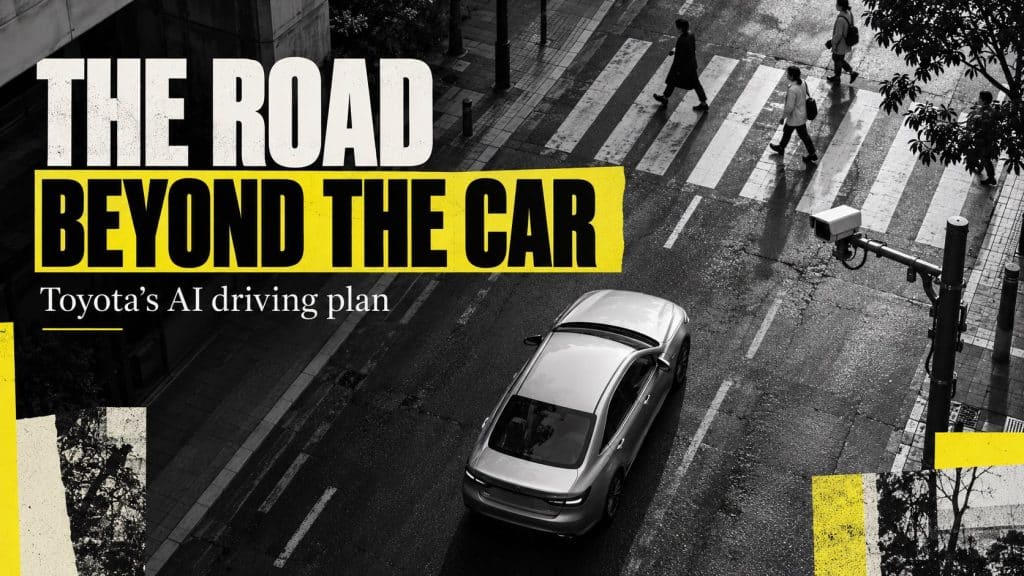
Toyota’s in-house AI driving plan puts a useful question back in focus: how much can a vehicle understand on its own, and what could it learn from the road around it? A camera on a car sees from the car’s position. A camera near an intersection may have a different view. Combining information is potentially useful, but it also creates a system that must be carefully evaluated.
An October 21, 2026 report from The Asahi Shimbun says Toyota plans to develop its own autonomous AI and use Woven City to explore supporting infrastructure. Toyota’s earlier official updates provide context for that work. They describe a living test environment and a planned upgrade to its AI Vision Engine.
Read plans as plans. This article distinguishes today’s reporting, Toyota’s published testing updates and our explanation of the technology. It does not establish that a consumer vehicle can drive without supervision or that a future rollout date is guaranteed.
The news: an in-house approach to driving AI
The Asahi report describes an end-to-end driving approach, an initial deployment goal from 2028 and wider model installation from 2030. It also reports a separate “Guardrail” program intended to constrain AI judgments and an interest in roadside cameras for difficult blind spots. These are reported objectives, not confirmation of an available feature.
The important distinction is between the vehicle’s AI and the environment supporting it. Better onboard interpretation and additional information from infrastructure are different engineering efforts. They may complement each other, but neither should be treated as proof that all driving situations have been solved.
What Toyota has documented at Woven City
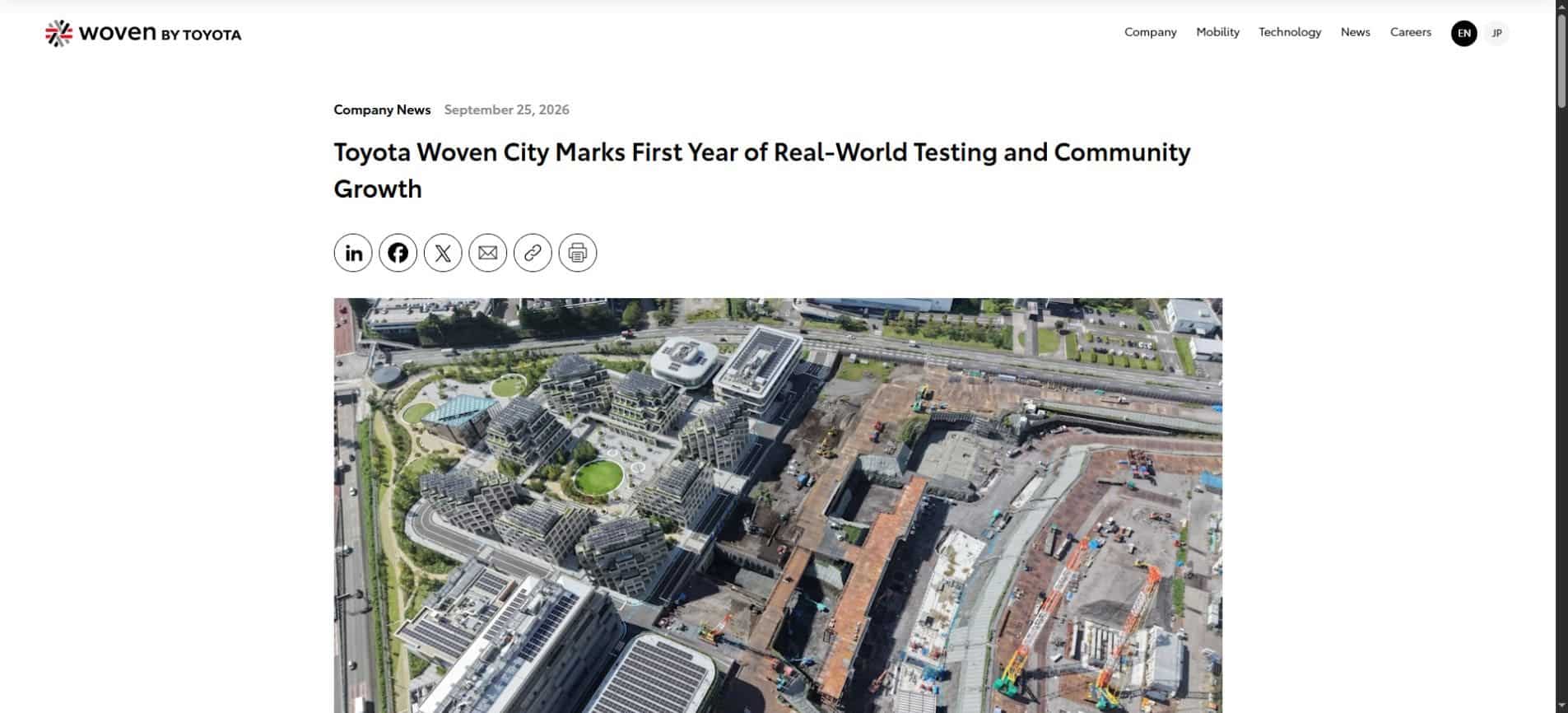
Woven by Toyota’s September 25, 2026 update says approximately 30 proof-of-concept projects were underway at Woven City. It describes resident participation, testing of its Integrated ANZEN System and a planned AI Vision Engine 2.0 release by the end of 2026.
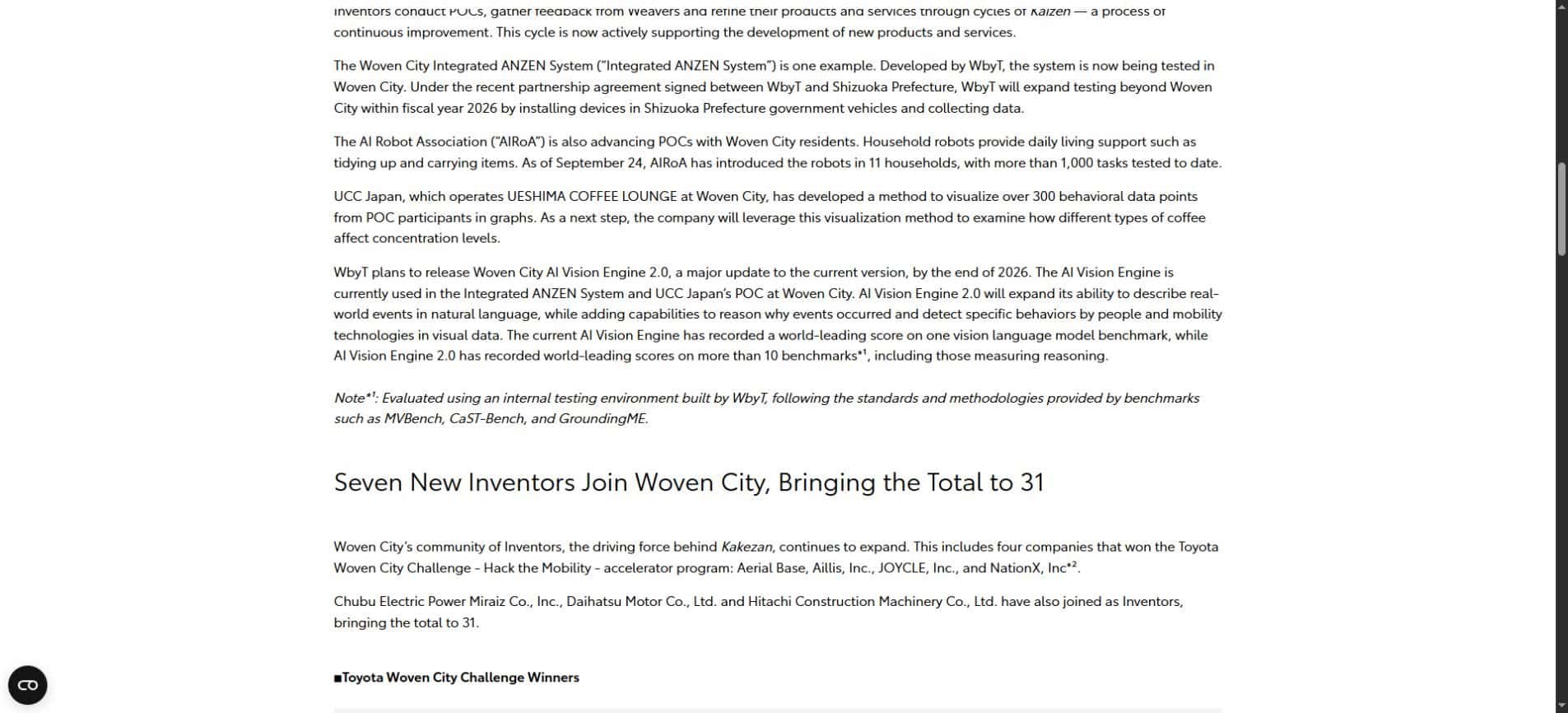
The planned engine update is intended to expand natural-language descriptions of events, reasoning about why events occurred and detection of specific behaviors in visual data. Toyota reports benchmark results from its own testing environment. That evidence concerns particular evaluations; it does not independently establish safe performance on every public road.
Why a living laboratory is different from a software demo
A software demonstration can show an impressive response in a selected situation. A living test environment creates opportunities to observe repeated interactions with people, spaces and routines. That can reveal friction a short demonstration misses: confusing alerts, inconsistent detections or behavior that changes when the scene becomes busy.
The value depends on how testing is designed. A test should state what is being evaluated, which conditions are included and how failures are recorded. More activity does not automatically mean more useful evidence. A small, well-characterized trial can answer a clearer question than a much larger collection of poorly labeled observations.
For background on AI interacting with the physical world, see our physical AI guide. A system that acts in a shared environment needs more than fluent descriptions: its perception, decisions and actions must work together under real constraints.
Three layers readers should keep separate
| Layer | What it contributes | What it does not prove |
|---|---|---|
| Visual interpretation | Identifies and describes information in a scene | Every object or event is understood correctly |
| Driving decisions | Selects actions within a vehicle system | It can handle every road and condition |
| Connected infrastructure | Provides information from additional viewpoints | That information is always current or available |
These layers may share technology, but they answer different questions. A model that describes a pedestrian crossing accurately is not automatically a complete driving system. A roadside sensor that detects an object does not, by itself, determine how a vehicle should respond.
The blind-spot example explains the opportunity
Imagine a hypothetical junction where a parked delivery vehicle blocks a car’s view of a pedestrian. A sensor positioned elsewhere may observe the pedestrian earlier. In principle, sending relevant information could improve awareness. This is an illustration of the idea, not a report of a tested result.
Several questions immediately follow. How old is the observation when it arrives? Does the receiving system know exactly where the detected object is? What happens if two sensors disagree? How does the vehicle behave if the message never arrives? Each answer matters more than an animation showing a smooth, ideal journey.
Our AI networking explainer covers why latency and reliable communication are distinct from raw bandwidth. A large amount of information is not necessarily useful if it reaches the decision point too late.
What an AI Vision Engine can add
A vision-language model connects visual information with language. This can make observations easier to search, summarize or explain. Instead of reviewing an entire video manually, a person might ask about a specific event and inspect the relevant segment.
Language is useful for communicating findings, but a confident sentence is not a substitute for the underlying evidence. A model can give a plausible account of why something happened without establishing the cause. In a testing workflow, retain the original scene and distinguish observation from interpretation.
For example, “the person stepped back” describes visible motion. “The person stepped back because the vehicle approached” adds an explanation. The second statement needs stronger support. Designing evaluations around that difference helps prevent an interpretation from silently becoming a fact.
End-to-end does not mean unbounded
“End-to-end” generally describes a more integrated learned path from input toward output. The exact meaning depends on the system. It does not tell a reader which sensors are used, what the operating limits are or how fallback behavior works. Those details require specific documentation.
An integrated model can still sit inside a larger architecture with monitoring and constraints. It can also need extensive testing. Do not infer that a single model removes the need for supporting software, operational rules or a defined response when the system cannot continue.
Ask about the operating conditions. A demonstration on one route does not establish equivalent behavior on every road, in every weather condition or under every traffic pattern. Compare evidence within its stated scope.
How to judge the next announcement
The most useful follow-up will connect a capability to a clearly described test. Look for the route or environment, conditions, evaluation period and definition of success. Ask whether results cover selected demonstrations or the complete set of attempts.
- Separate a future target from a confirmed release.
- Look for the exact feature, vehicle and region covered.
- Check the stated role of the person using the system.
- Ask how missing, delayed or conflicting information is handled.
- Distinguish provider-reported benchmarks from independent evaluation.
- Look for disclosed limitations and recorded failures.
This approach works beyond autonomous vehicles. Robotics, smart buildings and other physical AI systems also need evidence about complete behavior. A benchmark may illuminate one capability while leaving integration and everyday reliability unresolved.
The privacy questions are part of the design
Visual systems in shared spaces can capture people who are not the main subject of a test. A clear deployment description should explain what is collected, the purpose, who can access it and how long it is kept. Those are useful questions for evaluating a proposal; this article does not establish the policies of a particular installation.
Also distinguish an alert derived from a scene from the raw footage behind it. Different designs can expose different amounts of information. Readers should look for published details rather than assuming that every connected-camera system sends all video to the same place.
What this means for ordinary AI users
This is infrastructure and mobility coverage, rather than a new chatbot feature. There is no setting in an ordinary assistant that turns it into a vehicle control system. Nor does an announcement about a driving model establish the availability of that model through another AI platform.
The broader lesson is still useful: assess AI by the job it must perform. A fluent explanation, a visual benchmark and a working physical system are different achievements. Good evaluation keeps those achievements distinct while showing how they fit together.
Frequently asked questions
Did Toyota launch this driving system today?
The October 21 article reports development and deployment plans. It should not be treated as a product launch. Confirm availability, conditions and supported vehicles through current official information when considering a specific feature.
Is Woven City AI Vision Engine 2.0 already released?
The official September 25 update says release is planned by the end of 2026. That statement alone does not confirm release as of October 21. A later announcement would be needed to establish a changed status.
Does roadside AI replace the vehicle’s own sensors?
Additional viewpoints can supply complementary information, but that does not establish a replacement. The architecture, operating conditions and fallback behavior of a particular system must be documented separately.
Do high benchmark scores prove safe driving?
No single benchmark proves complete behavior in all conditions. A benchmark measures specified tasks under a defined setup. Real-world integration, system limits and failure handling require their own evidence.
The next step to watch
Toyota’s in-house AI driving plan is interesting because it links vehicle intelligence with the surrounding environment. The useful next evidence will be specific: documented capabilities, realistic evaluations and clear operating limits. Follow those milestones before translating a future plan into a promise about a car available today.
Sources and review: The Asahi Shimbun’s October 21 report and Woven by Toyota’s September 25 official update. Reviewed October 21, 2026. The hypothetical junction example and evaluation questions are editorial explanation; we have not independently tested the systems.