A smaller program can be as valuable as a faster computer. That idea is behind the new Google Quantum AI competition on Kaggle, where participants are using AI agents and algorithmic insight to reduce the resources required by quantum circuits.
The challenge opened on October 22, 2026, with a $150,000 prize pool. Its targets connect to fusion research, combinatorial optimization and quantum chemistry. The interesting part is how the work is checked: candidate circuits can be tested on ordinary classical computers instead of relying on an AI model’s explanation that its answer is correct.
The key distinction: this is AI helping design quantum programs. It is not a new consumer chatbot running on a quantum processor, and it does not establish that practical quantum advantage has already arrived.
Reviewed October 24, 2026. This report uses the official competition materials and companion research. We have not independently run or benchmarked submissions.
The news in one minute
According to the official Kaggle competition page, entrants optimize three specified computational bottlenecks. Each submission must satisfy verification requirements while improving a resource-based score relative to reference implementations. The final submission deadline is January 20, 2027, at 23:59 UTC.
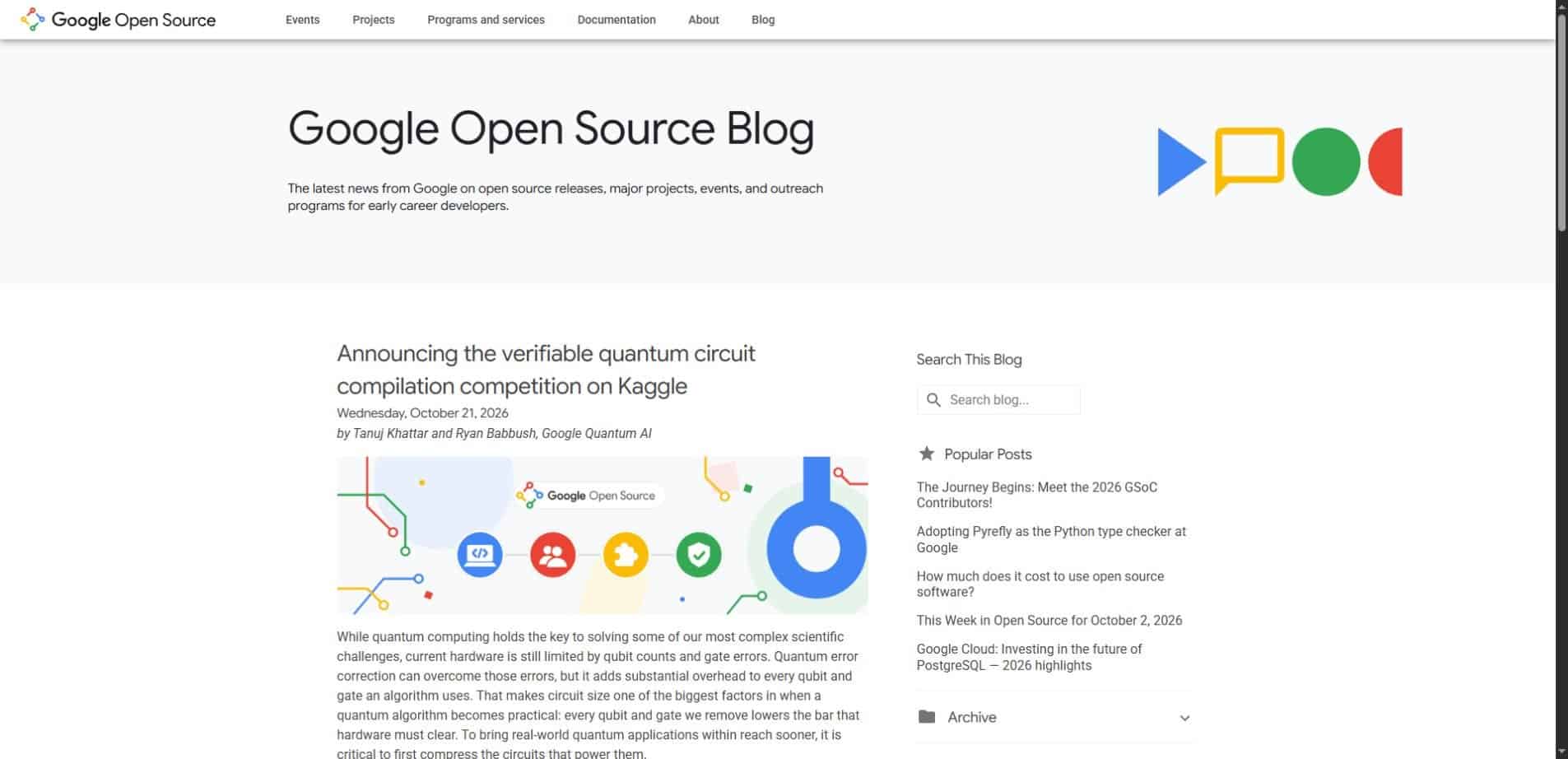
The Google Open Source announcement introduces kickmix, a library within Qualtran that helps build and test the relevant circuits. The broader research lesson is to give AI a constrained engineering problem with an external checking mechanism.
Why circuit size matters before the hardware arrives
A quantum algorithm is an abstract method. A circuit is a more concrete sequence of operations that implements it. Turning an algorithm into a circuit requires decisions about arithmetic, temporary storage, precision and cleanup. Two implementations of the same useful calculation can therefore require very different amounts of hardware and work.
A helpful analogy is packing for a journey. You can buy a larger vehicle, but removing unnecessary luggage also makes the journey easier. Circuit optimization follows that second route: reduce the demands of a computation so the machine has a more achievable job.
The competition focuses on fault-tolerant quantum computing. In that setting, error-corrected logical qubits are built using physical resources, and some operations are much more expensive than others. Counting every gate as if it had the same cost would miss an important part of the problem.
Kaggle highlights logical qubit counts and Toffoli counts as major resource measures. Toffoli gates are reversible logic operations with two controls and a target. On error-corrected hardware, implementing operations of this kind can require costly supporting resources. Reducing them can matter even when a circuit still looks complicated on paper.
What participants are actually trying to improve
This is not a competition to generate an attractive explanation of quantum computing. Participants submit circuit artifacts and, for the chemistry task, supporting numerical data. Those artifacts are evaluated against defined tasks and accuracy conditions.
| Task | What is being optimized? | Why it matters |
|---|---|---|
| Fusion energy | An inverse-square-root phasing calculation | Supports simulations of particle interactions in fusion fuel |
| Combinatorial optimization | A reversible Reed–Solomon decoder | Reduces a bottleneck in Decoded Quantum Interferometry |
| Quantum chemistry | Factorizations, lookup circuits and rotation structure | Targets a more economical simulation of FeMoCo chemistry |
Fusion: make a repeated calculation cheaper
The fusion benchmark concerns the inverse square root of a value representing squared distance. This calculation helps describe interactions between charged particles. If an operation appears repeatedly inside a simulation, improving that one routine can reduce a much larger total cost.
The challenge is not simply to copy a familiar classical shortcut. The circuit must respect reversibility, precision requirements and the handling of temporary qubits. A compact calculation that leaves unwanted information behind can fail the requirements even if its main numerical answer looks plausible.
Optimization: reduce the cost of decoding
The second benchmark targets a decoder used in Decoded Quantum Interferometry. It involves Reed–Solomon codes, a family of error-correcting codes also familiar from classical computing. Here the decoder becomes part of a quantum algorithm rather than an ordinary data-recovery tool.
The useful lesson is that a mathematically promising algorithm can still be held back by one expensive implementation step. Improving that step may make the full method more practical, but it does not make every optimization problem easy.
Chemistry: optimize the representation and the circuit together
The chemistry task concerns FeMoCo, the metal-containing cluster associated with biological nitrogen fixation. Modeling its electronic behavior is scientifically important. The competition asks entrants to consider both numerical representations and the circuits used to load and manipulate their parameters.
This creates a design trade-off: a representation that looks compact in one measure may require more repetitions or more costly circuit operations elsewhere. Evaluating the combined cost helps avoid optimizing one part while making the overall computation worse.
How AI can search without becoming its own judge
An AI coding agent can propose a circuit change, generate an artifact and inspect feedback. But the important judge is the verifier, not another paragraph produced by the model. That separates creative search from the decision about whether the result meets the benchmark conditions.
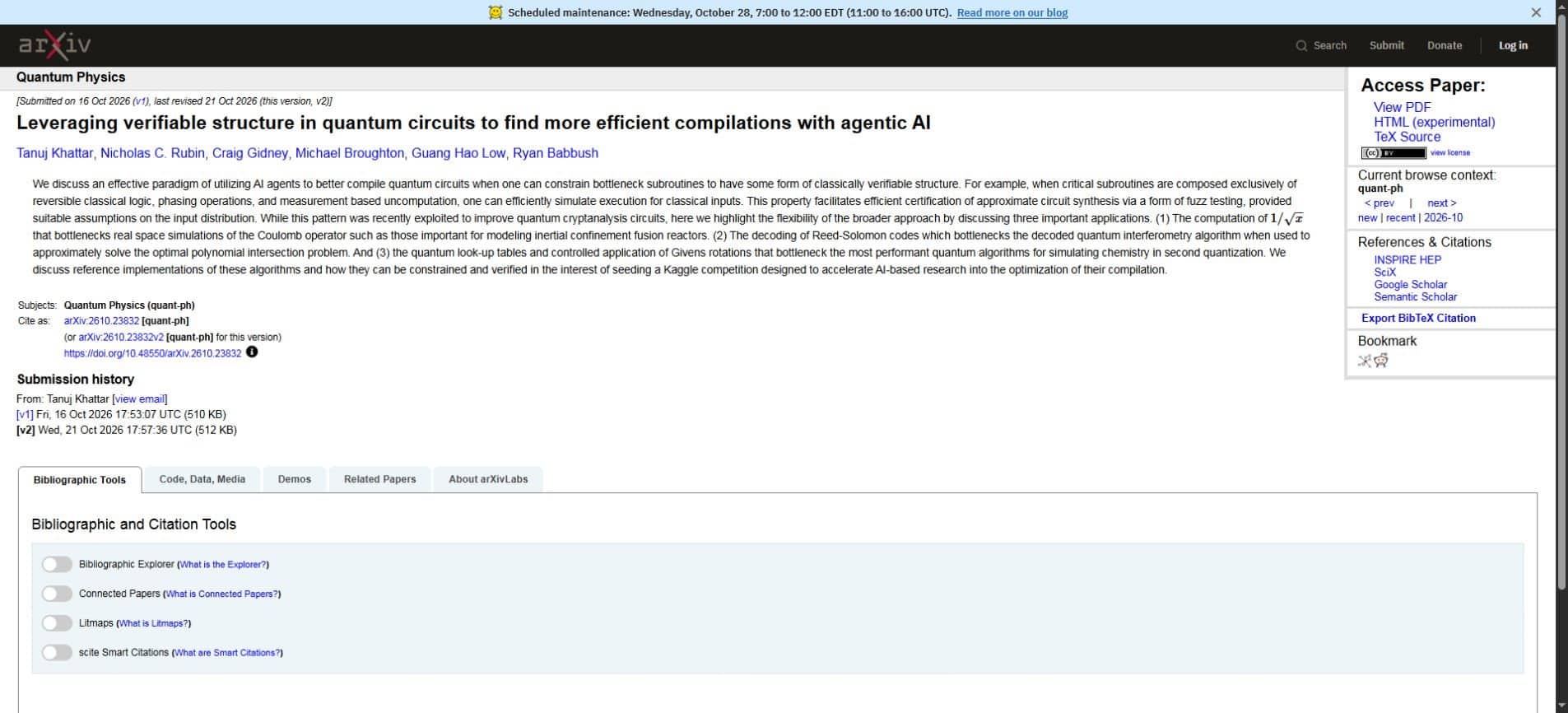
The companion research paper explains how classically verifiable structure can make this approach useful. The selected subroutines use reversible logic, phase operations and measurement-based cleanup. That structure allows efficient testing on classical inputs, subject to the assumptions and bounds described in the research.
For a broad quantum circuit, tracking its complete state can become prohibitively expensive on a classical machine. The chosen circuit family avoids requiring that general simulation approach for these specific verification tasks. The restriction is a feature of the competition design, rather than a claim that all quantum computations are now easy to simulate.
Randomized testing also needs careful interpretation. Passing sampled cases is evidence within a defined verification procedure; it is not automatically an exact proof for every possible circuit and input. The paper discusses approximate synthesis and assumptions about the input distribution. Those qualifications belong alongside any headline about AI-generated improvements.
A practical improvement loop
- Read the reference implementation and identify the actual cost function.
- Reproduce a valid baseline before changing the algorithm.
- Let an agent propose one bounded modification, such as a different arithmetic decomposition.
- Build the resulting circuit and run the verifier.
- Compare the full score, accuracy conditions and resource counts.
- Keep reproducible improvements and document unsuccessful approaches.
This workflow connects to the broader issue in AI-assisted software maintenance: producing code is only one part of useful engineering. Traceable changes, test evidence and a clear account of what improved are just as important.
How scoring prevents a misleading win
The competition combines improvements across its three tasks using a geometric mean. Each task has its own cost formula, so a reduction in a single raw count does not necessarily mean a better final score. Some formulas incorporate error or other algorithm-level factors.
Imagine replacing a precise routine with a smaller approximation. If it remains within the required limits and lowers the relevant cost, that can be a valid engineering improvement. If it increases failure enough to require additional work, the apparent saving may disappear. The metric is meant to account for trade-offs of this kind.
Readers should therefore ask for the benchmark name, baseline, verification result and complete scoring method before interpreting a claimed percentage improvement. A leaderboard number is meaningful in its competition setting; translating it into deployment time or a commercial breakthrough requires additional evidence.
Can someone without quantum hardware participate?
Yes. The organizers say quantum hardware and a quantum physics background are not required. However, participants still need to learn the circuit format, benchmark constraints and relevant programming tools. “No hardware required” should not be confused with “no technical learning required.”
The open-source kickmix implementation is a useful starting point. A sensible first goal is to understand and reproduce one valid reference circuit, then investigate a small improvement. Trying to redesign all three tasks immediately makes it harder to separate a good idea from a broken implementation.
Participation dates: Kaggle lists January 13, 2027, for entry and team mergers, and January 20, 2027, for final submissions. Deadlines are 23:59 UTC unless stated otherwise. Check the official rules and timeline before entering, because organizers can update them.
What this means for everyday AI users
The immediate value is a clearer example of where AI agents can help: searching a large design space when outputs can be checked against explicit constraints. That is a stronger foundation for useful automation than accepting an answer because it sounds technically confident.
It also explains why task context matters. An agent needs the baseline, allowed instruction set, precision bounds, file format and cost function. Our context engineering guide discusses the same principle in more familiar AI workflows: the information surrounding a request shapes the quality of the result.
There is no reason to conclude from this competition that ordinary chatbot requests will move to quantum computers soon. The project targets specialized research subroutines. Improvements may lower future resource requirements without changing the hardware constraints that still have to be solved.
Frequently asked questions
What is the Google Quantum AI competition?
It is a Kaggle challenge to reduce the cost of selected quantum circuits using AI agents, classical optimization and algorithmic insight. It covers fusion, optimization and chemistry benchmarks, with a total listed prize pool of $150,000.
Does the AI run on a quantum computer?
That is not what the challenge requires. AI tools help search for better circuit implementations, and the selected submissions can be verified using classical computing tools. Participants do not need access to quantum hardware.
Does passing the verifier prove exact correctness?
Not in the unrestricted sense. The research discusses efficient checks for a structured circuit family and approximate behavior under stated assumptions. Randomized fuzz testing should be understood within those conditions, rather than described as a universal mathematical proof.
Will this deliver fusion energy or cheaper fertilizer immediately?
No immediate real-world outcome follows from the competition alone. The tasks relate to scientific calculations relevant to those fields. Better circuit resource estimates are a research step, while practical applications also depend on hardware, validation and wider scientific progress.
What should readers watch next?
Look for reproducible submissions that explain which bottleneck changed, how the verifier was used and what the full resource trade-off looks like. Public notebooks and code can make a result easier to examine than an isolated leaderboard screenshot.
The most useful takeaway is the combination of AI search and independent evaluation. For ongoing developments, compare official research materials with broader AI news coverage and keep benchmark results separate from claims about commercial readiness.