Muse Spark Open gives developers a new way to access Meta’s AI: downloadable model weights, rather than only an assistant reached through someone else’s service. The release is aimed at coding and agentic work, but its size makes one distinction essential from the start. Open access to weights does not make a model easy to run on ordinary hardware.
Meta released the model on October 15, 2026. This guide, reviewed October 17, explains what arrived, what its headline specifications mean and how to think about hosted access versus running it yourself. It also separates the model from the tools and interfaces built around it.
Release context: Specifications and availability below come from Meta’s announcement and published model card. Performance claims are provider-reported, not our own test results. Hosting support, account access and deployment requirements can change.
What changed with this release?
Meta’s official announcement introduces Muse Spark Open as a multimodal model for coding, extended reasoning and workflows involving tools. The company released weights and named several hosted inference partners. That creates choices for developers who want to evaluate the model without relying on a single consumer interface.
The significant change is control over deployment. With weights available, a qualified team can investigate a self-managed setup, adapt the surrounding application and compare serving options. Those choices also bring work: infrastructure, monitoring, access management and ongoing evaluation become part of the project.
This is a different angle from our Muse Wonder article. Muse Spark Open is a released model checkpoint. A model supplies capabilities; an assistant or agent product combines a model with an interface, tools, permissions and other features. Similar names should not be treated as interchangeable products.
The specifications, translated into practical terms
| Published specification | What it means | What it does not guarantee |
|---|---|---|
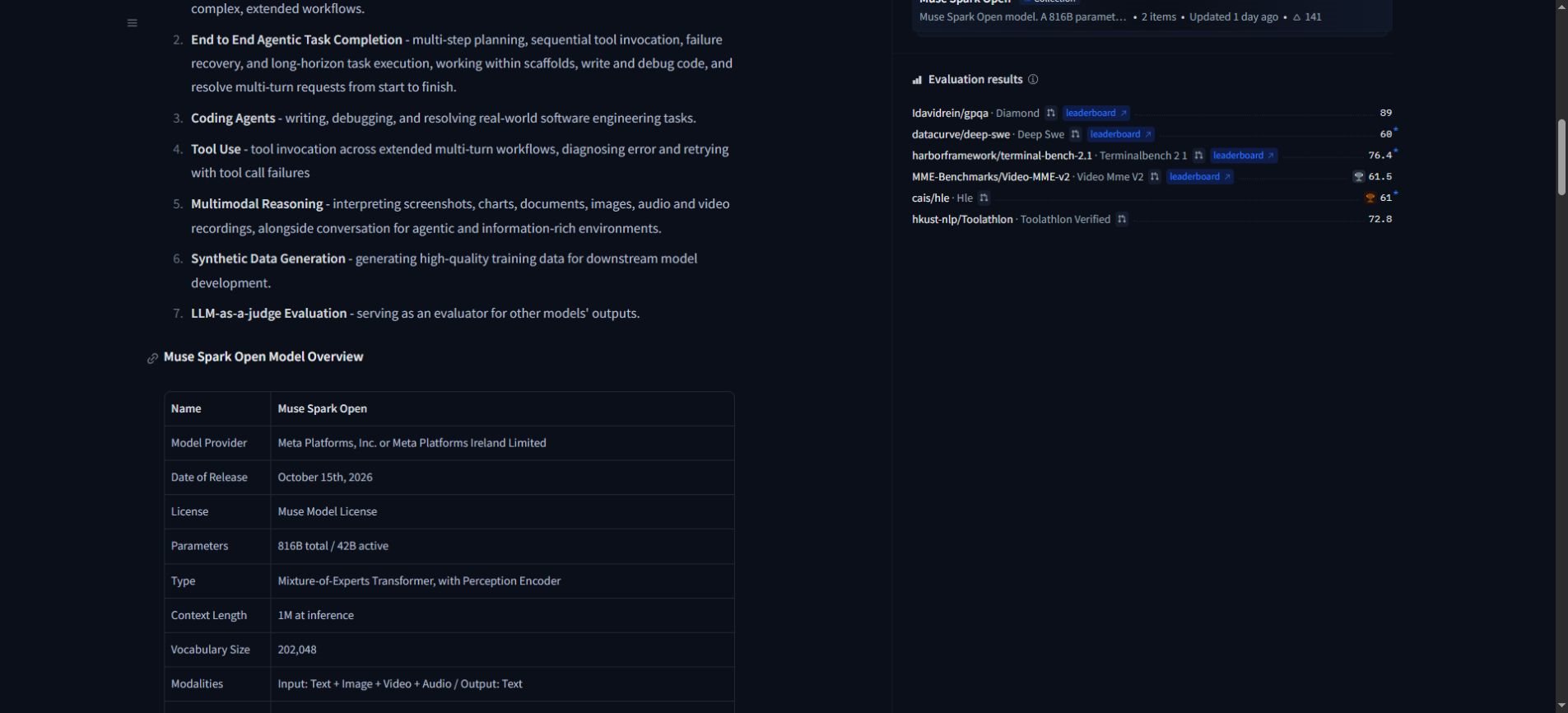
| 816B total parameters | A very large model architecture | Easy installation on a typical laptop |
| 42B active parameters | A subset participates in each token’s computation | Memory requirements equal to a 42B dense model |
| 1M-token context | A large supported input context at inference | Perfect recall or low cost at maximum length |
| Text, image, video and audio input | Multiple input formats in the model specification | Every host exposes all formats |
| Text output | Generated responses are text | Native image, video or audio generation |
These specifications are listed in the official model card. The distinction between supported input and generated output matters: a model can analyze a recording or photograph and respond in text without generating a new recording or photograph itself.
Why “816B total, 42B active” matters
Muse Spark Open uses a mixture-of-experts architecture. In broad terms, different parts of the model are selected for a particular token rather than every expert doing the same work on every step. This helps explain why total model size and active computation are reported separately.
The smaller active number should not be used as a shortcut for hardware planning. The serving system still needs access to the model’s weights, along with memory for the request and runtime overhead. Storage, memory, communication and processing demands need to be assessed together.
A large context window is capacity, not comprehension
A million-token context can accommodate substantial material, but putting more into a request is not automatically the best workflow. You still need relevant documents, clear questions and a way to check whether the answer used the right evidence. An impressive capacity number cannot replace those decisions.
For example, an application reviewing a software repository should identify the files and behavior involved in a task before loading everything available. Focused context can make results easier to inspect. If a larger context is necessary, test both answer quality and responsiveness under that actual workload.
Can you run Muse Spark Open on your own computer?
The published requirements make clear that this is not a routine laptop download. Meta’s model card states at least 700 GB of GPU VRAM for the NVFP4 version and 2 TB for BF16. It also describes an optimized configuration using two M5 Ultra Mac Studios with MLX. These are Meta’s stated configurations, not measurements from our own hardware.
Treat “desktop” in the announcement as a description of a specific high-memory setup. It does not mean any desktop computer meets the requirements. A supported framework also does not mean every device running that framework can load the model or deliver acceptable performance.
Quantization reduces the precision used to represent model values and can reduce memory needs. It does not remove all deployment costs. The checkpoint format, context length, concurrency and serving software can affect practical capacity, so a minimum figure should not become a universal sizing recommendation.
For the process that turns a loaded model into a response, see our AI inference guide. That background helps explain why acquiring weights and operating a useful service are separate steps.
Hosted access or self-managed deployment?
Hosted access lets a provider operate the infrastructure while you connect through its interface or API. Self-managed deployment means your team operates more of the system. Neither choice is automatically better; the right comparison depends on your workload, control needs and operational capability.
Hosted inference
This can be the simpler route for an initial evaluation because you do not need to provision the entire model yourself. Check which checkpoint the provider serves, its supported input types, context limits, usage charges and data-handling terms. A listing is not proof that every feature in the model card is exposed.
Meta’s announcement names partners including Baseten, Fireworks AI, Groq, Modal, Nebius, OpenRouter and Together AI. Availability is a starting point for checking a provider’s current documentation, not a promise that all partners offer identical behavior, capacity or pricing.
Self-managed inference
This route can provide more control over the runtime and integration. It also requires the skills to operate it. Plan for model loading, storage, monitoring, upgrades, failure recovery and access controls. Evaluate sustained performance rather than only whether one demonstration request succeeds.
Consider the people who will support the deployment after the first experiment. If no one owns updates, capacity planning or incident response, the apparent control of a local setup may be less useful than it sounds. Operational responsibility belongs in the comparison alongside hardware.
Open weights, open source and “free” are different questions
The reliable description here is open-weight: Meta has released downloadable weights under the Muse Model License. Do not infer unrestricted permissions from the word “Open.” Read the current license and usage policy through the official model page before planning a particular use.
Cost is another separate question. A model may have accessible weights while still requiring paid hosting, equipment, electricity and staff time. Conversely, a managed service may be easier to evaluate even when each request is billed. Compare total operating effort and measured results rather than download availability alone.
What agentic capability actually depends on
A model can propose steps and produce tool calls, but an agent needs a surrounding system to execute them. That system decides which tools exist, what data is available and which actions are permitted. The result is a combination of model behavior and application design.
Imagine an agent asked to fix a small interface bug. It needs the relevant files, a way to inspect the application, tools to edit a working copy and tests that expose the problem. Without those pieces, a capable model may only describe a fix rather than deliver one.
Start with limited permissions and inspectable tasks. Keep an approval step for actions that are difficult to reverse, and make the system report what it changed. Multi-step capability is useful when the work can be observed and checked, rather than judged only by a confident final message.
A practical evaluation plan before you commit
- Choose representative work. Use tasks your application actually needs, including difficult and unsuccessful cases.
- Define success first. Specify the output, correctness checks and acceptable limits before seeing the response.
- Record the setup. Note the checkpoint, host, reasoning setting, context and enabled tools.
- Measure more than a score. Track correctness, latency, cost, retries and the review effort required.
- Test failure handling. Observe how the system responds to missing information, unavailable tools and ambiguous instructions.
For a coding evaluation, a useful task has a known starting state and a testable completion condition. Ask for a change in an isolated working copy, inspect the difference and run relevant checks. One successful patch is a sample, not proof of broad reliability.
For document analysis, use questions with answers you can verify in the source. Include cases where the answer is absent. A system that admits missing evidence may be more useful than one that provides a polished explanation unsupported by the document.
Example evaluation prompt
Review the supplied material for this specific question. Separate supported facts from assumptions. If the answer is missing, say so. Identify the evidence needed to verify your conclusion, and do not take external actions.
How to read the benchmark claims
Meta presents the release as its strongest US open-weight model and publishes comparisons across several tasks. Treat that positioning as the company’s claim. The value of a benchmark depends on the evaluation method, model settings, tools and comparison set.
A ranking can help identify candidates, but your application may emphasize different needs. A coding benchmark does not establish the quality of multilingual support, and a large-context specification does not show whether an application retrieves the right detail. Use benchmark evidence alongside a task-specific evaluation.
Our AI overreliance guide offers a useful reminder for this process: keep your own criteria and verification steps. The model’s explanation of its performance is not independent evidence that the task succeeded.
Frequently asked questions
When was Muse Spark Open released?
Meta’s announcement and model overview give October 15, 2026 as the release date. This article was reviewed on October 17, 2026. Provider availability and deployment documentation should be checked again when you are ready to use it.
Does it generate images and videos?
The model card lists text, image, video and audio inputs, with text output. That means its multimodal input support should not be confused with native image or video generation. A separate application may add other tools around it.
Can a normal laptop run the full model?
The published configurations are far beyond an ordinary laptop. The active-parameter figure does not make the full model a small download or a low-memory deployment. Check the exact checkpoint and current requirements rather than assuming general framework support is sufficient.
Is it already available on Unlimited AI?
This article reports Meta’s release; it does not announce an integration into Unlimited AI. A model being available through third-party platforms does not establish that any particular assistant website is using it.
What should you do next?
If Muse Spark Open fits a real project, begin with a small, measurable evaluation using the current official documentation. Check access, inputs, runtime requirements and the conditions for your intended use. Then compare results against your existing workflow before expanding the deployment.
Read Meta’s release announcement and the Muse Spark Open model card for the primary information behind this article. The opportunity is greater choice over how a capable model is used; the practical work is proving that your chosen setup meets your needs.