Reflection Beam AI is a newly announced model aimed at developers watching the open-weight AI market. The interesting question is whether it can become useful infrastructure for real coding and agent workflows—and what evidence buyers should request before adopting it.
There is an important timing detail: an announcement, an early-access preview and a downloadable model release are different milestones. This guide explains the news, puts the technical language in context and provides a practical evaluation plan. It is an analysis of published material, not a hands-on review.
Last reviewed: October 9, 2026.
Availability first: Reflection announced Beam on October 5. Its official announcement describes final evaluations, a selective early-access waitlist and a planned weight release later in October. Do not assume the public download is already available.
Reflection Beam AI: the announcement at a glance
| Item | What Reflection announced |
|---|---|
| Architecture | Sparse mixture of experts: 501B total parameters, 23B active. |
| Intended workloads | Coding, reasoning and agentic tasks. |
| Release plan | Weights, model card, technical report and developer artifacts later this month. |
| Planned weight license | Apache 2.0; check the actual release files when published. |
These details come from Reflection’s announcement. They describe the vendor’s plans and positioning; they do not establish independent quality, deployment cost or suitability for your application.

Why the active parameter count needs context
In a sparse mixture-of-experts model, a learned router sends each token through selected expert networks rather than activating every expert. The total parameter count and the parameters used for a token therefore describe different things. Hugging Face’s mixture-of-experts explainer gives a useful technical introduction.
A simple analogy is a large workshop where only some workstations are used for a particular job. Selecting fewer workstations can reduce the work performed, but the workshop still needs space for the equipment. The analogy is approximate: experts are learned neural-network components, not people assigned to fixed job titles.
For deployment, distinguish compute from memory. Sparse execution can save calculation relative to activating the whole network, while storing the model still involves its full weights. Quantization, distribution across devices and serving implementation affect what is practical. An active parameter count alone is not a hardware shopping list.
This matters when a headline makes a very large model sound easy to run locally. Wait for supported configurations, tested memory requirements and installation documentation. Do not purchase hardware based on the smaller number in a launch headline. Our AI inference guide explains the broader distinction between running a model and training one.
Read the efficiency claim carefully
Reflection reports comparable advanced-reasoning scores to GLM 5.2 with three to four times less estimated inference compute. Its method excludes prompt prefill, context-dependent attention and serving overhead. The published methodology describes an approximate comparison, not a measured API bill. The benchmark table was updated on October 8.
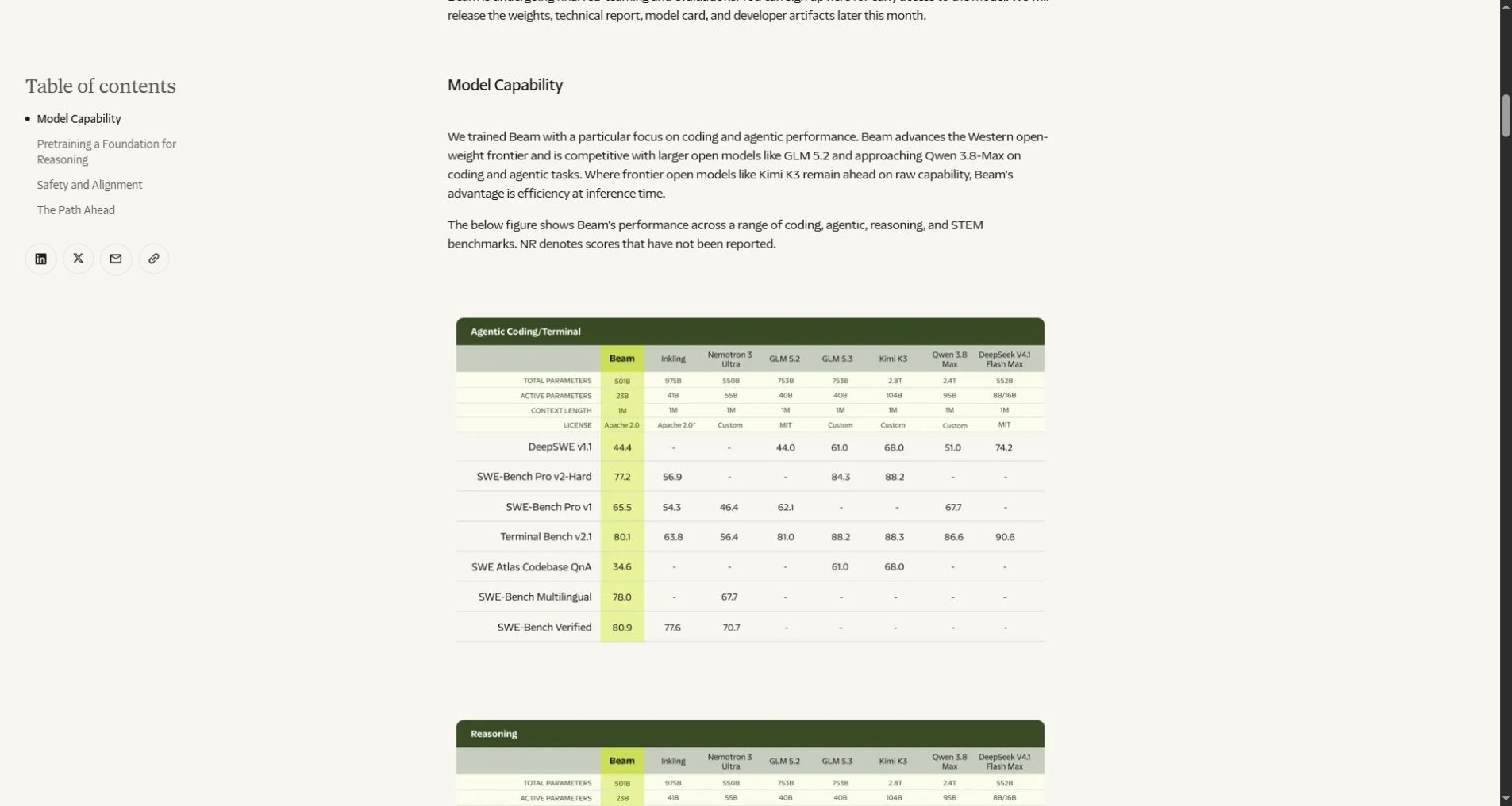
Treat that as a reason to investigate, not a forecast for your invoice. Your application might spend substantial time reading a long document, waiting for a tool or retrying a failed action. A cheaper generation step can coexist with an expensive overall workflow.
An efficiency comparison becomes more useful when the task, success condition and budget are held constant. For example, compare the total cost of getting a working patch accepted after review. Counting only the first response can reward a model that is fast initially but needs several rounds of repair.
Five questions to ask about any model benchmark
- Was the same task set used, with the same tools and time limits?
- How many attempts were allowed, and were failed attempts counted?
- Were reasoning settings, output limits and prompts comparable?
- Does the score measure a result that resembles your own workload?
- Can another evaluator reproduce the result with the released model?
Keep a short evidence log as you read comparisons. Record the source, publication date and evaluation setup beside each claim. A screenshot preserves what a vendor showed at a point in time, but it cannot replace the underlying evaluation details.
Where Beam could fit in a developer workflow
The following are suggested evaluation scenarios, not claims that we have tested Beam on them. They are designed to reveal whether an AI model makes useful decisions under ordinary constraints.
1. Fix a small, reproducible software bug
Choose a known bug in a non-sensitive sample project. Provide the failing test, a clear description of expected behavior and the relevant files. Ask for the smallest patch that fixes the issue without changing unrelated behavior.
Judge the result with tests and a human review. Check whether the model understands the failure, preserves existing behavior and explains any uncertainty. A convincing explanation should not compensate for a patch that breaks another requirement.
2. Investigate a repository before changing it
Give the assistant a specific question, such as where a configuration option is read and how its value reaches the user interface. Ask it to cite file paths and symbols. Begin with read-only access so that the task measures understanding rather than permission to alter the project.
This separates useful navigation from confident guessing. The reviewer should be able to follow every important claim back to the code. Unsupported references and invented files are failures even when the overall answer sounds plausible.
3. Run a bounded agent task
A model becomes part of an agent when software connects it to tools and a task loop. The surrounding system determines what it can inspect, execute or change. Our AI agents guide explains that relationship.
Start with a task such as preparing a change proposal in an isolated copy of a repository. Give it a time limit, a tool budget and a clear stopping condition. Require approval before it deploys, sends messages or changes access. Use the same limits for every candidate model.
Example evaluation request: Inspect this sample repository and explain why the supplied test fails. Cite the relevant files. Propose a minimal patch and list the checks needed to validate it. Do not deploy, install new dependencies or change unrelated files. Stop if essential information is missing.
Build a scorecard before requesting access
You do not need a complicated evaluation system to start. A small set of representative tasks, agreed success rules and a consistent review process will tell you more than an impressive one-off demo.
| Measure | What to record |
|---|---|
| Correctness | Did the answer or patch satisfy the task and survive review? |
| Evidence | Could the reviewer verify factual claims and file references? |
| Time | Total elapsed time, including tool calls and retries. |
| Cost | All requests and infrastructure used to complete the task. |
| Control | Did the assistant respect its permissions and stopping rules? |
| Review effort | How much human correction was necessary? |
Include easy, typical and difficult tasks. Keep a few previously unseen tasks for the final comparison so that prompt adjustments do not simply train your process around a small familiar set. Record partial successes separately from complete successes.
Also test what happens when information is missing. A useful assistant should ask for the missing requirement, explain the uncertainty or stop at a safe boundary. Include a task where the right response is to avoid making a change.
Open weights do not remove operational responsibility
Access to weights can give a team more deployment choices. It does not automatically make the resulting service private, inexpensive or reliable. A self-hosted application still has logs, storage, tool connections and people who administer the environment.
For a hosted preview, check the provider’s data handling, retention and access terms before submitting private material. For a self-managed deployment, map where prompts, outputs and tool results are stored. Use sample data until those decisions are settled.
The proposed weight license and any hosted-service terms should be reviewed separately. The Apache License 2.0 text is the primary source for that license. Verify the license files attached to the actual model release rather than relying on a marketing label.
If deployment location and control are central to the project, our sovereign AI guide offers additional background. For tool permissions and approval boundaries, see our AI agent safety guide.
What to check when the public release arrives
- Confirm the official download location and model version.
- Read the model card for intended uses, limitations and evaluation details.
- Check supported runtimes, precision options and hardware requirements.
- Verify the license and any separate conditions for hosted access.
- Re-run your task set against the release you would actually deploy.
- Keep a rollback plan and a human approval step for consequential actions.
A preview can be useful for exploration, but a production decision should reference a specific artifact and configuration. Save that information with the evaluation results. Otherwise, later changes in the model or serving system can make your comparison difficult to interpret.
Frequently asked questions
Can I download Reflection Beam AI now?
The announcement links to an early-access waitlist and describes a later public weight release. Check Reflection’s official page for a release update before looking for third-party downloads.
Does fewer active parameters mean it runs on my laptop?
No such conclusion follows from the active count alone. Memory, weight precision, runtime support and the full model size all matter. Use documented hardware requirements and a tested configuration.
Is Beam better than other coding models?
A vendor benchmark is useful evidence to examine, but it does not settle every workflow. Compare candidates on your own representative tasks with equal tools, budgets and review standards.
Should a small business switch immediately?
Start with a limited evaluation if the release or preview fits a real need. Keep the existing workflow available, use non-sensitive examples first and define the improvement required to justify a switch.
The practical takeaway
Reflection Beam AI is worth watching for teams interested in open-weight coding and agent systems. The next useful step is to examine the actual release documentation and test a small set of real tasks. Judge the model by verified results, total workflow cost and the effort required to keep its actions under control.
For another recent open-weight announcement, read our Mistral Large 4 overview. Use both announcements as starting points for evaluation rather than as substitutes for it.