
A clever prompt can improve one AI answer. A reliable AI system needs something broader: the right instructions, documents, memory, tool definitions and current state delivered at the moment the model needs them. Organizing that information is called context engineering.
The idea has become more important as chatbots evolve into AI agents that work across many steps. Every search result, file, message and tool output competes for limited attention. Adding everything can make an agent slower, more expensive and less accurate. Removing too much can make it forget the goal.
This guide explains context engineering in plain language, how it differs from prompt engineering and how to use its principles in everyday chats, research workflows and production AI agents.
Last reviewed: October 3, 2026
What Is Context Engineering?
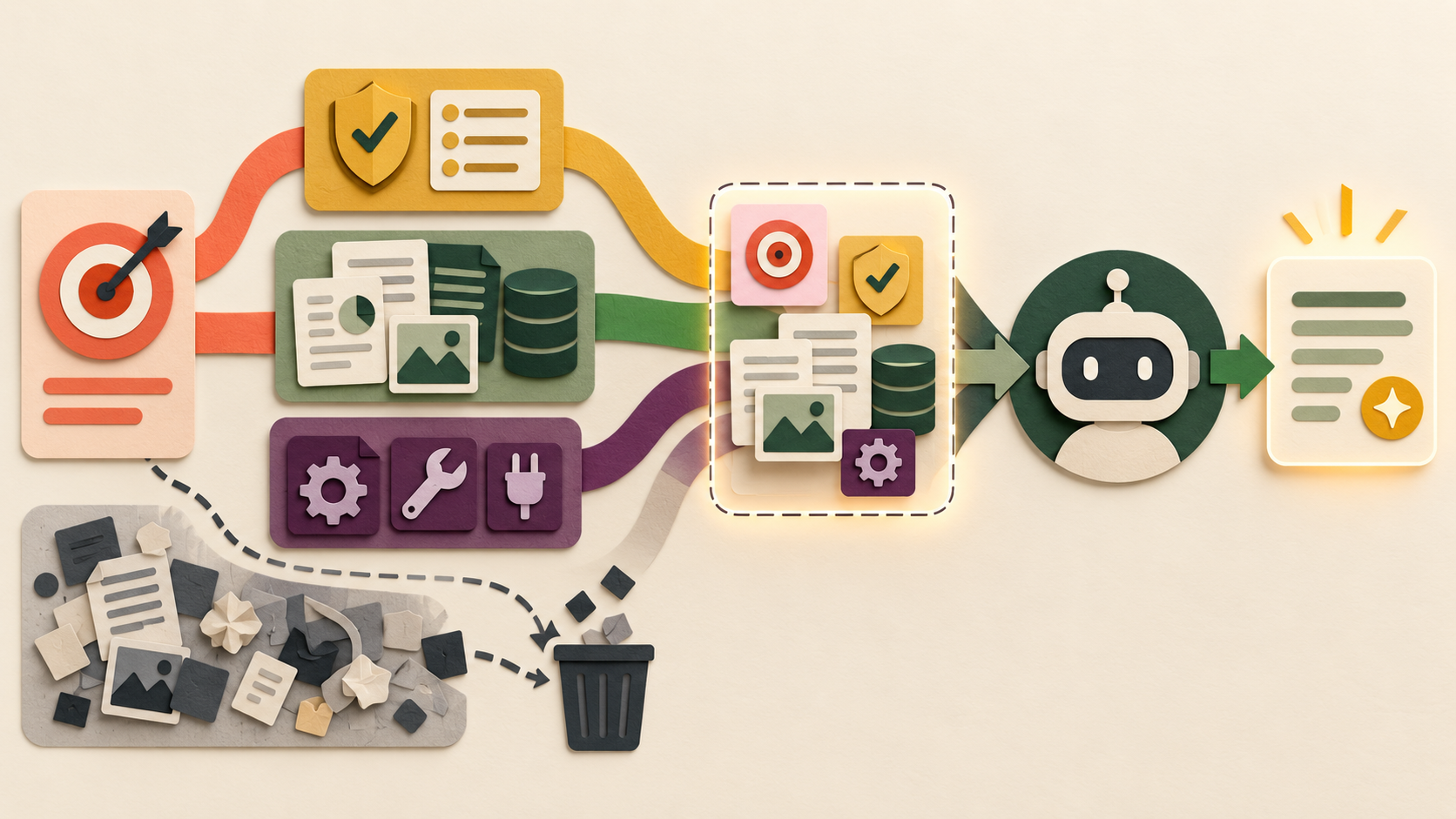
Context engineering designs the complete information environment around an AI model. Context can include the user’s request, system rules, conversation history, retrieved documents, examples, tool descriptions, user preferences, intermediate results and details about the current task.
Anthropic describes context engineering as a progression from prompt engineering: instead of optimizing only the wording of instructions, developers manage every token that may influence the model. Google’s Agent Development Kit takes a similar approach by separating durable sessions, searchable memory, large artifacts and the smaller working context sent to the model for one step.
A useful analogy is preparing a briefing folder for a specialist. Giving the specialist every document the company owns creates noise. Giving only a one-line request leaves dangerous gaps. A strong briefing contains the goal, essential rules, relevant evidence, available tools and the latest decisions.
Context Engineering vs. Prompt Engineering
Prompt engineering focuses mainly on how a request is written. It improves clarity through a defined goal, useful background, constraints, examples and a requested output format. Our AI prompt-writing guide covers those foundations.
Context engineering includes the prompt but also controls what surrounds it. It decides which older messages remain, which documents are retrieved, which tool results are summarized, when memory is consulted and what information should be withheld.
| Area | Prompt engineering | Context engineering |
|---|---|---|
| Main question | How should the instruction be written? | What should the model know at this step? |
| Typical scope | One request or reusable prompt | The full information lifecycle |
| Inputs | Goal, constraints, examples and format | Prompt, history, memory, files, tools and live state |
| Changes over time | Usually edited by a person | Often rebuilt for every model call |
| Main failure | Unclear or incomplete instruction | Missing, stale, excessive or unsafe information |
The two practices work together. A well-designed context cannot rescue a vague goal, and a perfect prompt cannot compensate for missing evidence or the wrong tool permissions.
Why More Context Is Not Always Better
Modern models can accept long documents, but capacity is not the same as attention. Relevant instructions may be buried between old messages, repeated logs and low-quality search results. Researchers often describe this as context degradation or the “lost in the middle” problem.
Large inputs also increase processing time and cost. If an agent carries a long API response through every later step, it repeatedly pays for information that may no longer matter. Sensitive data can spread into logs and model calls unnecessarily.
The better target is high signal density: enough verified information to complete the current step, with irrelevant and outdated material removed. Important evidence should remain traceable so the agent or a human reviewer can return to the source.
The Main Parts of AI Context
Instructions and policies
These define the agent’s role, goal, boundaries and required behavior. Stable rules should be concise and separated from temporary task details. Conflicting instructions need an explicit priority order.
Conversation and task state
Recent messages, decisions, completed steps and unresolved questions help the model continue coherently. Long sessions may need summaries so older history does not overwhelm the current task.
Retrieved knowledge
A retrieval system can select relevant passages from documents or databases. This is closely related to retrieval-augmented generation. Good retrieval preserves titles, dates and source links while filtering weak matches.
Memory
Memory may store user preferences, previous decisions or facts that survive beyond one session. Useful memory should be specific, reviewable and easy to correct. Sensitive information should not be saved merely because it appeared in a conversation.
Tools and live results
Tool descriptions tell an agent what actions are available and which inputs they require. Search results, calculations and database records update the context with current evidence. Tool access should follow least privilege so the agent sees and does only what the task requires.
A Practical Context Engineering Workflow
1. Define the decision or output
Start with the result required now. “Help with marketing” is broad. “Draft three email subject lines for returning customers using this approved offer” gives the system a clear target and prevents unrelated context from entering the task.
2. Separate stable rules from temporary facts
Brand rules, safety limits and output standards may remain stable. The current campaign, deadline and audience can change. Keeping them separate makes updates safer and allows stable instructions to be reused or cached.
3. Retrieve only relevant evidence
Search using the current question, apply access controls and return a small set of strong passages. Include enough surrounding text to interpret each passage correctly. Prefer current primary sources when facts can change.
4. Compress bulky history
Summarize completed work into decisions, constraints, evidence and remaining tasks. Keep original artifacts available by reference rather than pasting the entire file into every model call. OpenAI’s guidance on agent sessions describes trimming and compression as two practical ways to control long-running history.
5. Validate before action
Check whether the working context contains the current goal, required source material and correct permissions. Before a message, purchase, upload or account change, show the prepared action to a human and require approval.
6. Evaluate and improve
Record which context was supplied, what the model produced and why the result failed or succeeded. Test changes against representative tasks. A useful system can reproduce its context-building process instead of depending on hidden prompt edits.
Context Engineering for Everyday AI Users
You do not need to build an agent framework to use these ideas. When a conversation becomes long or confused, start a fresh chat with a compact briefing. Attach only the documents needed for the next task and identify which source should control when information conflicts.
Goal: State the result needed now.
Background: Include only facts that change the answer.
Sources: Name or attach the relevant documents and dates.
Constraints: List limits, policies and facts the AI must not invent.
Output: Specify the format and level of detail.
Verification: Ask the AI to distinguish sourced facts, assumptions and uncertainties.
For example, instead of pasting a year of meeting notes, provide the latest project brief, a short decision summary and the three unresolved questions. Ask the model to request missing information rather than guessing.
Common Context Engineering Mistakes
- Context dumping: adding every file and message without ranking relevance.
- Stale memory: carrying an old preference or decision after it has changed.
- Missing provenance: giving facts without dates, titles or source links.
- Instruction collisions: combining rules that contradict one another.
- Unsafe retrieval: allowing an agent to search information the user is not permitted to access.
- Tool overload: exposing many similar tools and making selection less reliable.
- Untrusted instructions: treating text inside webpages or files as commands rather than data.
- No evaluation: changing prompts and retrieval rules without testing the full workflow.
That seventh mistake matters for browsing and document agents. A malicious page can contain prompt injection designed to redirect the agent. The system should separate trusted instructions from untrusted content, restrict tools and require approval for consequential actions. Our AI agent safety guide explains these controls in more detail.
How to Measure Context Quality
Accuracy alone is not enough. A context pipeline should also be measured for cost, latency, source coverage, privacy and stability. Test whether the agent selects the correct tool, cites the right evidence, ignores irrelevant documents and preserves critical constraints over long tasks.
Useful test cases include contradictory documents, outdated policies, very long tool outputs and requests that require information the system does not have. The best result may be a clear refusal or a request for clarification rather than a confident answer.
| Metric | Question to ask |
|---|---|
| Relevance | Did the model receive the information needed for this step? |
| Faithfulness | Does the answer match the supplied sources? |
| Efficiency | Were unnecessary tokens and tool calls removed? |
| Freshness | Were time-sensitive facts current and dated? |
| Security | Were access controls and trust boundaries respected? |
| Continuity | Did summaries preserve decisions and unfinished work? |
Frequently Asked Questions
Is context engineering replacing prompt engineering?
No. Prompt engineering remains one part of context engineering. Clear instructions are essential, but agents also need managed history, evidence, memory and tools.
What is a context window?
A context window is the amount of tokenized information a model can consider during a response. It may contain instructions, messages, documents and tool results. A larger window does not guarantee that every detail receives equal attention.
What is context compression?
Context compression reduces long history or documents into a smaller representation that preserves important facts, decisions and unresolved work. The original material should remain available when exact details are needed.
Is RAG the same as context engineering?
No. RAG retrieves external information for a model. Context engineering is broader and also manages instructions, history, memory, tools, permissions and intermediate state.
Can context engineering prevent hallucinations?
It can reduce unsupported answers by supplying better evidence and verification rules, but it cannot eliminate errors. Important claims still require checking against original sources. See our guide to AI hallucinations.
The Right Information at the Right Time
Context engineering turns an AI interaction from a pile of text into a controlled information system. It decides what the model sees, what it can retrieve, which tools it may use and how the working state changes across steps.
The practical principle is simple: provide enough trusted information for the current decision, preserve traceability and remove everything that adds cost or confusion without helping the result. You can apply that principle when using Unlimited AI, building a chatbot or operating a complex multi-agent workflow.
Sources: Anthropic: Effective context engineering for AI agents; Google Developers: Context-aware multi-agent architecture; OpenAI Cookbook: Session memory and context engineering.