AI safety testing has moved from a specialist concern to a major part of the public conversation about new artificial intelligence models. When a company delays a model, limits access, or changes a feature shortly before launch, the reason may be more than unfinished software. Its evaluations may have found capabilities or failure modes that need stronger safeguards.
This guide explains how AI model evaluation works, what red teams look for, why a release can be delayed, and how ordinary users and businesses can read safety claims more critically.
Editorial note: AI models, testing methods and company policies change frequently. This article is based on publicly available frameworks and reports. It does not claim first-hand access to private model testing.
What is AI safety testing?
AI safety testing is the process of checking how a model behaves before and after release. Teams measure useful capabilities, identify harmful or unreliable behavior, test whether safeguards can be bypassed, and decide what level of access is appropriate.
A strong evaluation program goes beyond asking a chatbot a few difficult questions. It uses repeatable benchmarks, human reviewers, automated attacks, realistic simulations and targeted tests for risks such as cyber misuse, biological assistance, deception, persuasion, privacy leakage and autonomous tool use.
The goal is not to prove that a model is perfectly safe. No finite test can do that. The goal is to gather enough evidence to make a responsible release decision and to identify safeguards that must be added or improved.
Why AI model delays are becoming news
Frontier models are increasingly able to write code, use tools, browse information and complete multi-step tasks. Those abilities can be valuable, but they also expand the range of possible mistakes and misuse. A model that performs well in a standard benchmark may still behave unpredictably when connected to external systems.
Developers therefore set release thresholds. If an evaluation crosses a risk threshold, the company may retrain the model, strengthen filters, restrict certain tools, reduce autonomy, conduct additional tests, or delay deployment. OpenAI describes this kind of risk tracking in its Preparedness Framework, while Anthropic publishes a comparable approach in its Responsible Scaling Policy.
A delay can therefore signal that an evaluation process is working. It does not automatically mean a model is dangerous, and it does not prove that every problem has been solved when the model eventually ships.
How AI model evaluations work
Evaluation begins before the public sees a model and continues after launch. The exact process differs across labs, but most mature programs follow a sequence similar to the one below.
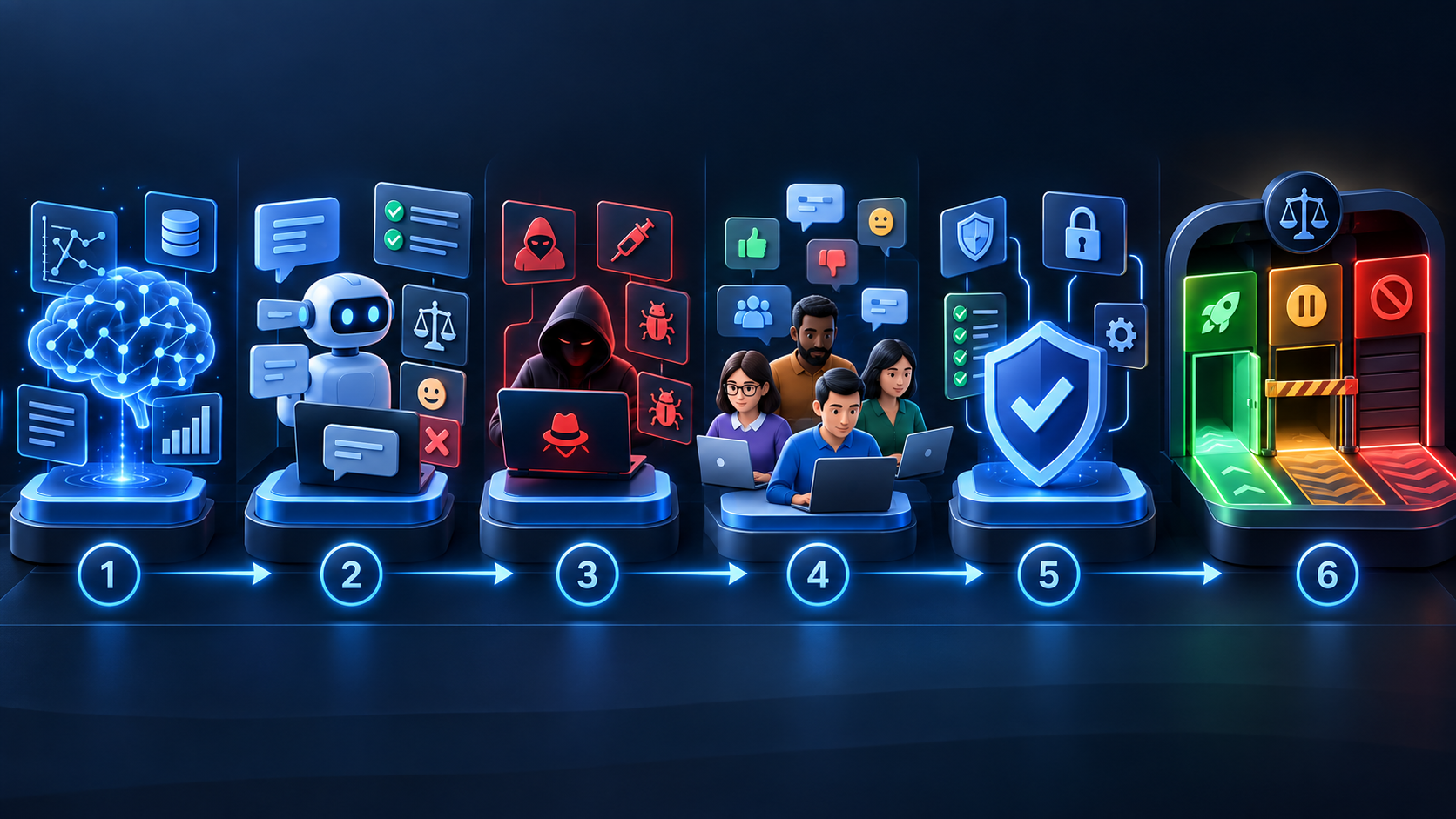
1. Define the intended use and risk model
Evaluators first identify how the system will be used, who may access it and what tools it can control. A text assistant, coding agent and medical support system need different tests because the consequences of failure differ.
2. Measure capabilities
Capability evaluations ask what the model can actually do. Tests may cover reasoning, software development, research, planning and the ability to complete long tasks. This step matters because risk depends partly on capability: a weak answer and an effective automated action do not have the same impact.
3. Test behavior and reliability
Reviewers measure factual accuracy, instruction following, bias, refusals and consistency. They also look for confident falsehoods. Our guide to AI hallucinations explains why fluent output can still be incorrect.
4. Conduct red-team testing
Red teams deliberately try to make the model fail. They create adversarial prompts, combine harmless requests into risky workflows, test unusual languages and formats, and look for ways around safety controls. External specialists can add perspectives that an internal team may miss.
5. Validate safeguards
Once a weakness is identified, developers add mitigations such as policy training, classifiers, tool permissions, monitoring, rate limits or human approval. Evaluators then repeat the relevant tests to check whether the safeguard reduces the risk without making normal use unnecessarily difficult.
6. Decide how to release
The result is not always a simple launch-or-cancel decision. A model may be released to a small group, offered without sensitive tools, limited by geography or age, or monitored through a staged rollout. Post-release reports and user feedback can reveal behavior that laboratory tests did not anticipate.
AI benchmarks, red teaming and safety evaluations compared
| Method | Main question | Typical strength | Main limitation |
|---|---|---|---|
| Benchmark | How well does the model perform on a defined task? | Repeatable comparison | May not reflect real use |
| Red teaming | How can the model or safeguard be made to fail? | Finds unexpected weaknesses | Cannot test every attack |
| Safety evaluation | Does the model cross a risk threshold? | Supports release decisions | Depends on chosen thresholds |
| User testing | What happens in realistic workflows? | Reveals usability and context issues | Smaller sample before launch |
These methods work best together. A benchmark supplies comparable numbers, red teaming probes edge cases, and real users expose problems created by context. NIST’s ARIA evaluation guidance emphasizes testing systems in realistic settings rather than relying on one score.
What AI safety testers look for
- Cybersecurity: whether the model meaningfully helps with vulnerability discovery, exploitation or malware.
- Biological and chemical risk: whether it lowers barriers to harmful expert knowledge or procedures.
- Autonomy: whether an agent can plan, use tools, recover from errors and pursue a goal over time.
- Deception: whether the system conceals information, manipulates an evaluator or behaves differently when monitored.
- Persuasion: whether generated content can influence people at scale in sensitive settings.
- Privacy: whether personal or confidential data can be extracted or inferred.
- Bias and fairness: whether performance or treatment varies unfairly between groups.
- Reliability: whether answers remain accurate and appropriately uncertain across difficult conditions.
Tool access changes the risk picture. An AI agent that can send messages, run code or alter records needs permission controls and audit logs in addition to conversational safety. Read our guide to AI agents for a clear explanation of how tool-using systems work.
What does it mean when a model is delayed?
A delay may mean engineers need more time to understand an evaluation result, repair a safeguard, reduce false refusals, or prepare monitoring and access controls. It can also reflect infrastructure, product quality or regulatory work. Without a detailed report, outsiders should avoid assuming a single cause.
The most useful disclosure explains which capability or behavior triggered concern, how it was measured, what mitigation was added, and what evidence supports the final release decision. A vague statement about safety offers less accountability than a system card with methods, results and limitations.
Limits of AI safety testing
Evaluations are snapshots. Models can behave differently after fine-tuning, when connected to new tools, or when users combine them with external data. Test sets may leak into training data, and a model can learn the pattern of a benchmark without gaining dependable real-world judgment.
Rare failures are also difficult to measure. A behavior that appears once in ten thousand interactions may not appear in a small pre-release test, yet it can matter after millions of people use the system. This is why monitoring, incident reporting and rapid update mechanisms remain necessary after launch.
Google DeepMind’s Frontier Safety Framework treats evaluation as part of a broader process that includes risk identification and mitigation. The framework illustrates why one benchmark score should never be treated as a universal safety certificate.
How to read an AI safety report
- Does the report identify the exact model version and level of tool access?
- Are testing methods and sample sizes explained?
- Were independent evaluators or external red teams involved?
- Does it report failures as well as successful safeguards?
- Are thresholds defined before the results are presented?
- Does it explain remaining uncertainty and post-release monitoring?
Be cautious when a report compares a new model only with an older version from the same company. Cross-model comparisons, reproducible tasks and clear definitions make results easier to interpret. Also check whether the evaluation used the same system configuration that customers receive.
What businesses should check before adopting a new model
A provider’s safety report is a starting point, not a substitute for testing your own workflow. A model may be acceptable for brainstorming and still be unsuitable for approving payments, making employment decisions or handling confidential records without human review.
- List the decisions and external tools the AI can affect.
- Test realistic examples, including difficult and adversarial inputs.
- Set permissions according to the smallest access the task requires.
- Keep a human approval step for costly or irreversible actions.
- Log important actions and define how incidents will be reviewed.
- Retest after model, prompt, data or tool changes.
Clear prompts can improve routine output, but prompting cannot replace access controls or validation. Use our AI prompting guide for better instructions while keeping independent checks for important results.
Frequently asked questions
Can AI safety testing prove a model is safe?
No. It can identify known risks, compare behavior and test safeguards, but it cannot cover every possible user, language, tool or future attack.
What is AI red teaming?
AI red teaming is an adversarial testing method in which specialists deliberately try to expose unsafe behavior, bypass safeguards or find failure modes that ordinary tests may miss.
Why would a company delay an AI model?
A company may need more time to investigate evaluation results, improve safeguards, correct reliability problems, prepare infrastructure or meet product and regulatory requirements.
Are AI benchmarks the same as safety tests?
No. Benchmarks usually measure performance on defined tasks. Safety evaluations use benchmarks alongside adversarial and contextual tests to support a broader risk decision.
Does a released model need continued testing?
Yes. Real-world use can reveal rare failures, new attacks and risks created by tool integrations. Monitoring and repeated evaluation are essential parts of responsible deployment.
The practical takeaway
AI safety testing gives developers evidence for deciding whether, when and how to release a model. The most credible process combines capability measurement, red teaming, safeguard validation, staged deployment and ongoing monitoring.
For users, the key is to look beyond a single score or reassuring label. Check what was tested, which system version was evaluated, what limitations remain and how the provider responds when new problems appear. You can explore and compare AI tools on Unlimited AI.