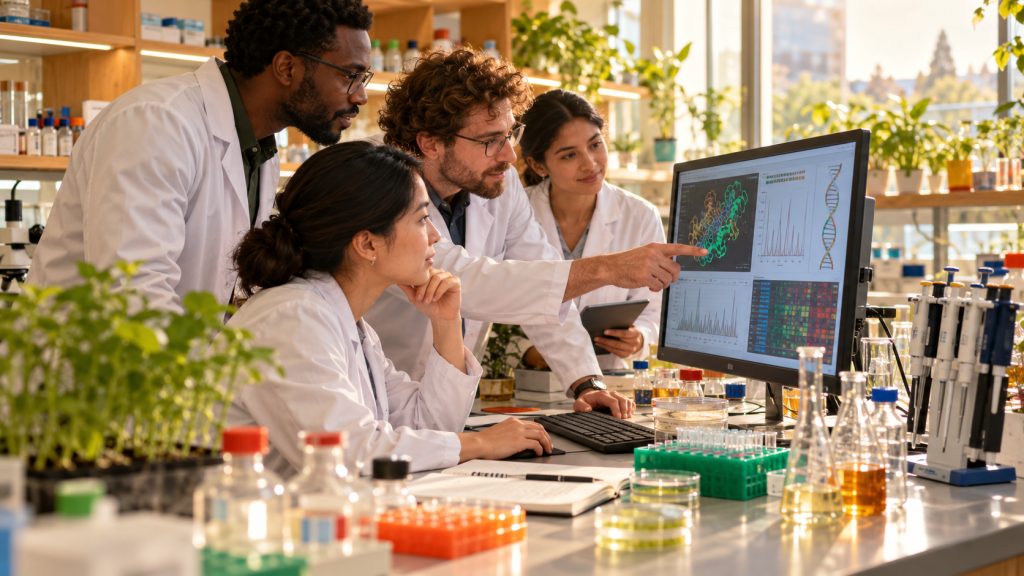
Artificial intelligence is beginning to do more than summarize papers or organize references. In a recent biology project, an AI system helped scientists identify a previously unknown enzyme system, turning a large search problem into a set of hypotheses that could be tested in a laboratory.
This is an early but useful example of AI scientific discovery: researchers combine machine reasoning, biological data and physical experiments to find patterns that humans may not discover as quickly on their own. The result does not mean laboratories can run without scientists. It shows how AI can narrow the search space while people choose the questions, design tests and decide whether the evidence is convincing.
Last reviewed: October 1, 2026
What Is AI Scientific Discovery?
AI scientific discovery is the use of machine learning and generative models to help form, evaluate or prioritize scientific ideas. A system might search millions of molecules, compare protein sequences, notice an unusual relationship in a dataset or propose an experiment that would distinguish between competing explanations.
The important word is help. A model can produce a plausible hypothesis, but plausibility is not proof. A scientific claim becomes credible only when researchers test it against observations, controls and independent replication. This is also why researchers must watch for AI hallucinations: fluent explanations can contain errors or unsupported connections.
What Did Claude Reportedly Discover?
On September 23, 2026, Anthropic reported that Claude, working under the high-level direction of scientists, helped identify a novel enzyme system associated with repeating DNA sequences. Anthropic described the genetic arrangement as reminiscent of CRISPR, although that comparison does not mean it has the same function or is ready for medical use.
According to Anthropic’s account of the project, the model assisted with searching biological information, connecting clues and suggesting candidates. Researchers then used laboratory experiments to test whether the proposed system behaved as predicted.
The careful interpretation is significant: an AI-assisted process generated a testable biological hypothesis that reportedly survived initial wet-lab validation. It is not evidence that an AI independently completed the full scientific process, proved a treatment or replaced expert judgment.
How an AI-Assisted Discovery Workflow Works
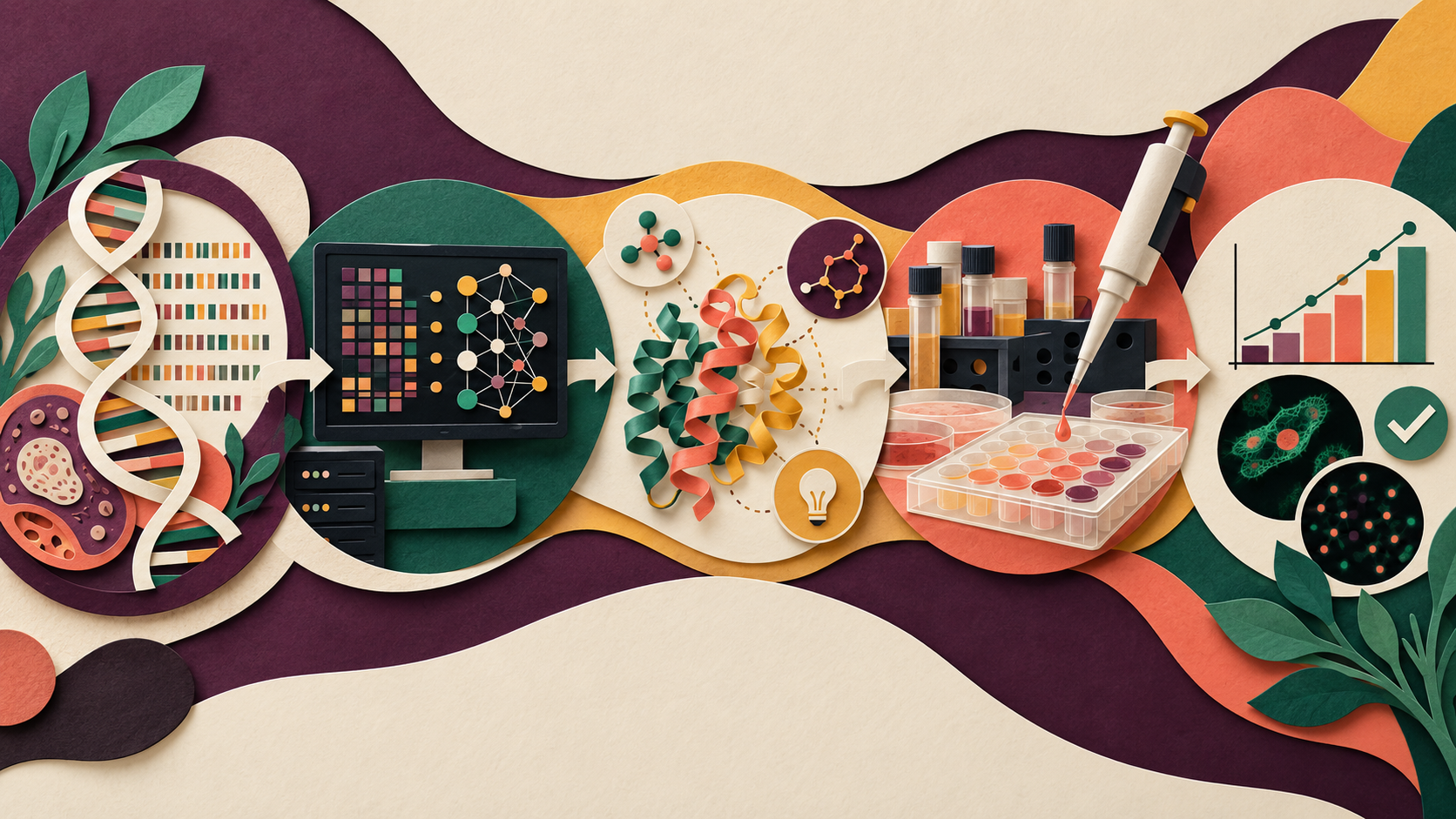
Scientific discovery rarely follows a perfectly straight path, but AI-assisted projects often include six connected stages.
1. Define a Narrow Research Question
Scientists decide what they want to understand and what evidence could answer the question. This step sets boundaries that prevent the model from wandering through an enormous space of interesting but irrelevant possibilities.
2. Search Large Scientific Datasets
An AI system can compare sequences, papers, structures or experimental records at a scale that would be slow for a small research team. It may retrieve candidate genes or proteins whose features match the research objective.
3. Detect Patterns and Generate Hypotheses
The model looks for relationships that deserve investigation. It might notice that a protein family repeatedly appears beside a certain DNA pattern, then propose a possible function. At this stage, every output remains a hypothesis.
4. Rank the Most Informative Experiments
Laboratory time and materials are limited. AI can help prioritize candidates by estimating which experiment has the best chance of producing useful information. Scientists still review feasibility, controls, safety and cost.
5. Test Predictions in the Physical World
Researchers synthesize materials, run assays or collect observations. A biological model cannot substitute for this stage because living systems contain interactions, noise and conditions that may be absent from training data.
6. Interpret, Replicate and Report
Scientists compare results with controls, revise the hypothesis and document methods so others can repeat the work. Independent replication matters more than a compelling announcement.
Where AI Can Help Scientists Today
The same workflow can support many fields. The tools, evidence standards and risks differ, so researchers must adapt them to each discipline.
| Research task | How AI can help | What still needs human or physical validation |
|---|---|---|
| Literature review | Find relevant papers and map competing claims | Check citations, study quality and missing evidence |
| Biology and genomics | Compare sequences and predict structure or function | Run assays and confirm behavior in real systems |
| Drug and materials discovery | Generate and rank candidate molecules | Test safety, stability, effectiveness and manufacturing |
| Climate and physics | Build surrogate models and detect patterns | Compare with observations and known physical laws |
| Experimental planning | Suggest variables, controls and high-value tests | Review ethics, feasibility and causal interpretation |
| Laboratory automation | Schedule repetitive workflows and record results | Maintain calibration, safety and accountable oversight |
For readers choosing tools, our guide to the best AI for research explains how assistants differ for search, analysis, writing and citations.
Why Laboratory Validation Still Matters
AI models learn statistical relationships from existing information. They can suggest what may be true, yet a pattern can arise from biased samples, measurement errors or an unrelated variable. The more surprising a claim is, the more carefully researchers should test alternative explanations.
Wet-lab experiments create evidence outside the model’s text or training distribution. Controls show whether an observed effect depends on the proposed mechanism. Repeated experiments estimate how stable the result is, while independent teams reveal whether a finding survives different equipment, samples and assumptions.
This separation between prediction and verification is one of the healthiest features of AI-assisted science. A model can be creative without receiving the final authority to declare its own idea correct.
The Main Benefits of AI in Scientific Research
- Scale: AI can screen far more sequences, molecules or papers than a person can inspect manually.
- Speed: Automated search and first-pass analysis can reduce time spent on routine information work.
- Cross-field connections: Models may connect ideas described with different terminology across biology, chemistry, medicine or engineering.
- Experiment prioritization: Ranking candidates can direct scarce laboratory resources toward the most informative tests.
- Better records: Structured prompts, code and machine-readable logs can improve traceability when teams preserve them carefully.
Google’s September 2026 AI & Economy research summary, drawing on work with Google DeepMind and MIT researchers, reported that nearly half of surveyed scientists used AI daily and that users estimated almost seven hours of weekly time savings. These are survey findings rather than a universal measure, but they suggest that scientific bottlenecks may shift from information work toward validation, equipment and physical experimentation.
Risks and Limits
Faster hypothesis generation can produce more good ideas, but it can also produce more convincing mistakes. Research teams need processes that make errors visible before they spread into papers, products or policy.
- Fabricated evidence: A model may invent a paper, citation, sequence feature or mechanism.
- Biased datasets: Predictions may fail for populations, environments or materials missing from the data.
- False discovery: Searching enough variables can surface accidental correlations that appear meaningful.
- Automation bias: People may accept polished output without applying normal scientific skepticism.
- Reproducibility gaps: Undocumented prompts, model updates and private datasets can make results difficult to repeat.
- Safety and dual use: Some biological or chemical capabilities require controlled access, monitoring and specialist review.
Organizations can use the NIST AI Risk Management Framework as one reference for documenting risks, assigning responsibility and measuring whether safeguards work.
A Responsible Checklist for Researchers
Before treating an AI output as a scientific lead:
- Define the question and success criteria before asking the model.
- Verify every citation and factual claim against the original source.
- Separate exploratory model output from confirmed findings.
- Use positive, negative and blinded controls where appropriate.
- Record model version, settings, prompts, code and data provenance.
- Ask domain experts to challenge assumptions and alternative explanations.
- Test on held-out data and, when possible, in a physical experiment.
- Report failures and uncertainty, not only successful predictions.
- Arrange independent replication before making a strong public claim.
Clear prompts can improve the exploratory stage, but they cannot repair weak evidence. Our AI prompt writing guide shows how to state goals, context, constraints and quality criteria for more reviewable outputs.
Will AI Replace Scientists?
The near-term pattern is collaboration. AI handles broad searches, drafts analyses and proposes candidates. Scientists decide which questions matter, recognize when an assumption is biologically implausible, design safe experiments and accept responsibility for conclusions.
More capable AI agents may coordinate tools and multi-step research workflows. Even then, accountable oversight and external validation remain necessary because an automated chain can repeat an early error across every later step.
What This Means for Everyone Else
For students, AI scientific discovery is a reason to learn statistics, experimental design and source evaluation alongside prompting. For businesses, it may shorten early research cycles, but promising model output should not be marketed as a proven product. For the public, the best signal is transparent evidence: methods, controls, peer review, replication and clear limits.
The Claude enzyme report is interesting because the AI-assisted idea moved into a laboratory test. The next questions are whether independent researchers reproduce the result, what the enzyme system does in nature and whether it leads to useful applications. Those steps will determine its lasting scientific value.
Frequently Asked Questions
What is AI scientific discovery?
It is the use of AI to help search scientific information, detect patterns, generate hypotheses, prioritize experiments or analyze results. Human review and real-world validation remain essential.
Did Claude discover a new enzyme by itself?
No. Anthropic says Claude worked under high-level direction from scientists, helped identify a candidate enzyme system and contributed to a process that included laboratory testing by researchers.
Can an AI model prove a scientific claim?
A model can generate or analyze evidence, but its answer alone is not proof. Credible claims require appropriate experiments, controls, transparent methods and replication.
Which fields use AI for discovery?
Common areas include biology, medicine, chemistry, materials science, climate research, astronomy and physics. Each field uses different data and validation standards.
What is the biggest risk of AI-assisted science?
A major risk is mistaking a plausible model output for verified knowledge. Strong workflows separate hypothesis generation from validation and require experts to investigate errors, bias and alternative explanations.
The Next Stage of Discovery
AI can make scientific exploration faster and broader, but trustworthy discovery still depends on patient verification. The most valuable systems will help researchers ask better questions, expose their reasoning to scrutiny and move promising ideas toward reproducible evidence.
Try the research and writing tools available on Unlimited AI, and treat every generated claim as a starting point for checking rather than a finished scientific conclusion.