
A research proposal can sound convincing and still miss the most important paper in its field. It can also ask a useful question but propose an experiment that cannot answer it. Those gaps are difficult to notice when brainstorming, searching and writing happen in separate windows.
LitPivot, a research system developed by Ai2 with University of Pennsylvania collaborators, puts those activities into a connected workflow. Its central idea is to revisit the literature as a proposal changes, rather than assess every revision against a fixed reading list.
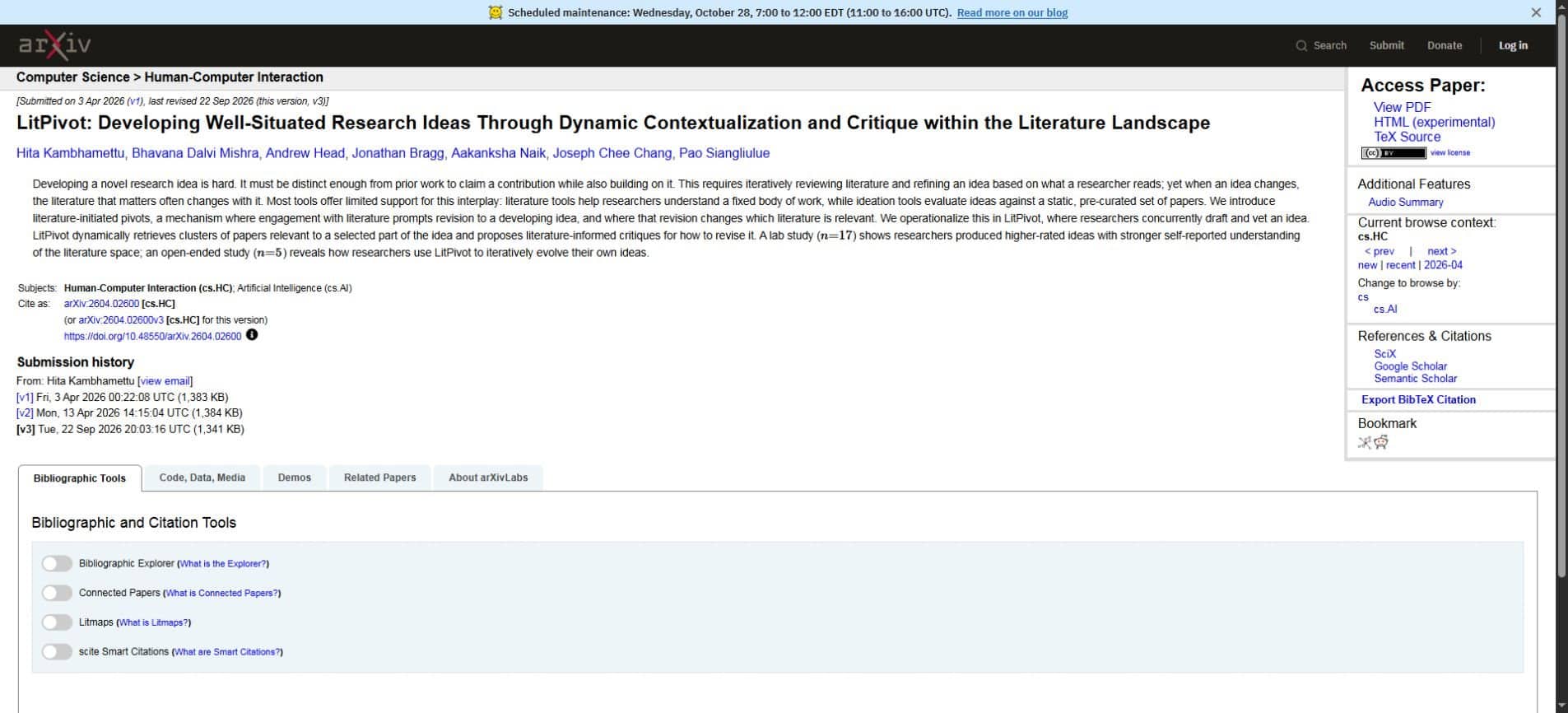
Ai2 highlighted the work on October 23, 2026. The research itself predates that announcement: the LitPivot paper on arXiv was first submitted in April and revised in September. The new announcement is an opportunity to examine the approach, not evidence that an entirely new study happened yesterday.
Start with the decision, not the polished paragraph
The most useful question for an AI research assistant is often not “Can you write this better?” It is “What would make me change this idea?” A fluent rewrite can preserve a weak assumption. A relevant study can reveal that the assumption needs to change.
The Ai2 announcement describes a system that organizes papers around the selected part of a proposal, links critiques to supporting excerpts and lets the researcher accept, edit or reject revisions. Its three main facets are the problem, proposed contribution and evaluation plan.

That separation is useful even before choosing any software. A problem explains what needs attention. A contribution states what the project adds. An evaluation explains how the researcher will find out whether that addition works. Mixing all three into one ambitious sentence can hide a mismatch.
Three parts of a proposal, three different checks
The problem: is the need real?
Imagine a proposal to help first-year students judge whether an online source is reliable. This is an illustrative example, not a participant result from the LitPivot study. Before designing an assistant, the researcher should ask which students have this difficulty, in what setting and with what consequences.
A useful reading list would include studies of the underlying problem, not only papers about the proposed technology. Evidence that students struggle to evaluate health claims, for example, would not automatically establish the same difficulty for every subject or age group.
An AI assistant can help identify passages to investigate, but the researcher should read enough context to understand the population, method and limitations. The aim is to build a justified problem statement, not accumulate citations around a sentence already decided.
The contribution: what changes compared with prior work?
Suppose earlier research already tests a chatbot that rates sources. The project needs more than a new interface color or a different model name to support a strong novelty claim. It might investigate how students explain a judgment, whether feedback transfers to unfamiliar sources, or when assistance becomes counterproductive.
These are possible directions, not established gaps. Each would require a fresh literature check. A search result that fails to show an earlier study is not proof that no such study exists.
A practical contribution statement should name the change and its expected value. “We add explanations” is less informative than a statement about which explanations, for whom, in which task and why existing evidence leaves the question unresolved.
The evaluation: would the test answer the question?
If the project claims to improve students’ independent judgment, measuring whether they like the chatbot is insufficient. Satisfaction can matter, but it is a different outcome. The evaluation should reflect the contribution actually being proposed.
For this example, a researcher might consider performance on unfamiliar sources, the quality of students’ explanations and whether any improvement persists without assistance. Appropriate methods depend on the field, research setting and relevant review requirements.
A quick consistency test: finish these three sentences separately: “The problem is…”, “Our project adds…”, and “We will know it helped when…”. If the third sentence cannot test the second, revise the plan before polishing the prose.
Why the reading list should change with the idea
The research paper frames idea revision and literature selection as an iterative process. A change in direction can make a different set of papers relevant. LitPivot brings that relationship into the drafting workflow instead of treating retrieval as a one-time preparation step.
In the student example, a shift from source rating to independent learning would change the search. Papers about classification accuracy might become less central, while studies of learning transfer and feedback become more important. The original reading list would still be useful, but it would no longer define the whole project.
This is also where AI can reinforce a mistaken direction. If every follow-up request asks for evidence supporting the current proposal, the assistant may keep producing a more persuasive version of the same idea. Ask explicitly for conflicting evidence and closely related alternatives.
Read the study result carefully
The paper reports a lab study with 17 researchers and an open-ended study with five. Ai2 says domain experts rated proposals developed with LitPivot as better grounded in the literature than proposals from a text-editor-and-AI-chat baseline. Participants also reported benefits to their understanding and ideas.
That is an encouraging result about a research workflow. It is not proof that the system produces correct discoveries, guarantees novelty or improves every discipline. A proposal’s grounding, a participant’s perception and the eventual success of a scientific project are different outcomes.
Small studies can reveal useful interaction patterns while leaving broader questions open. Long-term use, different fields, unfamiliar literature and independent replication would all help establish where this approach works best. We have not independently tested LitPivot or reproduced the study.
A research notebook method you can use now
You do not need to assume public access to LitPivot to use the underlying discipline. The following is our suggested workflow for working with literature and an AI assistant. It is not a claim about the system’s interface or a substitute for reading the original studies.
- Write the problem, contribution and evaluation as three short statements.
- For each statement, record the evidence it depends on and the uncertainty that remains.
- Collect relevant papers, including work that might undermine the proposal.
- Ask for a critique of one statement at a time, with exact source locations.
- Check the cited passages and decide which revisions are justified.
- After changing one statement, review the other two and update the reading list.
Keep an “idea changed because” note after each substantial revision. It can be only two sentences: what changed and which evidence led to the change. This makes a project’s development easier to explain to a supervisor, collaborator or future reader.
Our context engineering guide discusses why relevant background and constraints matter to an assistant. In research, context should include what the sources actually establish, not only the conclusion the writer hopes to reach.
What to record beside every important claim
| Record | Why it helps |
|---|---|
| The source and exact location | Makes the evidence easier to inspect |
| The study population and setting | Prevents an overly broad interpretation |
| What was measured | Separates the outcome from a stronger claim |
| A relevant limitation | Keeps uncertainty visible during revision |
| What would change your mind | Encourages a meaningful search for contrary evidence |
For example, “participants preferred the tool” and “participants learned more” require different evidence. A citation attached to both statements does not make them equivalent. The same care applies when an AI assistant converts a cautious abstract into a confident summary.
Questions to ask before adopting an AI ideation tool
Does it show evidence you can inspect?
Look for traceable references and enough surrounding context to evaluate a critique. A list of plausible titles is not enough. Check that the cited paper exists, that the passage supports the claim and that a limitation elsewhere in the paper does not change the interpretation.
Can you challenge its choice of literature?
The tool should support your judgment rather than hide the reading list behind a confident verdict. Consider whether you can add overlooked work, remove irrelevant papers and revisit the search after changing the question.
Is the system available for your intended use?
A research announcement, paper and public application are different things. Check official project information for current access, terms and supported features. The announcement links to Asta Paper Finder as the retrieval service used in the workflow; that alone does not establish that LitPivot is a generally available Asta feature.
The researcher still owns the pivot
A useful assistant should make a revision easier to assess, not pressure the writer to accept it. Sometimes the right decision is to narrow a claim. Sometimes it is to keep the question and design a stronger test. Sometimes the literature is too incomplete to justify a confident answer.
Our article on AI overreliance and critical thinking explains why retaining that decision matters. In research, the responsibility includes checking sources and being able to explain the reasoning without simply referring back to the model.
LitPivot’s interesting contribution is the attention it gives to the movement between ideas and evidence. For readers following AI research news, the question to watch is whether tools make this reasoning more visible and testable over time. A better-looking proposal is useful; a clearer account of why it deserves investigation is more valuable.
Reviewed October 24, 2026. Reporting is based on Ai2’s announcement and the linked research paper. The student-research example, notebook method and evaluation suggestions are editorial illustrations, not findings from the LitPivot studies.