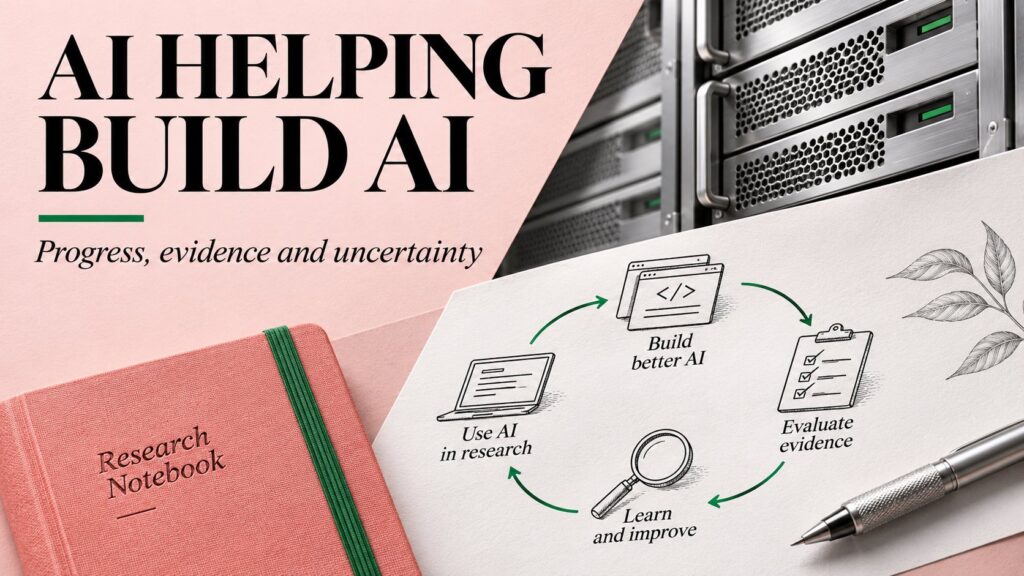
If AI helps researchers write code, run experiments and interpret results, could it also help them build the next generation of AI more quickly? That feedback loop is moving from a theoretical discussion into something researchers are trying to measure.
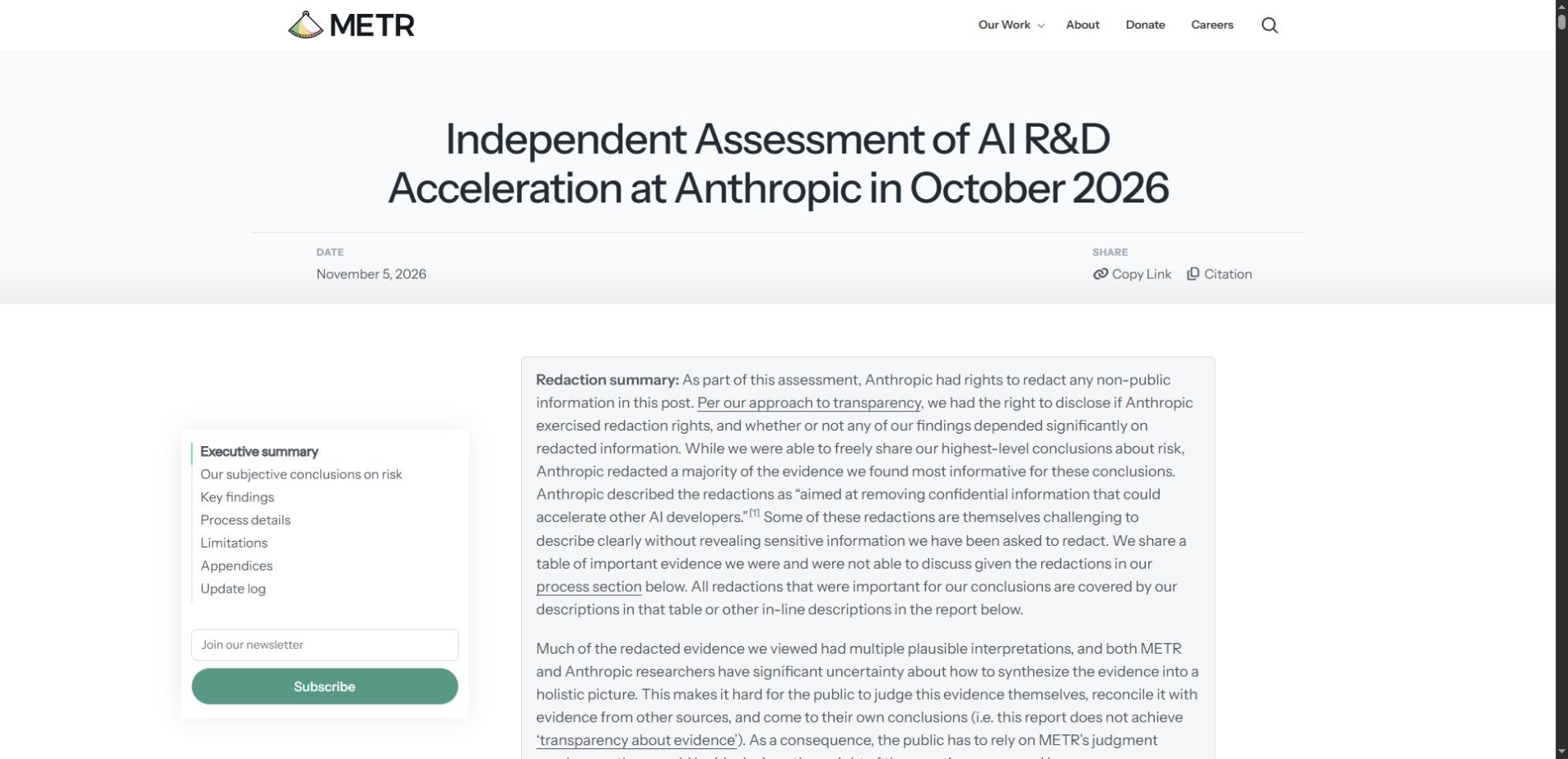
A new assessment from METR, published on November 5, 2026, examines AI research acceleration at Anthropic. Its findings deserve attention, but the headline number needs context: faster progress on measured capabilities is different from a laboratory running itself.
Three points before reading the headline
- The report concerns a particular organization and period, rather than a measured speedup for every AI developer.
- A faster rate of benchmark improvement is different from twice the intelligence or twice the usefulness on every task.
- Explaining the causes of faster progress is harder than observing a change in the trend.
What the assessment found
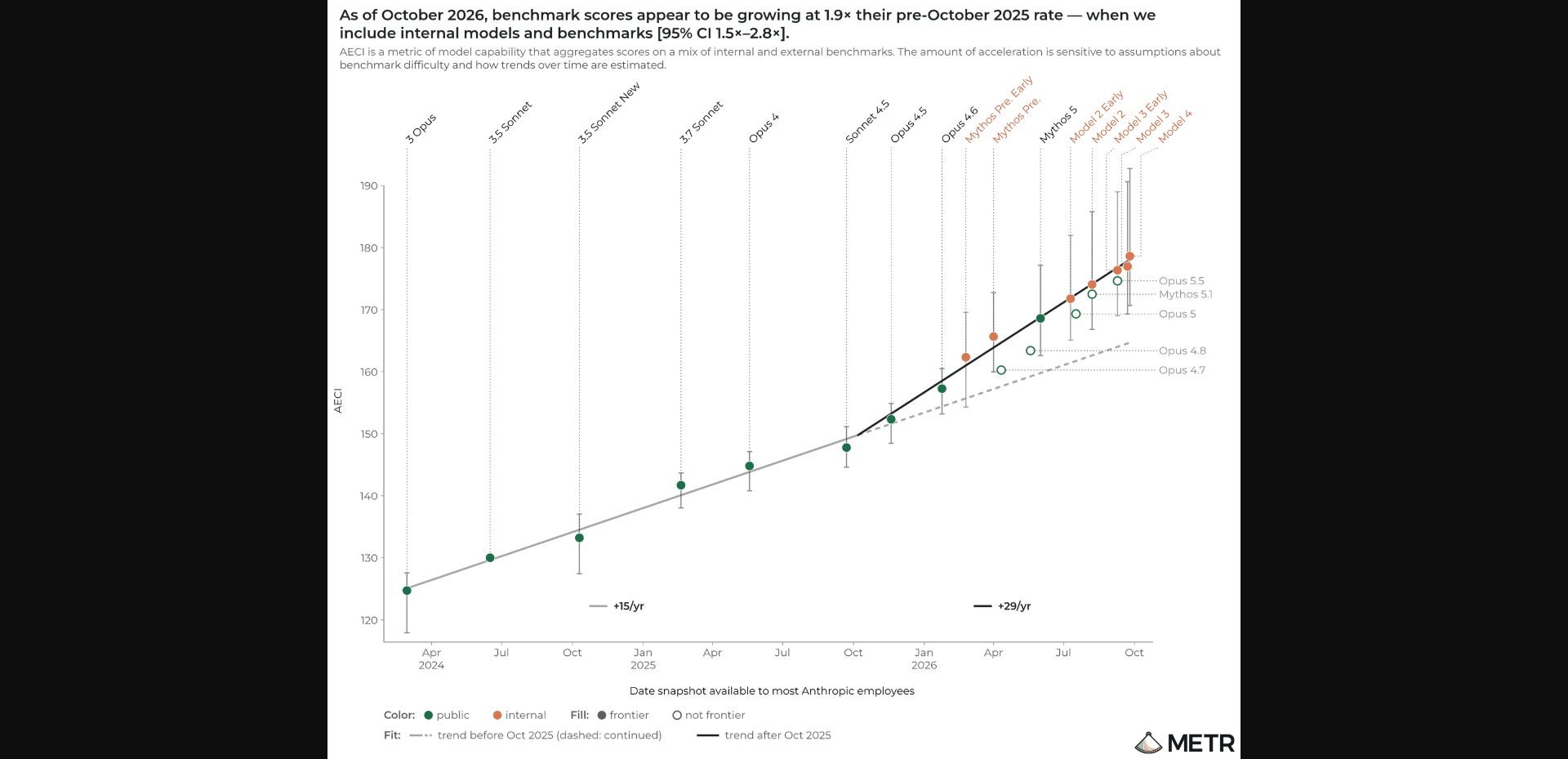
In its independent assessment of Anthropic’s AI R&D acceleration, METR estimates that AECI benchmark scores improved at about 1.9 times their earlier rate after October 2025, with a 95% confidence interval of 1.5–2.8 times. Its broader judgment is that extensive AI assistance likely accounts for most of the recent acceleration, with substantial uncertainty.
METR also says Anthropic redacted much of the evidence it considered most informative. The report discusses access constraints and possible interpretations that could make its estimate too high or too low. Those qualifications belong alongside the result.
How to read the finding: it is evidence about a changing pace of progress, accompanied by a judgment about causes. It is not proof that AI can already run an entire research organization autonomously.
What does a faster rate actually mean?
Imagine a fictional research score that rises by ten points over one year and twenty points over the next. The second increase is twice as large. That does not mean the resulting system can do twice as much useful work, and it does not establish that the same increase will happen next year.
This example uses invented numbers to explain a rate. A score summarizes performance under a chosen measurement system. To interpret it, you need to know what the tests contain, how scores are combined and whether the tasks resemble the work you care about.
A small change in a benchmark might be valuable if it crosses a threshold needed for a real task. A large change might matter less if it comes from tasks that are easy to test but rarely appear in practice. Neither possibility can be resolved by looking at the acceleration ratio alone.
It also matters which dates are compared. Public release dates and the dates researchers first use an internal model can differ. Readers should inspect a chart’s time axis before drawing conclusions about how quickly customers will receive improvements.
How AI assistance could affect a research pipeline
The following examples are an editorial explanation of possible mechanisms, not additional findings from METR. They show why measuring research productivity requires more than counting how much text or code an assistant produces.
Faster preparation
A researcher might use an assistant to draft experiment code, organize references or prepare a comparison table. That can shorten preparation time. The relevant outcome is whether the prepared work is correct enough to use, including the time spent checking and repairing it.
If a draft appears in minutes but takes hours to debug, generation speed is a poor measure of progress. On the other hand, a modest-looking tool that reliably removes repetitive setup could have a meaningful effect across many projects.
More experiments within a fixed schedule
A team that can prepare and review experiments more efficiently may explore more options. Yet additional runs are useful only when their design and interpretation are sound. More activity does not automatically produce better scientific decisions.
The limiting step may also move. Faster coding can reveal a shortage of compute time, evaluation capacity or human attention. To understand a pipeline, measure the stages that determine its overall completion time rather than assuming the fastest-improving stage controls everything.
Better decisions about what to try next
An assistant could help compare previous attempts and suggest directions. This possibility is harder to evaluate than a simple coding speedup because the best next experiment may not be known in advance.
A persuasive explanation is not enough evidence that a suggestion was valuable. Record the proposed direction, why it was selected, the result and the human review involved. Our article on AI research workflows explores why keeping evidence visible matters when agents coordinate specialist tools.
Keep three kinds of evidence separate
An evaluation can combine several sources of evidence, but each answers a different question. This table is a general reading guide for research-productivity claims.
| Evidence | What it can help show | What needs care |
|---|---|---|
| Benchmark trends | How measured capabilities changed over time. | Task coverage, scoring and model selection. |
| Worker interviews or surveys | How people describe AI’s role in their work. | Recall, expectations and comparison baselines. |
| Workflow records | What happened during a project. | Whether faster activity improved the final outcome. |
| Controlled comparisons | How outcomes differ under specified conditions. | Whether the conditions generalize. |
Agreement across different forms of evidence can strengthen a conclusion. It does not remove the need to explain how each was collected. An observation that a team improved and an interview saying AI helped are relevant, but they do not form a controlled experiment by themselves.
Why causation remains difficult
Research organizations change several things at once: tools, staffing, training methods, compute allocation and evaluation practices. If progress speeds up during the same period, separating their contributions is challenging.
A useful causal question is counterfactual: what would the organization have achieved during that period without the additional AI assistance? That alternative history cannot simply be read from the observed score chart.
This is why uncertainty should not be treated as an embarrassing detail. It tells readers how much weight to put on an explanation and what new evidence could change it. A strong article can report an estimate clearly while preserving the difference between measurement and interpretation.
Assistance and automation are different milestones
In its separate review of Anthropic’s August risk report, METR distinguishes AI-assisted acceleration from full automation. It broadly agrees that direct catastrophic risks from automated R&D were low for the models available by July 15, while warning that subsequent progress could change the assessment.
The date is essential. An assessment of a model available in July does not automatically describe a later internal system. Similarly, evidence that researchers complete work faster does not establish that a system can independently choose goals, manage resources and verify an entire research program.
For an ordinary user, the practical lesson is to ask who defines success and who checks it. A task can involve extensive AI output while still depending on people at critical decisions. “AI helped” is a broad description that needs a more specific account.
What users and builders can take from the report
There is no need to convert this assessment into a prediction that every job or product will change on a fixed schedule. A narrower conclusion is more useful: tools may improve the process used to develop later tools, so evaluations should be updated rather than treated as permanent.
If you build with AI, keep a small collection of representative tasks and repeat them after meaningful changes. Include failure cases and review effort, not only examples where the assistant succeeds. Our AI assistant testing guide shows how fictional records can provide clear answer keys.
If you read AI news, ask what the reported number measures before sharing it. Is it a benchmark score, a self-reported productivity estimate, a completed-work measure or a forecast? Those categories should not be silently exchanged in a headline.
Questions worth asking next
- Which tasks account for the measured improvement, and which important tasks are missing?
- How much review, correction and supervision did the work require?
- What alternative explanations were considered?
- Which evidence is public, and what cannot outsiders inspect?
- What observation would make the assessment change?
These questions help evaluate both enthusiastic and skeptical claims. They focus attention on what can be checked rather than requiring readers to choose between a dramatic forecast and dismissing the research entirely.
Common questions
Does 1.9 times faster progress mean twice the intelligence?
No. A ratio describing the rate of change in an index is not a universal multiplier for intelligence or practical value. The meaning depends on how the index is constructed and which tasks matter.
Does this prove recursive self-improvement is already autonomous?
No. Assistance that speeds up research and complete autonomous research are different claims. Evidence for the first does not, by itself, establish the second.
Did Unlimited AI independently reproduce METR’s analysis?
No. This article explains the public assessment and adds original examples for interpreting it. It does not claim access to Anthropic’s internal evidence or independent replication.
The takeaway to keep
The report makes AI-assisted AI development a concrete measurement question. Its significance comes from the combination of observed progress, evidence about how work is changing and explicit uncertainty about the explanation.
Read the headline with those distinctions intact. The useful next development will be clearer evidence about which research tasks accelerate, what still requires supervision and whether the gains persist across time and settings.