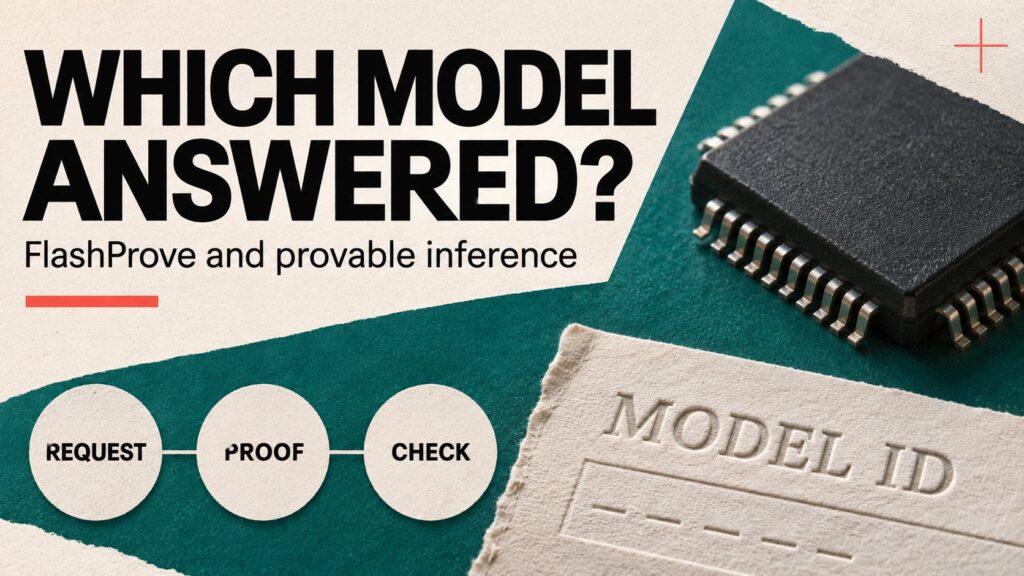
Two AI services can display the same model name and return equally convincing answers. From the wording alone, a customer may struggle to determine which underlying model produced either reply. That is a different problem from deciding which answer is more useful.
FlashProve, a research prototype described by Anthropic on November 2, 2026, explores cryptographic evidence for model execution. The idea is called provable inference: checking that an output matches a specified model computation instead of relying only on a label in an interface.
The distinction to remember: proof of model execution addresses where an answer came from. It does not establish that the answer is factually correct, safe or suitable for your task.
What Anthropic released
In its provable inference research announcement, Anthropic describes a provider committing to model weights and generating a proof that a response follows the committed computation. A verifier can check that proof without receiving the weights. The system uses a form of cryptographic proof called a zkSNARK.
The release is research, rather than a verification button automatically available in every chatbot. Reading about FlashProve does not mean your existing AI conversations now have proofs attached. A service would need to implement a suitable proof-generating and verification workflow.

Follow one request through the idea
Consider a fictional company called Paperlane that buys access to a particular AI model. Its team wants evidence that an evaluated configuration is the one serving a request. This is an explanatory scenario, not a claim about an actual provider or a FlashProve deployment.
Before the answer: establish the reference
A useful check needs an agreed reference. If Paperlane accepts any identifier supplied alongside an answer, it has not established that the identifier belongs to the model it intended to use. The connection between a public model name and a particular commitment needs its own trustworthy record.
A useful analogy is a package tracking number. The number helps connect events to one package only after you know which shipment it represents. It is not evidence that the contents are what you wanted. Likewise, a model commitment needs a clear meaning and a reliable way to obtain it.
After the answer: check the specified relationship
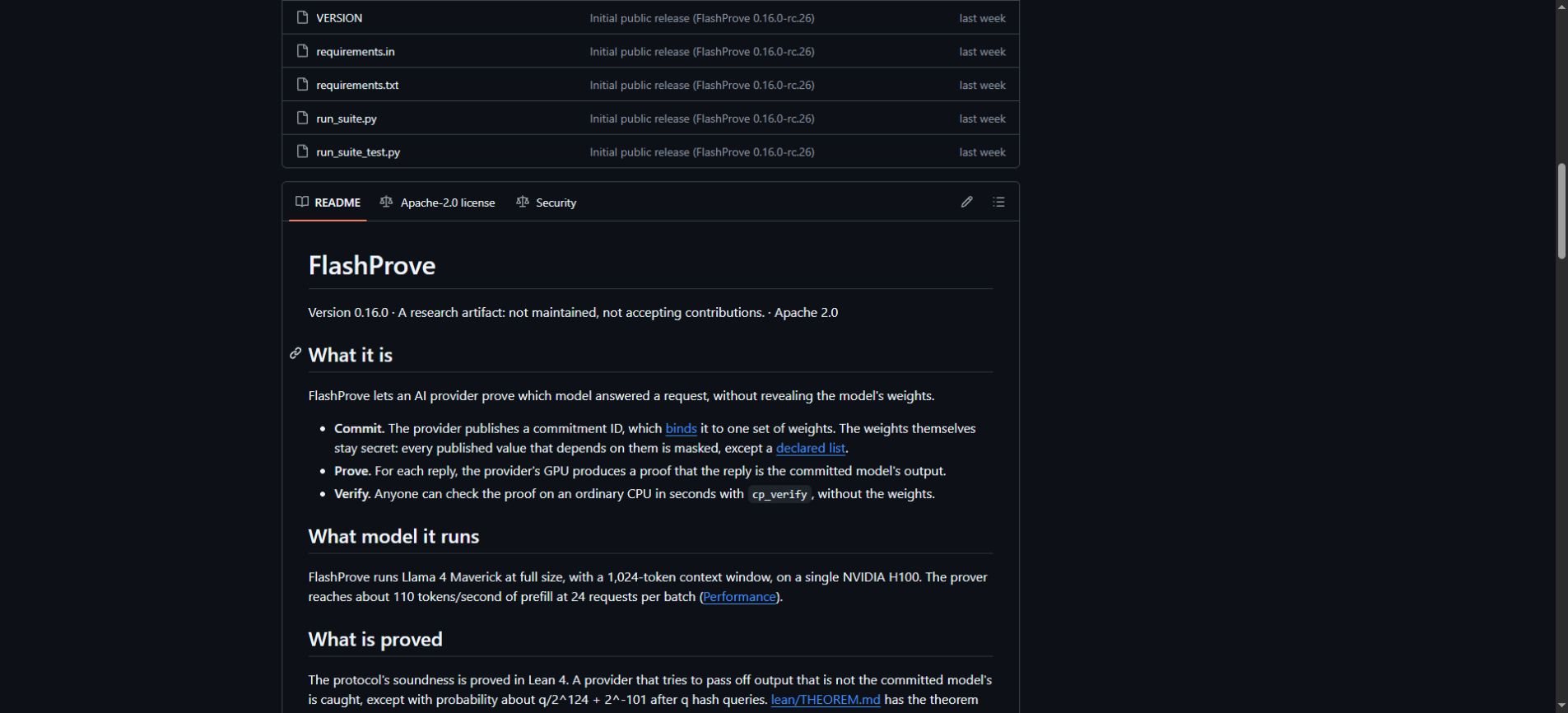
The FlashProve repository describes three stages: a provider commits to weights, produces a proof for a reply, and another party verifies it. The prover uses GPU resources; verification can run on a CPU. That division lets the recipient check evidence without rerunning the entire model.
For Paperlane, a meaningful record would identify the request, output, reference commitment and verification result. If any essential part is substituted, an unrelated successful check should not be presented as evidence for the answer the user actually received.
A valid proof can accompany a wrong answer
Now imagine the fictional model answers a question about an event date and gives the wrong month. A computation proof could establish that the committed model produced that text. It would not turn the wrong month into the right one.
The same applies to an invented citation, an arithmetic mistake or an unhelpful recommendation. The origin of the text and the quality of its content are separate questions. A user still needs sources, task evaluation and judgment appropriate to the decision.
This separation is useful because it prevents a vague word such as “verified” from doing too much work. A clear product would say exactly what was checked and avoid implying that every sentence had passed a factual review.
| Question | Relevant evidence | What remains separate |
|---|---|---|
| Did the output match the committed computation? | A valid proof for the specified request and output. | The meaning of a marketing model name. |
| Is the answer correct? | Original sources, calculations and task-specific review. | Which model generated the words. |
| Is this service appropriate for my data? | Data-handling terms and operational controls. | A proof of model execution. |
| Does the system perform my task well? | Representative evaluation cases. | A successful provenance check alone. |
For practical accuracy checks, our AI assistant testing guide uses fictional documents with known answers. A provenance check and that kind of task evaluation could answer complementary questions; neither substitutes for the other.
The prototype has a specific scope
The repository identifies FlashProve as an unmaintained research artifact. It demonstrates Llama 4 Maverick with a 1,024-token context limit and reports about 110 tokens per second of prefill proof generation on a single H100 at a batch size of 24. Those conditions matter when interpreting the number.
Anthropic’s announcement reports roughly 19 MB proofs per 1,024-token request and substantial overhead versus ordinary inference. This is not a claim that proving a chat response is free or as fast as generating it. Performance depends on what is measured and the configuration used.
The announcement also limits the computation to an integer model with greedy decoding and states that its formal guarantees do not establish that the fast executable code, protocol document and Lean implementation all match. Those are material boundaries, not details to omit when describing the result.
A long conversation, a different architecture or a sampled response should therefore not be assumed to fit this prototype automatically. Supporting additional settings is an engineering and research question. A demonstration for one defined computation is a starting point for broader work.
Why model identity could matter
A team comparing AI systems needs to know what it evaluated. If a service changes configurations between an evaluation and normal use, the original scores may no longer describe the operational system. Evidence about execution could help make those changes easier to investigate.
This is a possible application, not evidence that any particular service is secretly substituting models. Routing can be a legitimate product feature when it is described clearly. The issue is whether the evidence supports the specific promise made to a customer.
Version records matter too. A model family name may cover multiple releases or serving configurations. A useful assurance process should state which one is involved, how updates are recorded and what happens when a proof cannot be checked.
For users, the benefit would be clearer boundaries around a claim. Instead of treating a model badge as a complete trust signal, they could ask which parts of execution have evidence and which still depend on provider statements or independent evaluation.
What this means for privacy
Keeping model weights hidden from a verifier is different from keeping a user’s prompt private from the service. Do not read “zero knowledge” as a blanket promise about the provider’s data handling.
Before sending sensitive material, review the service’s retention, access and processing terms. The proof system’s technical properties address a particular relationship; they do not automatically describe every database, log or external tool used by the surrounding application.
Applications that retrieve documents or call tools add further steps. Even if part of the model computation is checked, you still need to know what inputs were provided and what actions occurred outside that check. Our context engineering guide explains why those inputs can change an assistant’s output.
Questions to ask when a product says “verified AI”
- What exact claim is verified? Ask whether it concerns model execution, factual accuracy or something else.
- Which commitment is trusted? Check how it is connected to the promised configuration.
- Does the proof cover this request? An example proof is not evidence for an unrelated answer.
- What are the supported limits? Look for context, arithmetic, model and decoding constraints.
- What happens on failure? A missing or rejected proof should have a clear, visible outcome.
These questions do not require every customer to become a cryptographer. They require the product to describe its assurance precisely enough that a reader can tell what the result supports.
Common questions about FlashProve
Does FlashProve detect hallucinations?
It is not a factuality detector. Checking that a particular model computation produced text does not establish that its statements match reality.
Can I verify any chatbot with this release?
No. Proof generation requires participation from the serving system and a supported configuration. A pasted response or screenshot alone does not provide the required evidence.
Did Unlimited AI run the software?
No. This is an explanation of the announcement and repository, with original examples of how to assess the claims. It is not a hands-on performance benchmark or security audit.
The useful next step
FlashProve points toward a more specific way to discuss AI trust: identify the claim, identify the evidence and state the remaining uncertainty. That is more useful than a broad assurance that a system is simply “verified.”
For now, keep model provenance, answer quality and data privacy as separate checks. Better evidence for one can improve the overall picture, but it does not answer the other two questions on its own.