Claude Haiku 5.5 puts a practical question at the center of model selection: how much intelligence does each task actually need? A business processing thousands of short requests may care more about reliable output, quick responses and predictable spending than about choosing the biggest model for every job.
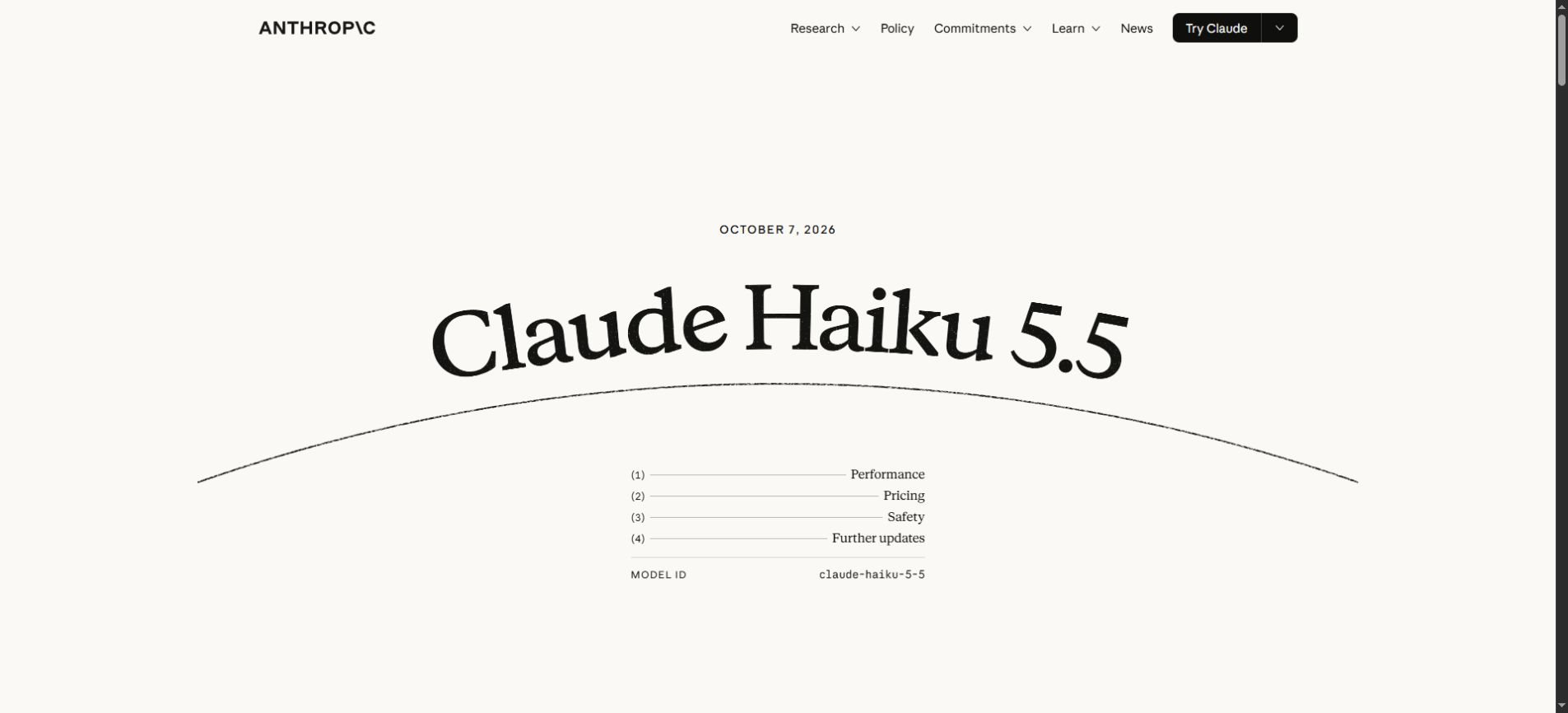
Anthropic introduced the model on October 7, 2026, positioning it for frequent, narrowly scoped work. Below, we explain the published pricing, work through a transparent cost example and show how to decide which tasks should stay with a larger model. This is an analysis of official documentation, not a hands-on performance review.
Last reviewed: October 11, 2026.
Start with the price of your actual workload
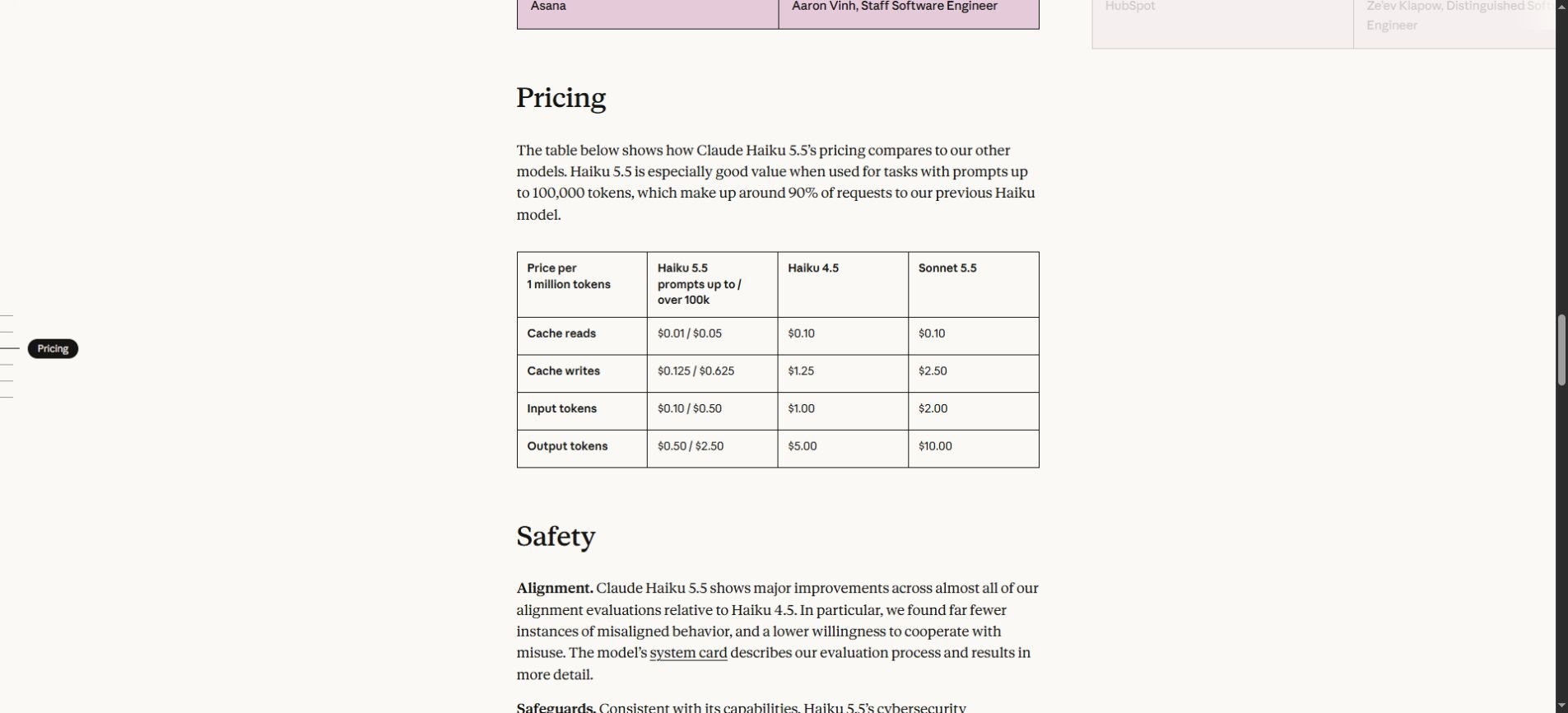
The official pricing table separates prompts up to 100,000 tokens from longer prompts. These are USD rates per million tokens, not subscription prices.
| Token category | Prompt up to 100k | Prompt over 100k |
|---|---|---|
| Input | $0.10 | $0.50 |
| Output | $0.50 | $2.50 |
| Cache read | $0.01 | $0.05 |
| Cache write | $0.125 | $0.625 |
Use the rate category for the request you are sending. Do not average the two columns together or treat the lower column as a universal price. Provider-specific charges, tools and other services can change the final bill; confirm terms for your chosen platform.
A simple Claude Haiku 5.5 cost example
Imagine 10,000 independent requests. Each uses 1,000 input tokens and produces 200 output tokens. Assume all prompts qualify for the lower tier, no caching, no retries and no extra service charges.
- Input total: 10,000 × 1,000 = 10 million tokens. At $0.10 per million, that is $1.00.
- Output total: 10,000 × 200 = 2 million tokens. At $0.50 per million, that is $1.00.
- Illustrative combined token cost: $2.00.
This is arithmetic using the listed rates, not a promise that a real application will cost $2. The workload assumptions are deliberately explicit. A longer system prompt, repeated conversation history or extra attempts would change the result.
The most useful budget unit is a completed, acceptable task. If an answer needs several corrections, count every request used to reach the final result. Also record the time a person spends reviewing it. A small token bill can hide an expensive manual process.
Budgeting rule: Estimate input, output, retries and review effort separately. Start with a small sample of your own tasks, measure the real usage and then project the monthly total.
What changed—and what the launch does not prove
According to the launch announcement, Haiku 5.5 adds adjustable effort and targets summaries, classification and other short workloads. Anthropic recommends its larger Sonnet and Opus models for complex agentic coding. The Claude Platform model ID is claude-haiku-5-5; cloud-platform availability is also listed on the announcement.
A model launch can tell you what the provider intends and what its evaluations report. It cannot tell you the acceptance rate on your support messages, internal documents or software projects. Those inputs contain vocabulary, exceptions and expectations that may differ from the benchmark tasks.
This is why “small” should be treated as a model-family description rather than a complete buying decision. Test a clearly defined job. If it succeeds consistently within your budget, it may be a good fit even if another model leads a broad leaderboard.
For background on the steps behind a response, see our AI inference guide. It helps explain why model choice, response length and the surrounding workflow all affect the experience.
Four useful trial tasks for a smaller model
These are suggested trials, not claims about results we obtained from Haiku 5.5. Each has a limited scope and a result that a reviewer can inspect.
Sort an incoming queue
Give the assistant a fixed set of categories and ask it to label incoming messages. For a support inbox, the labels could be billing, technical problem, account access and other. Include an “uncertain” route so ambiguous requests do not have to receive a confident label.
Keep the model’s role separate from the action taken afterward. Assigning a billing label should not authorize a refund or a subscription change. Review mistakes by category: an overall accuracy number can hide failures in a small but important group.
Produce short summaries with evidence
Ask for a few factual bullet points from a supplied document, preserving dates, amounts and unresolved questions. Require the summary to distinguish a decision from a suggestion. A note that says “we may launch Friday” must not become “launch confirmed for Friday.”
Compare the output against the original rather than another generated summary. Keep enough source information for a reviewer to check important details. Our AI hallucinations guide explains why fluent writing is not evidence of factual accuracy.
Extract a small set of fields
Use a sample record and request specific fields such as a document date, reference number and organization name. Tell the assistant to mark a field as missing when the evidence is absent. Validate the output format before it reaches another application.
Do not let the model quietly fill gaps from general knowledge. A plausible company address is still wrong when the task is to extract the address shown in a particular document. Extraction and inference should be separate operations with separate labels.
Draft a response from an approved policy
Provide a current policy and ask for a concise draft that answers a customer’s question using only that material. A person can approve the draft before sending it. Include examples where the correct action is to ask for clarification or refer the request to a colleague.
This keeps the trial focused on communication quality and policy grounding. It avoids confusing a well-written message with permission to make commitments. For prompt structure, see our guide to writing AI prompts.
Use a clear handoff rule for harder work
A smaller model does not have to complete an entire workflow alone. You can give it a narrow first step and send unresolved cases to a person or another model. The handoff should follow explicit conditions that you can audit.
| Situation | Suggested handling |
|---|---|
| Clear input, fixed categories | Try the smaller model and validate the result. |
| Missing or contradictory evidence | Ask for clarification or route to review. |
| Several interacting code changes | Evaluate a larger model with tests and human review. |
| Action affecting customers or access | Require an explicit approval step. |
Avoid treating a self-reported confidence score as sufficient proof. A stronger handoff signal may be a failed validation rule, an unknown category or a discrepancy with a trusted record. Those checks exist outside the generated explanation.
Our AI agents overview explains how tools and task loops surround a model. That surrounding design determines whether a draft remains a draft or becomes an external action.
Migrating from Haiku 4.5 needs more than a name change
Anthropic’s Haiku 5.5 migration guide identifies request and response changes. It says to recount tokens, update legacy thinking settings to adaptive thinking, remove sampling parameters and replace assistant prefill. Applications should select response blocks by type rather than assuming the first block contains the answer.
The guide also documents platform differences: structured outputs are unavailable for this model on Amazon Bedrock, and Priority Tier is unsupported. Review the checklist for your exact starting model and deployment platform before modifying production code.
A careful migration begins with a copy of the integration and representative stored examples that you are permitted to reuse. Check that the application still handles incomplete outputs, refusals and tool results. Keep the old configuration available until the replacement passes the same acceptance rules.
Recalculate spending with the new model’s measured token counts. Comparing prices alone can miss a change in how the same text is counted or how much output the workflow generates. For recurring tasks, include conversation growth rather than testing only the first request.
A one-week trial that produces a useful decision
- Choose one task with a clear owner and a measurable acceptance rule.
- Prepare a sample containing ordinary inputs, ambiguous cases and missing information.
- Run the existing workflow and the candidate with the same source material.
- Measure accepted results, total requests, elapsed time and review effort.
- Inspect failures and decide whether better instructions or a different model are needed.
- Adopt only the scope that passed, with a rollback plan and spending limit.
Write down the decision before expanding the pilot. “Approved for message classification” is much more useful than “approved for business use.” The first statement tells colleagues what was tested and where the result should not be assumed to apply.
Use permission boundaries from the beginning, especially when tools can change records or contact customers. Our AI agent safety guide covers practical controls for those situations.
Questions readers are asking
Is Claude Haiku 5.5 the right choice for every request?
No model should be chosen solely because it has a lower listed rate. Use the least expensive option that reliably meets the task’s requirements, and escalate cases that do not pass your checks.
Are the example costs monthly subscription fees?
No. The example calculates token usage for a hypothetical API workload. Chat subscriptions, cloud charges and application-specific services are separate considerations.
Should I use the highest effort setting?
Begin with a setting appropriate to the task, then compare accepted results and usage. Extra effort is useful only when it produces a meaningful improvement for the work you need completed.
Can a benchmark replace my own trial?
No. Benchmarks can help identify candidates, but your own data and acceptance rules decide whether the model fits. Preserve the model version and configuration with the trial results.
Choose by task, then measure the savings
Claude Haiku 5.5 is an opportunity to reconsider routine AI spending. Start with a narrow job, make the output easy to verify and count the whole process. Keep complex or consequential work behind appropriate review rather than assuming every task should move to the cheapest option.
For current rates and platform-specific migration details, return to Anthropic’s official announcement and developer migration guide. Prices and supported features can change after this article’s review date.