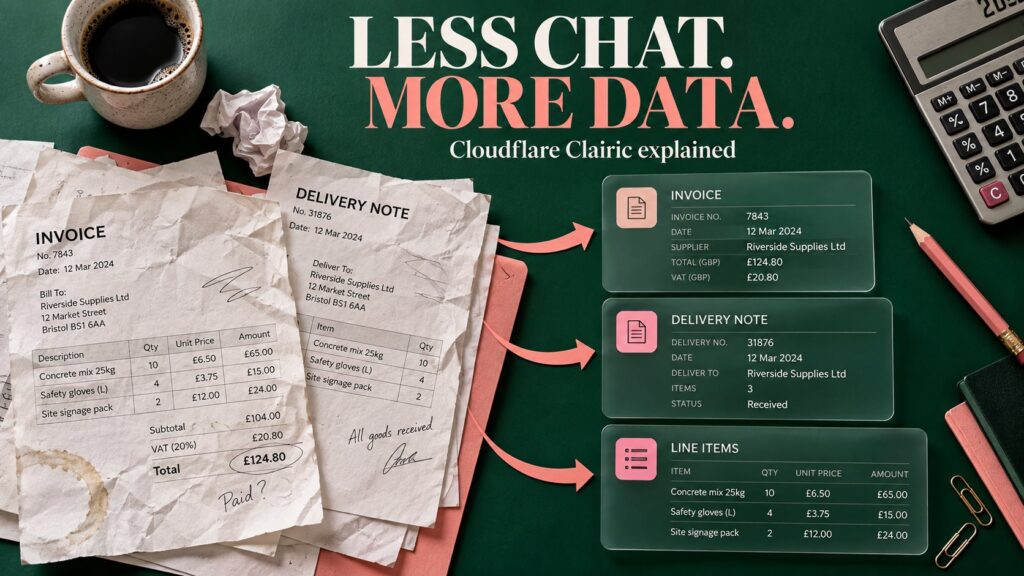
A customer sends a delivery complaint. Your software needs an order number, a purchase amount and a delivery date. A beautifully written paragraph is useful later; first, the application needs values it can check and store.
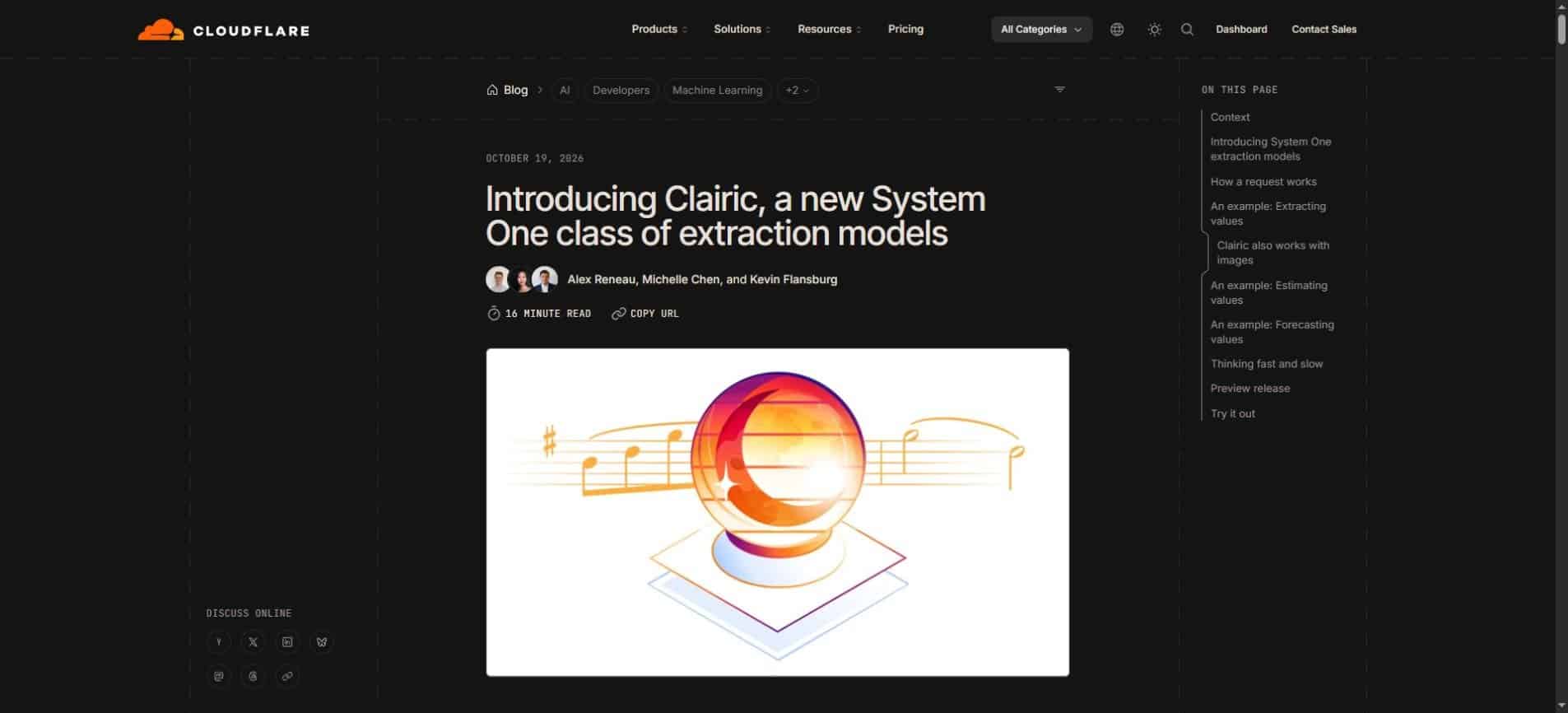
Cloudflare Clairic puts that less glamorous part of AI work in the spotlight. Announced on October 19, 2026, it is a preview extraction model on Workers AI. Cloudflare describes a model that answers with typed values rather than generating a stream of text. Its planned open-weights release should be distinguished from the hosted preview available now. Read Cloudflare’s announcement.
The practical takeaway: a well-formed answer is only the beginning. The useful question is whether the right value came from the right evidence—and what your application does when it did not.
This guide uses an illustrative support workflow to explain the idea, compare extraction with chat and show how to evaluate it. The examples below are editorial scenarios, not results from our own Clairic testing.
Start with the record your application actually needs
Imagine this fictional message: “Order AB-142 arrived on October 21. I paid $84.50 including shipping. The lamp shade is cracked. Please send a replacement.” A support worker can understand it instantly. An automated workflow still has several distinct jobs.
It must identify the order, interpret the amount, record the delivery date and describe the damage. It then needs a policy decision: does this request qualify for a replacement, and is approval required? Only after that should it compose a customer reply.
Treating those as separate stages makes the workflow easier to inspect. You can examine a wrong delivery date without wondering whether the polite wording of the final message hid the mistake. You can also change the replacement policy without changing how the order number is captured.
What an AI extraction model changes
Cloudflare’s extraction-model guide separates three jobs: returning values, choosing among predefined options and producing open-ended content. That is a useful design distinction for teams building AI applications. It does not mean every task needs three different models.
| Your immediate need | Output to design for | Illustrative support task |
|---|---|---|
| Capture facts | Named, typed fields | Record the order ID and stated price |
| Apply a policy | An allowed action or review route | Decide whether approval is required |
| Communicate clearly | Natural language | Explain the approved next step |
For the fictional complaint, a sensible field specification would ask for the order identifier exactly as written, the total paid with its currency, the delivery date and a concise description of the damage. A vague field called “amount” is weaker: it could mean the item price, shipping cost or requested refund.
The schema should reflect how the application uses the information. Keep the customer’s stated facts separate from an employee’s verified records. A message saying “I paid $84.50” is evidence of a claim; checking the order database is a separate operation.
Clairic’s typed outputs—and their limits
The launch changelog lists text spans, numbers, dates, durations and lists, alongside estimates and forecasts. Scalar results include confidence information and a probability that the input does not determine the requested value. Predictions include uncertainty intervals.
These signals can help route uncertain cases to a person. A confidence score still needs testing against your own documents. A high score is not a receipt, a signature or a database match.
It is also essential to label a prediction differently from a captured fact. “The customer says the lamp arrived on October 21” and “the repair might cost $25” have different evidential status. Displaying both in the same unqualified column invites mistakes downstream.
Keep these labels visible: extracted from the input, calculated from stated facts, estimated, or independently verified. Do not let a polished dashboard erase the difference.
A small pilot that can reveal expensive mistakes
Begin with one narrow task, such as preparing draft support records for an employee to review. Choose examples you are authorized to use, remove unnecessary personal information and retain a reference answer for every field. Do not start by giving the system permission to issue refunds.
Build the test set around disagreement, not just tidy documents. Include messages with two order numbers, corrections to an earlier price, an omitted year and a missing delivery date. Include one message that explicitly says the customer does not know the purchase amount.
- Write down the exact field definitions before testing.
- Have a person label the reference answers and note genuine ambiguities.
- Run the same documents through the candidate workflow and your current method.
- Count wrong values, missing values and unnecessary review separately.
- Measure the time required to correct the complete record, not just model response time.
A model can look strong on average while failing on the field that matters most. Report order-ID accuracy separately from damage-description quality. A wrong identifier can attach a complaint to the wrong customer even when every other field looks reasonable.
Keep a small set of difficult examples aside until the field instructions are finished. If every example is repeatedly used to tune the instructions, the final score says less about how the workflow will handle unfamiliar documents.
The “missing value” path deserves its own design
What should happen when a delivery date is absent? One answer is to leave the field empty and ask the employee to check the tracking record. Another is to request clarification from the customer. Silently inserting today’s date would create false certainty.
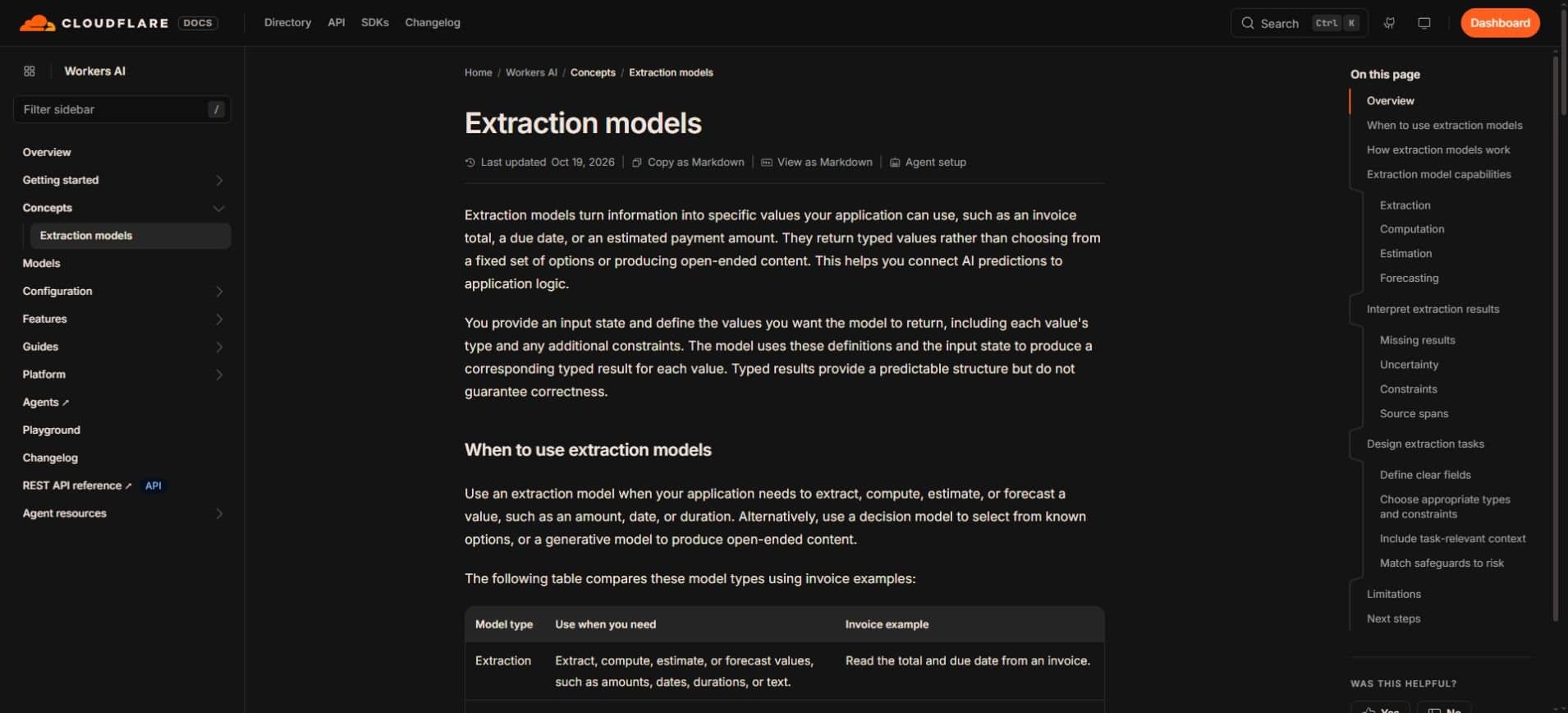
Cloudflare’s concepts guide explains that a null result can reflect insufficient information or a failure to identify it. That means missing data needs a recovery route. Store the original message alongside the review task so a person can distinguish those cases.
For relative dates such as “last Friday,” make the reference date explicit in the workflow. Also decide whose timezone matters. Those choices should be documented as application rules rather than left to an employee to infer from an isolated result.
When ordinary code is still the better tool
Use deterministic checks wherever the business rule is already clear. An order ID can be checked against an existing record. A subtotal can be recomputed from validated line items. A date can be compared with the policy window using ordinary application logic.
Clairic’s preview notes caution about long arithmetic chains, aggregation across many rows, basic forecasting and uncertainty on unfamiliar data. The sensible response is to measure those cases directly and keep critical calculations in code. A typed result can still contain the wrong number.
For messy documents, the broader issue is also context: which version of a record did the model receive, and which evidence was omitted? Our context engineering guide explains why the material supplied to an AI system matters as much as the request itself.
Read pricing as one part of the workflow
At launch, Cloudflare lists Clairic at $0.10 per million input tokens, without an output-token charge because it does not generate tokens. The endpoint is a preview, so check current documentation before budgeting.
Your pilot should track the full cost of a usable record: preprocessing, model calls, retries, storage and employee corrections. A cheaper extraction call is valuable only if its errors and review burden fit the task. Compare complete workflows using the same sample and the same acceptance rules.
For a small team, saving several minutes of repetitive copying may matter more than an impressive headline speed number. For a large queue, rare errors and review capacity may dominate. Choose the measure that matches the actual bottleneck.
Questions worth answering before you adopt it
Is Cloudflare Clairic a replacement for a chatbot?
It is aimed at a different output need. Use a text-generating assistant when the job is explanation or drafting. Consider a typed extraction stage when software needs specific fields. A combined workflow can use each where it helps.
Does typed output make the data trustworthy?
It makes the form more predictable. Trust also depends on evidence, correct field definitions, checks against records and an appropriate review process. Test factual accuracy separately from whether a response fits the expected type.
Should a small business switch immediately?
Start with a reversible pilot if repetitive data entry is a real problem. Compare it with your existing process before connecting it to consequential actions. Our small AI guide offers a broader view of choosing focused tools around practical needs.
Where can I follow further developments?
Use the linked Cloudflare announcement and documentation for product details. For broader coverage, News AI is another place to follow AI news; verify implementation decisions against the relevant provider’s primary documentation.
The useful shift: make the evidence inspectable
The most interesting part of this announcement is the attention it brings to a simple application question: what exact value does the next step need? Answering that first can produce a clearer workflow, whether you adopt Clairic or keep your existing tools.
A strong first project would prepare a reviewable record, show where each field came from and make uncertainty obvious. Expand automation only after you understand which errors remain. That is a more useful milestone than producing a confident-looking answer.