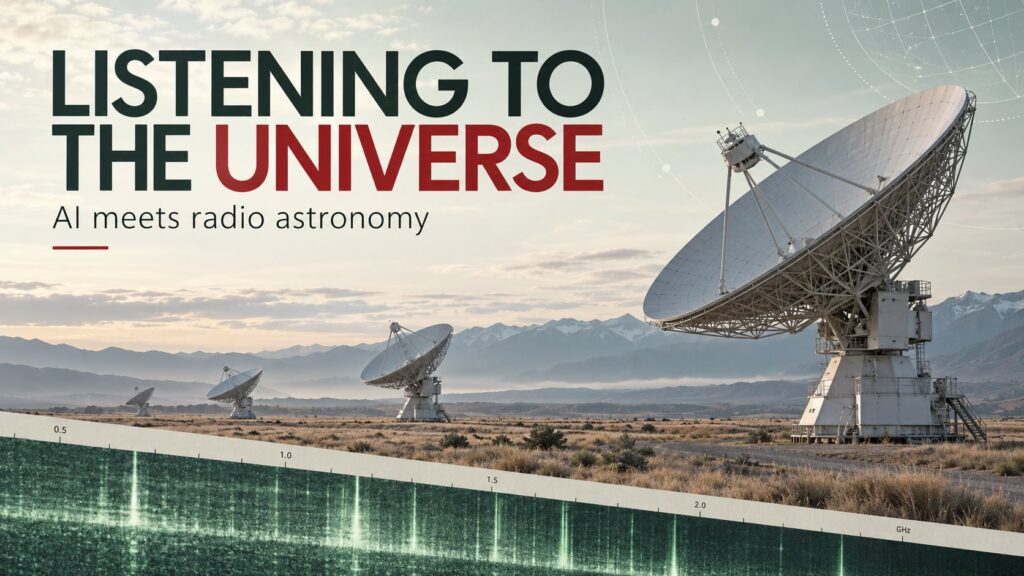
The next useful AI result might arrive as a faint pattern in a torrent of telescope data, rather than a fluent answer in a chat window. Radio astronomy offers a striking example of the shift: software must help an instrument collect, process and interpret information while an observation is still happening.
AI in radio astronomy is back in the news after NVIDIA’s October 30, 2026 report on the Allen Telescope Array. It describes Breakthrough Listen and the SETI Institute using agents to coordinate observations and live data processing. The reported demonstration was real-time AI detection of a pulsar in the Crab Nebula.
What the news establishes: a reported technical demonstration involving a natural astronomical source. It is not a report that AI discovered extraterrestrial life, decoded an alien message or found a previously unknown pulsar.
The interesting story is how AI fits into an observing system. This guide follows the route from telescope signals to a scientific claim, separating instrument control, data processing and interpretation.
Begin on Earth: what is the Allen Telescope Array?
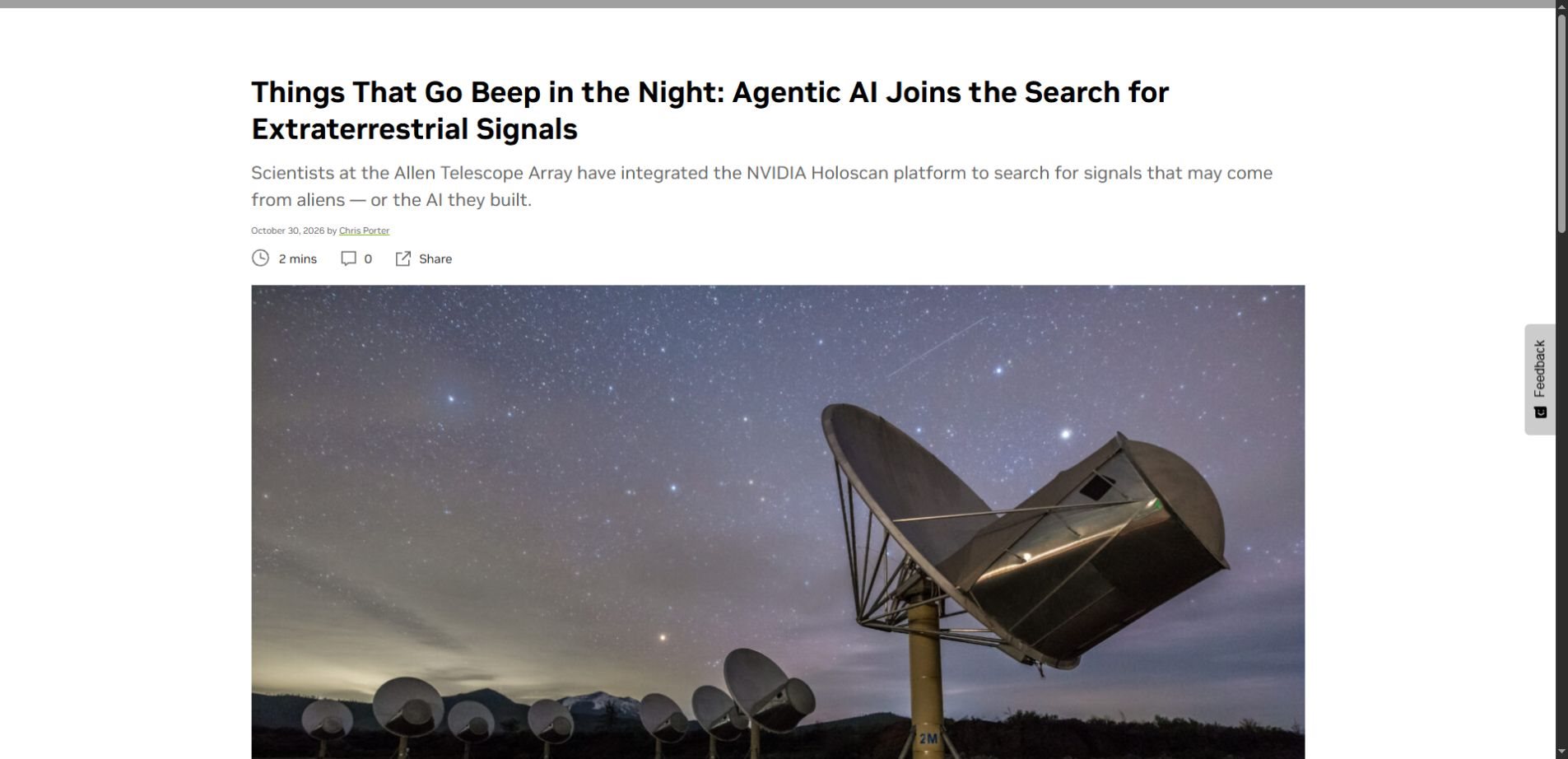
The SETI Institute’s FAQ describes the Allen Telescope Array at Hat Creek Observatory in northern California. Its 42 antennas can support both searches for extraterrestrial intelligence and other radio-astronomy research. SETI searches look for evidence of technology beyond Earth; sharing an instrument with broader astronomy does not turn every observation into an alien-signal candidate.
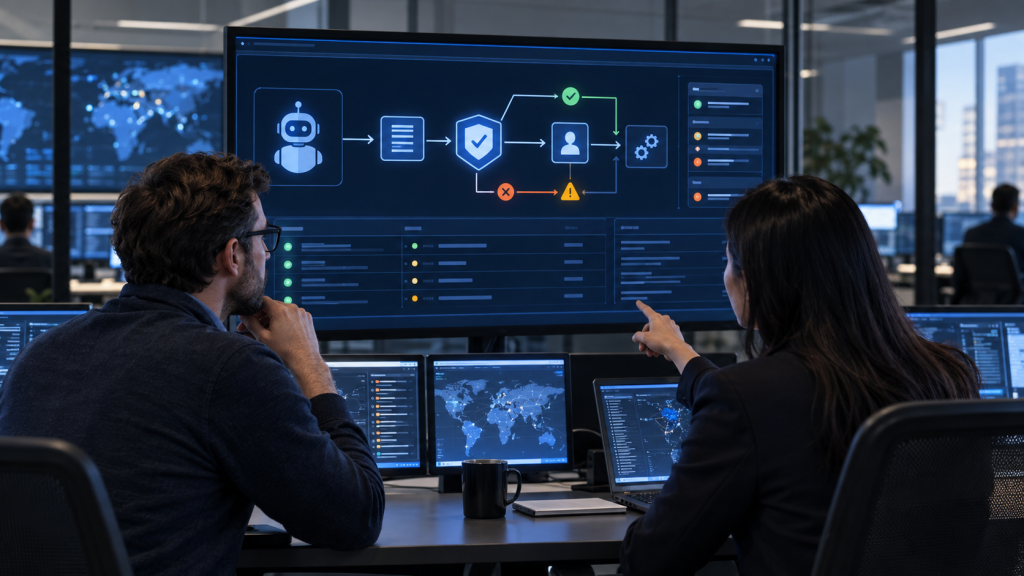
A useful way to think about an observatory is as a chain of operations. The collecting hardware is one part. Scheduling, calibration, computing, data quality and scientific analysis also have to work together. A problem in any of those stages can affect what researchers conclude from the observation.
That makes the setting different from a chatbot answering a general question about space. An observing assistant needs information about an actual instrument and the state of its data. Its output may involve a software operation or a change to a processing pipeline, not just a paragraph for someone to read.
Follow the signal through three jobs
The instrument has to collect useful data
Before asking whether a pattern is interesting, researchers need confidence in how the data was collected. Pointing, calibration and the health of the recording system matter. A neat plot cannot compensate for an observation that was configured incorrectly.
The significance of an agent here is coordination. If an authorized researcher describes an observing goal, software can help connect that instruction with the relevant tools. The scientific value depends on whether those tools are used correctly and their effects remain visible.
The stream has to be processed quickly enough
NVIDIA reports that the described system handles 2.4 terabits per second on RTX PRO 6000 Blackwell GPUs, with inference beside the instrument. DAQIRI moves incoming data toward GPU processing, CyberEther performs signal-processing work and Nexus provides a shared view of instrument state and pipelines. Those are reported characteristics of this installation, not universal requirements for astronomy AI.
At such a stage, AI is part of a larger computing system. Data transfer, conventional numerical operations and monitoring still matter. Calling the workflow “agentic” does not mean a language model independently performs every calculation or replaces the telescope’s engineering.
A helpful analogy is a control room. Different components have specialized jobs, and the coordinating layer needs to know what is running and what has failed. Faster coordination is useful only if the underlying information is trustworthy.
A detected pattern has to be interpreted
A system can correctly flag a pattern without establishing its cause. The first question might be whether a feature is present. Later questions concern its source, repeatability and explanation. Moving between those questions requires evidence, not stronger wording.
| Stage | What it can establish | What it does not establish alone |
|---|---|---|
| Data-quality check | A stream meets specified checks | Every feature is astrophysical |
| Pattern detection | A candidate matches a selection rule | The candidate’s origin |
| Source identification | Evidence supports an explanation | Extraterrestrial technology by default |
| Scientific claim | A conclusion supported by the available record | Certainty beyond the evidence |
Why the pulsar result matters
NASA’s pulsar explainer describes pulsars as rapidly rotating, strongly magnetic neutron stars: dense remnants of dead stars. Their radiation beams sweep through space, and an observer sees pulses when a beam crosses the line of sight. The lighthouse comparison explains why a natural object can produce a remarkably regular signal.
A known astronomical source can be useful when assessing a new processing workflow. Researchers have something meaningful to compare with the system’s output. As an editorial interpretation, that makes the reported Crab result more informative than a demonstration that merely produces a visually striking, unexplained plot.
It is still important to keep the scope narrow. Detecting a known source through a new workflow is different from discovering that source. It is also different from proving that the workflow will reliably handle every unfamiliar signal. Those are separate milestones.
The history of pulsars offers a useful warning about labels
NASA traces the first pulsar observations to Jocelyn Bell Burnell in 1967. The unusually regular signal initially inspired the joking label “Little Green Men,” before the physical explanation as a rotating neutron star emerged. Regularity was a reason to investigate, not a sufficient reason to infer a civilization.
The lesson applies neatly to AI-assisted searches. A model can help identify something that deserves attention. The explanation may still be ordinary physics, a problem with the measurement or something not yet understood. Interesting evidence deserves careful follow-up rather than an immediate dramatic label.
This is not a reason to dismiss unusual observations. It is a reason to preserve the distinction between finding a feature and explaining it. Good scientific tools should make that distinction easier to maintain.
What makes an observatory agent different from a classifier?
A classifier might assign a label to a fixed input. An agent can use tools across several steps, inspect intermediate results and choose what to do next within its allowed workflow. The difference is the loop between observation and action.
For an illustrative example, imagine software notices that an expected data stream is incomplete. A coordinating assistant could check system status, identify the affected stage and ask for an approved recovery step. That example explains the design idea; it is not a claim that we operated the reported telescope system.
Such an assistant needs dependable context. It must distinguish the current instrument state from an old note, a proposed command from an executed command and a successful operation from a merely plausible explanation. Our context engineering guide explores the same issue in everyday AI workflows.
A scientific agent should leave a useful trail
If an automated step changes how data is processed, researchers need to reconstruct that change later. The result should be connected to the inputs, settings and actions that produced it. Otherwise, a faster workflow can become harder to understand.
- Record the observation and the relevant configuration.
- Distinguish requested actions from completed actions.
- Keep the processing version associated with the result.
- Show data-quality warnings alongside candidate detections.
- Preserve enough evidence for a person to examine alternative explanations.
These are general design principles rather than an audit of the Allen Telescope Array deployment. They help explain what readers should look for when evaluating claims that an agent has improved a scientific process.
A confident natural-language summary should remain a route into the evidence. It should not replace that evidence. Our AI overreliance guide discusses why polished explanations can make independent checking feel less necessary than it is.
What could improve—and what remains uncertain
The potential benefit is a shorter path between an observing goal and a usable analysis, with fewer repetitive coordination steps. That is an interpretation of the workflow described in the report, rather than a measured claim that every observatory will see the same improvement.
To judge an installation, useful questions include how often the system completes its intended task, how it responds to faults and how much researcher time is required to review or correct its work. A headline data rate answers only one part of that evaluation.
The larger search also remains open-ended. Better tools can expand the work researchers can attempt, but improved processing does not guarantee a particular discovery. Scientific progress can include learning that a candidate has a natural explanation or finding a limitation in the instrument.
AI in radio astronomy FAQs
Did this system find aliens?
No such finding is established by the linked report. Its concrete demonstration concerns a pulsar, a natural stellar object. The broader SETI mission and the result of this particular demonstration should be read separately.
Is radio astronomy the same as SETI?
No. Radio astronomy studies the universe through radio observations. SETI searches specifically for evidence of extraterrestrial intelligence. An instrument can contribute to both, as the SETI Institute explains for the Allen Telescope Array.
Does AI replace astronomers?
The described approach places software inside an observing workflow. Choosing research questions, assessing evidence and supporting a scientific conclusion still require expertise. Automation can change the work without removing those responsibilities.
Can a chatbot at home reproduce the demonstration?
A conversation about a published result is different from having access to calibrated telescope data, the observing instrument and its processing system. Readers can study the sources, but should not treat a generated simulation or explanation as an independent observation.
The meaningful advance is better observation
This story is compelling without claiming contact with another civilization. It shows AI moving into a demanding environment where useful action depends on live data, specialized computing and an instrument with a real scientific purpose.
The strongest question to ask is whether the complete system helps researchers observe and reason more effectively. A reliable path from signal to evidence is valuable even when the source turns out to be a familiar cosmic lighthouse.