
AI-generated text, images, audio and video are becoming harder to distinguish from human-made work. That has created a practical question for publishers, teachers, businesses and everyday users: can a file carry evidence about how it was made? AI watermarking is one answer, but it is often misunderstood as a perfect detector. It is better viewed as one layer in a broader content-provenance system.
This guide explains how invisible watermarks such as Google SynthID work, how C2PA Content Credentials differ, how major AI companies are applying these systems, and what a verification result can—and cannot—prove.
Last reviewed: October 3, 2026.
What Is AI Watermarking?
AI watermarking adds a signal to generated content so a compatible system may later identify its origin. The signal can be visible, hidden inside the media itself, or stored as signed metadata. The goal is not to make a picture, sentence or recording look different to a person. The goal is to give software an additional clue about where the content came from.
The idea resembles the watermark on a banknote, but digital systems are more complicated. A social platform may resize an image. A user may crop a video, compress audio, translate text or take a screenshot. A useful watermark must remain detectable after at least some of those changes without noticeably damaging the content.
Watermarking also differs from the statistical methods discussed in our guide to detecting AI-generated content. A detector guesses from patterns it observes. A watermark verifier looks for a signal deliberately inserted by a participating generator.
Why AI Watermarking Matters in 2026
Generative media now moves through newsrooms, classrooms, advertising systems and social feeds at enormous scale. Synthetic voices and realistic video can be useful creative tools, yet the same capabilities can support impersonation, misinformation and undisclosed automated content. Provenance tools are becoming part of the response.
Regulation is adding pressure. The European Union’s AI transparency rules have encouraged major model providers to make AI-generated output more machine-readable. In August 2026, Anthropic announced text watermarking for new Claude models and C2PA metadata for supported files. Google continues to expand SynthID, while OpenAI describes a layered approach using watermarks, C2PA Content Credentials and public verification.
The Three Main Provenance Methods
1. Visible watermarks and labels
A visible label is the simplest method. It may appear as a logo, disclosure or small mark placed over an image or video. People can see it without special software, which makes it useful for immediate disclosure. However, visible marks can be cropped, covered or removed, and they may distract from legitimate creative work.
2. Invisible content watermarks
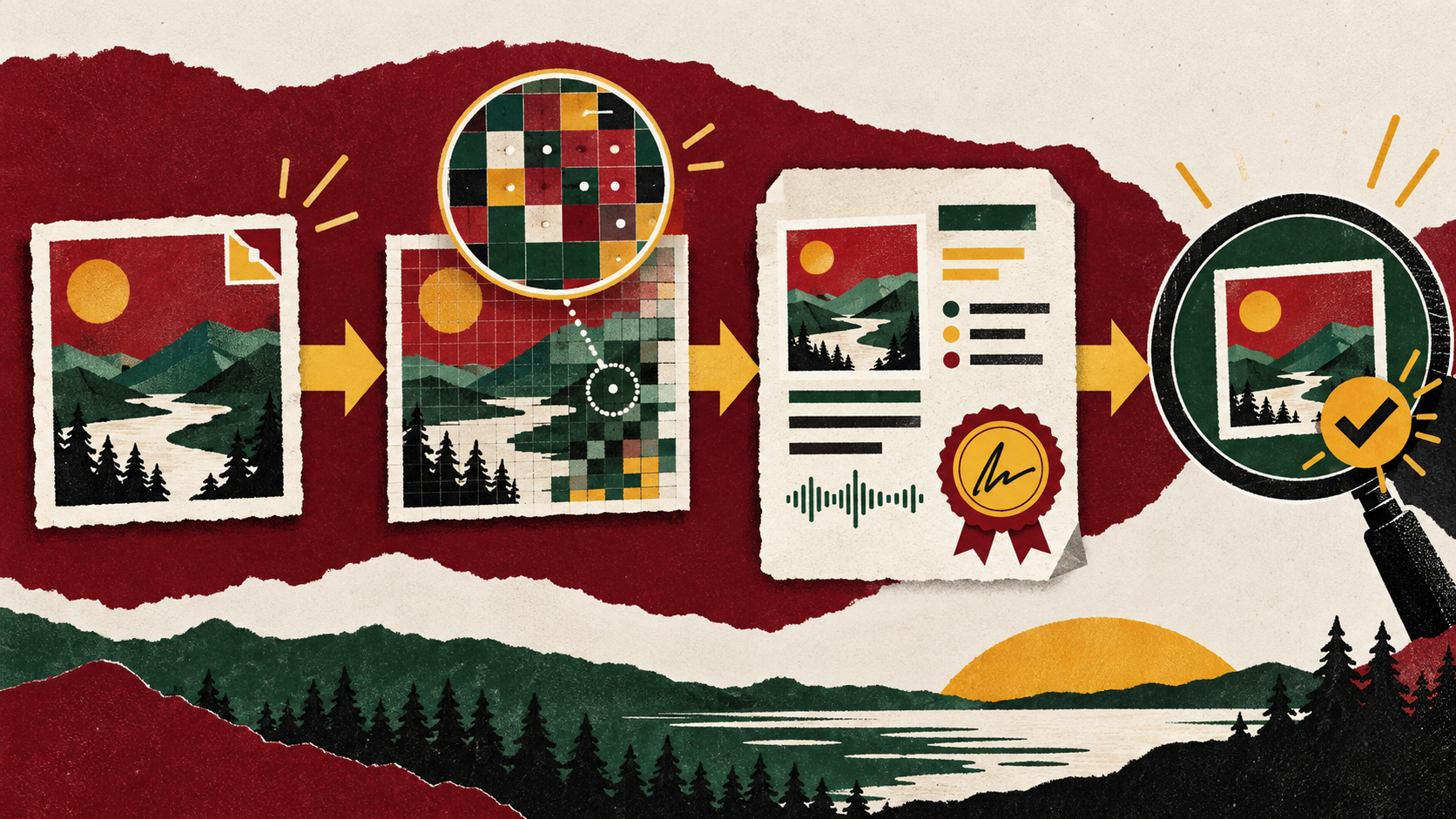
An invisible watermark changes the content in subtle ways that are designed to be imperceptible to people but detectable by a matching verifier. For images, the signal can be spread across pixel patterns. For audio, it can be embedded in frequencies. For text, a model can favor certain token choices according to a hidden statistical pattern.
3. Signed metadata and Content Credentials
Metadata-based provenance attaches information about a file’s origin and editing history. The C2PA standard supports cryptographically signed Content Credentials that a compatible viewer can inspect. The signature helps reveal whether the manifest has been altered, while the manifest can identify the tool or organization that created or edited the media.
How Google SynthID Works
Google DeepMind’s SynthID is a family of watermarking and identification technologies for AI-generated images, audio, text and video. Instead of relying on one identical technique for every medium, it adapts the signal to the structure of each content type.
- Images: a signal is embedded across the image so normal visual quality is preserved and some common transformations may not erase it.
- Video: watermark information can be distributed through frames, helping a verifier examine a clip rather than one isolated pixel area.
- Audio: the signal is placed within the sound in a way intended to remain inaudible while allowing machine detection.
- Text: the generating model subtly changes the probability of token choices. A verifier then examines enough text for the expected statistical pattern.
Text watermarking is particularly sensitive to length and editing. A short answer may not contain enough evidence. Heavy paraphrasing, translation or mixing output from several models can weaken the pattern. That is why a negative result should be reported as “no supported watermark detected,” rather than “written by a human.”
How C2PA Content Credentials Work
C2PA is not an invisible watermark by itself. It is a technical standard for recording provenance in a signed manifest. A creator, camera, editing program or AI service can add assertions describing what happened to a file. A verifier checks the signature and displays the available history.
This approach can provide richer information than a yes-or-no watermark result. It may show that an image was generated, edited or exported by a particular participating tool. The trade-off is that metadata can be removed when a platform strips it, a file is converted, or someone takes a screenshot. A robust provenance strategy therefore combines signed credentials with signals embedded in the content.
| Method | Where the evidence lives | Main strength | Main limitation |
|---|---|---|---|
| Visible label | On the content surface | Immediately understandable | Easy to crop or cover |
| SynthID-style watermark | Inside pixels, audio, video or token patterns | Can survive some ordinary edits | Needs a compatible detector |
| C2PA credentials | Cryptographically signed metadata | Can record origin and edit history | Metadata may be stripped |
| Statistical AI detector | No embedded evidence; analyzes patterns | Can inspect unsupported content | Produces probabilistic errors |
How Major AI Providers Use Provenance
Google applies SynthID across several generative systems and offers verification features for supported Google AI content. OpenAI’s content-provenance approach combines C2PA Content Credentials, SynthID watermarks and verification. Its help documentation explains that supported verification can look for either a trusted C2PA manifest or an OpenAI watermark.
Anthropic’s 2026 Claude text-watermark announcement shows how the same idea is moving into written output. The company says new Claude models insert a statistical watermark in generated text and attach C2PA metadata to supported files. These systems are provider-specific, so interoperability and public access to verification remain important questions.
This is also why broader standards matter. A publisher should not need a completely different workflow for every generator. C2PA can provide a common credential format, while embedded watermarks can help when metadata disappears.
How to Verify AI-Generated Content
- Keep the original file whenever possible. Screenshots and re-uploads often remove useful metadata.
- Inspect visible labels and the surrounding publishing context.
- Use the generator’s official verification tool when you know the likely source.
- Check for trusted C2PA Content Credentials with a compatible verifier.
- Compare the claim with the uploader, publication history and independent evidence.
- Record the exact result and its limits instead of converting uncertainty into a definitive claim.
A positive watermark result can support the conclusion that compatible software detected a provider’s signal. A valid C2PA manifest can support claims about the signed provenance record. Neither result proves that every statement inside the content is accurate. AI-generated material can contain factual errors, as explained in our AI hallucinations guide.
A negative result is weaker. The content may come from a model that does not watermark output, the watermark may have been damaged, the sample may be too short, or the verifier may not support that provider. Treat “not detected” as an unresolved result.
Limits, Removal Attacks and False Confidence
No watermark is indestructible. Cropping, aggressive compression, noise, transcription, paraphrasing and repeated transformations can reduce detectability. Attackers may intentionally search for edits that remove a mark while keeping the media useful. At the same time, an overly sensitive detector could create false positives, which is especially harmful in education, journalism or employment.
Access is another limitation. If only a provider can run the most reliable verifier, outside researchers may have difficulty auditing error rates or challenging a disputed result. Independent testing, documented thresholds and appeal processes should accompany high-stakes use. Our AI safety testing guide explains why transparent evaluation matters.
Best Practices for Publishers, Creators and Businesses
- Preserve originals: keep source files and generation records before social platforms transform them.
- Disclose material AI use: give readers a plain-language label when synthetic media could affect interpretation.
- Retain Content Credentials: export with provenance metadata when your tools support it.
- Use more than one signal: combine watermark checks with source verification and fact-checking.
- Avoid automated punishment: do not treat one detector score as conclusive evidence of misconduct.
- Document workflows: record which tool generated or edited an asset and who approved publication.
Creators using an AI image generator should also consider licensing, consent and disclosure separately. Provenance can tell viewers something about origin, but it does not automatically settle copyright, privacy or ethical questions.
Where AI Watermarking Is Going Next
The next stage is likely to combine open credentials, provider-specific watermarks and verification services. Watermarks may also move beyond media. In September 2026, Google DeepMind introduced a SynthID Bio proof of concept for marking AI-generated proteins while preserving biological function. That research suggests provenance techniques may eventually accompany AI-designed scientific outputs as well as text and media.
The strongest future system will not depend on one company or one signal. It will make provenance portable, verification accessible and uncertainty visible. Until then, users should treat watermarking as a useful piece of evidence inside a larger authenticity process.
Frequently Asked Questions
Can AI watermarks be removed?
Some edits can weaken or remove a watermark. Robust systems are designed to survive common changes, but no method is guaranteed to survive every transformation or deliberate attack.
Does a missing watermark prove content is human-made?
No. The generator may not add a watermark, the verifier may not support it, or editing may have damaged the signal.
Is SynthID the same as C2PA?
No. SynthID embeds a signal in supported content, while C2PA records signed provenance metadata. They can complement each other.
Can AI text be watermarked?
Yes. A model can choose tokens according to a hidden statistical pattern. Reliable verification usually needs enough unedited text and access to the correct detector.
Should schools use watermark checks to accuse students?
A watermark result can be one piece of evidence, but schools should use transparent policies, preserve context and allow review. A detector or missing mark should never be the sole basis for a serious accusation.
Final Thoughts
AI watermarking is becoming an important part of digital trust, but its value depends on careful interpretation. SynthID can embed signals in content, C2PA can preserve signed history, and visible labels can help people understand what they are viewing. Used together with source checks and responsible disclosure, these tools make AI-generated content easier to assess without pretending uncertainty has disappeared.
To explore the technology behind these systems, read our generative AI guide or try supported creative tools on Unlimited AI.
Sources: Google DeepMind: SynthID; Google DeepMind: SynthID Bio; OpenAI: Advancing Content Provenance; OpenAI Help: C2PA and verification; Anthropic: Claude text watermark; C2PA.