In this in-depth but easy-to-understand article we’ll compare two of the most advanced language & multimodal AI models available today: Google’s Gemini 3, and OpenAI’s GPT-5.1. We’ll cover what each does, their strengths and weaknesses, use-cases, and how to pick between them.
What Are They?
Gemini 3
The model Gemini 3 is introduced by Google and its subsidiary research arm DeepMind. According to Google’s official blog:
- Gemini 3 is described as “our most intelligent model” combining multimodal reasoning (able to handle text, images, possibly video etc) and strong agentic/tool-use capabilities.
- It supports a very large context window (e.g., the blog mentions “1 million-token context window”) so it can process long inputs.
- It emphasizes three broad use-domains: Learn anything, Build anything, Plan anything.
- It also introduces “Deep Think” mode for even higher reasoning tasks.
GPT-5.1
The model GPT-5.1 comes from OpenAI. From the announcement page:
- ChatGPT-5.1 is described as an upgrade to the GPT-5 generation, with two model flavours: GPT-5.1 Instant and GPT-5.1 Thinking.
- GPT-5.1 Instant is the more conversational/warm-style model; GPT-5.1 Thinking is optimized for deeper reasoning, variable thinking time, more clarity.
- It also brings enhanced customization (tone/style control) so user experiences can be more tailored.
Core Features & Capabilities
Here’s a side-by-side look at some of the key features of each model (as per the official sources) to help compare.
| Feature | Gemini 3 | ChatGPT-5.1 |
|---|---|---|
| Multimodal capability (text + images + maybe video) | Yes: Gemini 3 claims strong multimodal reasoning, image/video capability. | While GPT-5.1 focuses primarily on improved reasoning & conversational style; multimodal details less emphasised in the announcement. |
| Reasoning / benchmark performance | Gemini 3 claims state-of-the-art on multiple AI benchmarks (e.g., “Humanity’s Last Exam”, GPQA Diamond) and strong long-context, tool-use, planning capabilities. | GPT-5.1 emphasises better instruction following, variable thinking time, stronger reasoning than previous GPT version. |
| Context window size / long inputs | Gemini 3 mentions “1 million-token context window”. | GPT-5.1 announcement doesn’t specify exact token window in the snippet; focus is more on reasoning & conversation. |
| User customization / style control | Doesn’t emphasise direct tone/style control in the same way; more on capability. | GPT-5.1 emphasises making ChatGPT “uniquely yours” with style presets (Friendly, Professional, Quirky, etc) and more direct control. |
| Tool-use / agentic capabilities | Gemini 3 emphasises “agentic development platform” (Google Antigravity) enabling autonomous agents, tool use, browser/terminal control. | GPT-5.1 focuses on better instruction-following and adaptable thinking time, rather than explicit “agentic” platform in the announcement. |
| Availability & rollout | Gemini 3: available in Google’s Gemini app, AI Mode in Search, developers (AI Studio), enterprise (Vertex AI). Deep Think mode coming later. | GPT-5.1: rolling out starting Nov 12 2025 for paid users, then free and logged-out users; API access planned. |
| Safety / responsible development | Gemini 3 emphasises safety: “most secure model yet”, testing against prompt-injection, misuse, independent evaluations. | GPT-5.1 mentions “system card addendum” for safety approach; emphasises smooth transition and sunset for legacy models. |
What’s New / What’s Improved
What Gemini 3 brings that’s new
- It claims to combine all the previous Gemini model strengths (native multimodality from Gemini 1, agentic capabilities & reasoning from Gemini 2) into one unified model.
- New Deep Think mode: For ultra-reasoning tasks, pushing beyond standard model.
- Very large context window and improved multimodal reasoning (e.g., ability to take in long videos, images + text + code) for “learn anything” or “build anything”.
- Strong tool/agent integration for developers: e.g., build in AI Studio, use in Google Antigravity (agentic dev platform) with the ability to plan, execute, code, etc.
What GPT-5.1 brings that’s new
- Warmed up conversational tone: GPT-5.1 Instant is described as “warmer by default and more conversational” than earlier.
- Better instruction-following: the model more reliably answers the question asked and follows instructions more accurately.
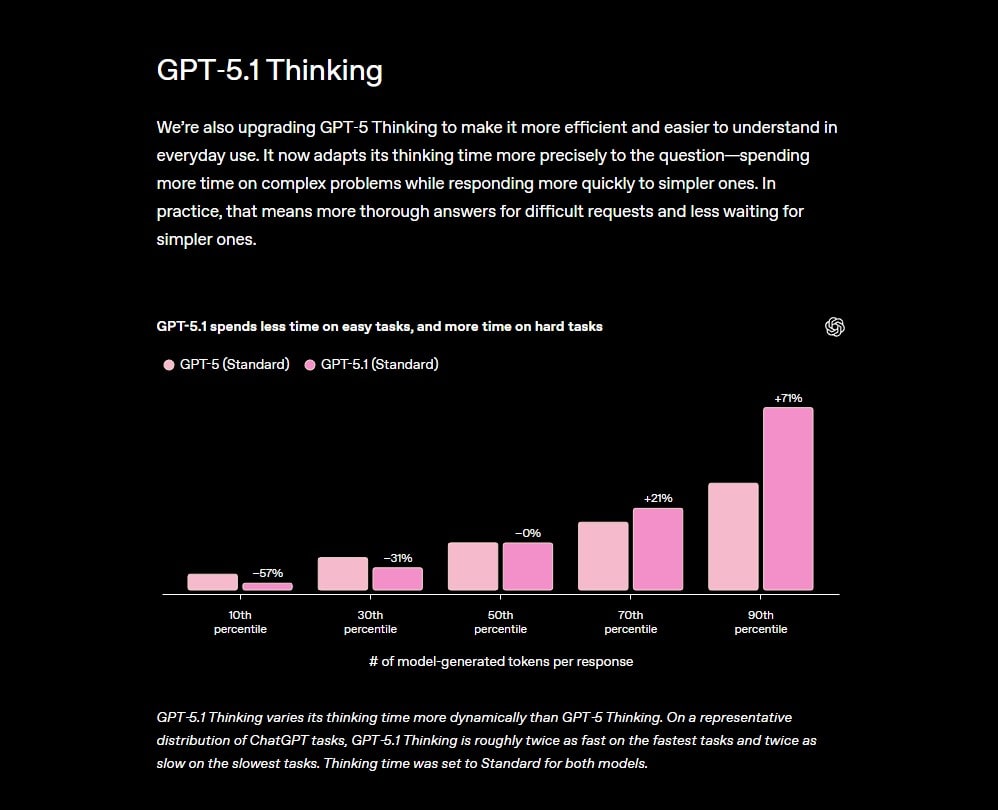
- Variable thinking time: GPT-5.1 Thinking adapts its reasoning time depending on task, faster for simple tasks, longer for complex tasks.
- More customization: The user can choose tone settings (e.g., Friendly, Professional, Quirky) and future granular controls (how concise, how warm, how many emojis) to tailor responses.
Strengths & Potential Limitations
Gemini 3 – Strengths
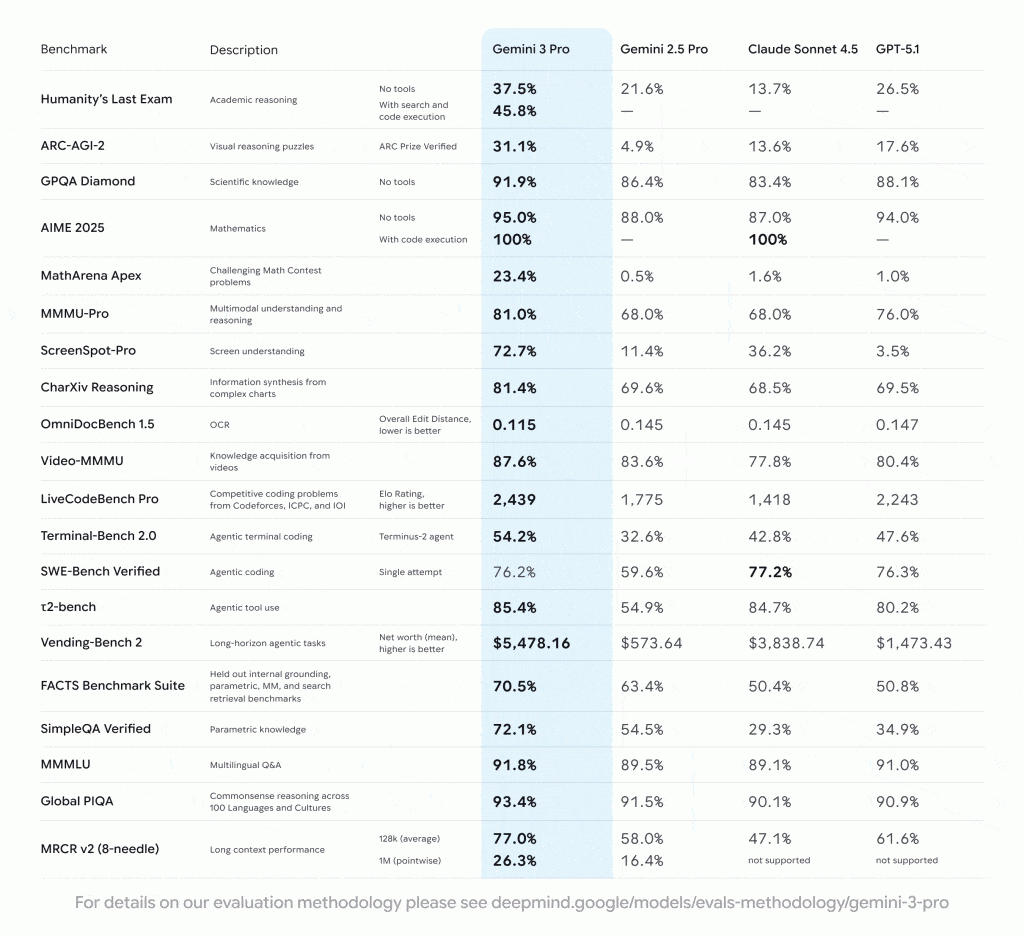
- Strong multimodal support: very helpful when you have inputs beyond plain text (images/videos/code) or want rich outputs (visualisation, UI generation).
- High reasoning and tool-use capacity: good for developers, researchers, or advanced workflows (building apps, automating complex tasks).
- Long context window: beneficial for large documents, long dialogues, multi-step workflows.
- Integration within Google ecosystem (Search AI Mode, Gemini app, Vertex AI) – may make it seamless for users already in that ecosystem.
Gemini 3 – Potential Limitations
- As with any new frontier model, availability may be limited (Deep Think mode coming later) and cost may be high for advanced features.
- Multimodal and tool-use features often require more complex prompts or platforms – for casual users plain text might be sufficient.
- While tuned for very advanced tasks, for very casual/conversational use one might not notice huge differences vs other models.
GPT-5.1 – Strengths
- Enhanced conversational tone and style: good for everyday users who want a natural “chat” feel.
- Reliable instruction-following: for tasks like generating content, summarisation, coding, etc, less need for highly crafted prompts.
- Customisation of tone/style is a plus for different user personas (professional, friendly, quirky).
- Strong rollout via ChatGPT and API – if you’re already using ChatGPT, upgrading to GPT-5.1 is likely smooth.
GPT-5.1 – Potential Limitations
- While reasoning is improved, the announcement doesn’t emphasise multimodal & agentic tool use as heavily as Gemini 3. If your workflow relies heavily on images, video or large-scale tool integration, that might be a factor.
- The large context window isn’t explicitly detailed in the announcement (at least not in the part we reviewed) — so for ultra-long inputs one should check actual specs after release.
- Model customisation is improved, but still may require exploration to find the right settings or tone for a given user/team.
Use-Cases: Which Model for What?
Here are some typical scenarios and which model might fit best:
- Casual conversation / content creation / summarisation: If you want to talk, ask for help writing articles, blog posts, social media content, get explanations in plain language — GPT-5.1 (Instant) is very strong due to its conversational tone and improved instruction-following.
- Multimodal tasks (image + text + code), complex reasoning, developer workflows: If you have tasks like analysing video footage, building interactive visualisations, integrating AI into applications via tools/agents, then Gemini 3 stands out.
- Enterprise/workflow automation / tool use / long-input processing: For multi-step workflows (e.g., plan a project, integrate across software, generate UI, automate tasks) the agentic features and long-context ability of Gemini 3 make it compelling. On the other hand, GPT-5.1 remains excellent for general automation and developer tasks but may have less emphasis (in announcement) on the “agentic” layer.
- Tone and user experience control: If your application needs the AI to adopt a specific personality or tone (e.g., professional consultant vs friendly coach) GPT-5.1’s customisation features give an edge. Gemini 3 might be more focused on capability than personality (though that doesn’t mean tone control is absent).
- Ecosystem integration: If you already use Google services (Search, Vertex AI, Google Cloud) then Gemini 3 may integrate more naturally. If you’re using ChatGPT or OpenAI API, GPT-5.1 may be easier to plug in.
Quick Summary
“Gemini 3 vs GPT-5.1” comparison:
- Google Gemini 3: Google’s next-gen model with strong multimodal and agentic capabilities, long context support, built for building, learning and planning.
- Openai GPT-5.1: OpenAI’s upgraded GPT-5 model focusing on smarter, more conversational interactions, better reasoning and user tone/style customisation.
- Choose Gemini 3 for advanced workflows involving images/video/code/agents; choose GPT-5.1 for everyday conversational AI, writing, summarisation and tone-specific use-cases.
Final Thoughts: Which One Should You Pick?
There’s no one “better” model universally — it depends on your needs:
- If you are a developer, researcher or someone building advanced AI-centric workflows, especially involving multimodal inputs and tool/agent integration — lean Gemini 3.
- If you are a writer, content creator, or regular user seeking a smart, easy-to-talk-to model with good writing, summarisation and style control — GPT-5.1 may be the better fit.
- It’s also possible to use both: for example use GPT-5.1 for everyday tasks, but switch to Gemini 3 when you need heavy-duty multimodal reasoning.
As both models roll out more broadly, you’ll want to test for your specific tasks. Check integration, cost, latency, ease of prompting, API support, and ecosystem compatibility.