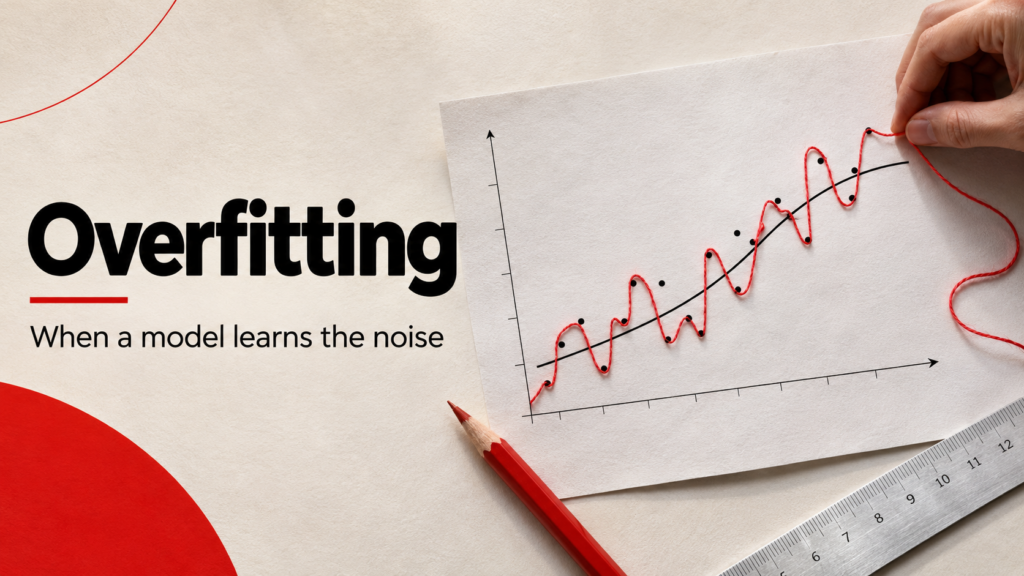
Your model performs brilliantly on the examples it studied, then disappoints on new ones. Training for longer makes the first score even better without rescuing the second. Before adding another layer or collecting random extra data, check whether the model is overfitting.
Overfitting happens when a model adapts too closely to its training data, including details that do not reliably generalize to unseen examples. A strong training result is useful, but the goal is performance beyond that particular collection of examples.
This guide starts with a diagnosis, then matches each likely cause to a practical repair. The examples are illustrative; they are not measurements from a model tested by Unlimited AI.
First, decide which problem the scores suggest
Compare training and validation performance using the same task and an appropriate metric. The validation set helps you choose a model; a separate test set should be reserved for the final evaluation. A difference between scores is a clue, not a diagnosis by itself.
| What you observe | What to investigate |
|---|---|
| Strong training performance, much weaker validation performance | Overfitting, a difficult split, or a change in the data distribution |
| Weak performance on both sets | Underfitting, unsuitable features, optimization problems, or poor labels |
| Validation results look unusually perfect | Duplicate examples, data leakage, or an evaluation mistake |
| Validation results vary widely between runs or folds | A small or unrepresentative evaluation set, unstable training, or unsuitable splits |
For example, imagine a classifier with 99% training accuracy and 78% validation accuracy. That gap deserves investigation, but there is no universal percentage at which overfitting begins. Class balance, dataset size, uncertainty, and the difficulty of future cases all affect the interpretation.
What overfitting looks like on a curve
The scikit-learn polynomial example shows three models fitted to noisy samples from a smooth function. A straight line misses the pattern. A moderate-degree polynomial follows it more closely. A highly flexible polynomial bends around the samples and behaves poorly between some of them.
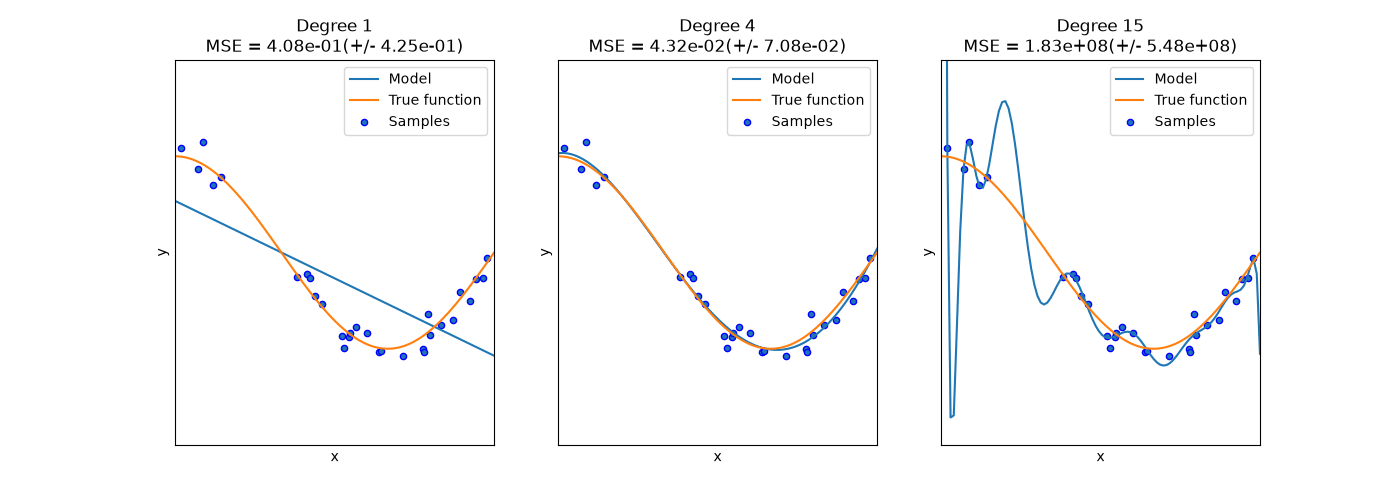
The problem is not that flexible models are always bad. Flexibility lets a model represent useful relationships, but it can also represent accidental patterns. The right level depends on the data, the task, and how the model is constrained.
Neural networks can have the same generalization problem. If you need a refresher on their layers and training process, read our deep learning explanation. Overfitting also occurs in other model families, including decision trees and polynomial regression.
Read training loss and validation loss together
Loss measures how wrong the predictions are according to the chosen objective. Lower loss is generally better when comparing the same loss under the same conditions. During training, the training loss may keep decreasing while validation loss stops improving or starts increasing.
That pattern suggests the extra training is improving the fit to the training examples without improving generalization. Select a checkpoint using validation performance rather than assuming the final training epoch is best.
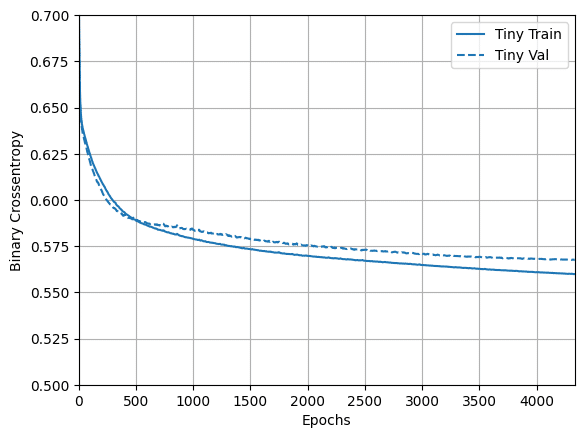
Real curves are noisy. Look for a sustained pattern rather than one unfavorable epoch. Also check that the plotted quantities are comparable: training-time dropout, augmentation, and regularization can make training and validation losses differ even when the model is useful.
Five repairs, matched to the cause
1. Make the evaluation split reflect the real task
A random split is convenient, but it is not always the right test. If many records come from the same person, document, or device, keep related records together when independence matters. For forecasting, train on earlier data and evaluate on later data rather than allowing future information to influence the past.
Fit learned preprocessing steps on training data only. For example, a scaler or feature selector should not learn from the held-out test set. Scikit-learn’s data leakage guidance explains how pipelines help keep preprocessing attached to the correct training split.
This does not directly simplify the model. It makes the evidence trustworthy, so you can tell whether the remaining gap is a modeling problem. Repeatedly inspecting a test set and changing the model in response also weakens its value as an independent final check.
2. Reduce unnecessary flexibility
Try a simpler baseline before assuming that a bigger model will help. In a tree, this might mean limiting depth or requiring more examples per leaf. In a polynomial model, reduce the degree. In a neural network, compare a smaller architecture with the current one.
Keep the evaluation setup fixed while making that comparison. If the simpler model improves validation performance while its training performance becomes less impressive, that can be a useful trade. If both results become poor, you may have reduced capacity too far.
3. Add regularization with a clear comparison
Regularization discourages certain kinds of complexity. Weight penalties such as L2 add a cost related to weight magnitude. Dropout changes training by randomly suppressing some activations. Each changes the learning process; neither is a substitute for checking the results.
The official TensorFlow overfitting tutorial compares model capacity, weight regularization, and dropout. Use these techniques as candidates to evaluate, rather than copying a particular setting as a guaranteed fix for every dataset.
4. Improve the examples the model can learn from
More useful data can expose the model to a broader range of conditions. More copies of nearly identical examples may add little. Look for missing cases: different lighting, writing styles, device types, or other variations that matter in the intended use.
Check labels and duplicates too. For images, suitable augmentation can create additional training variations, but the transformation must preserve the answer. A change that turns a readable symbol into a different symbol is not automatically a valid example. Keep validation and test data representative of the conditions you want to measure.
5. Stop training when validation improvement runs out
Early stopping monitors validation performance and ends training after improvement has stalled under a chosen rule. A patience setting allows several checks without improvement, reducing the chance that a small fluctuation ends training too early.
Keep the best validation checkpoint when that is appropriate for the objective. Early stopping can limit over-training, but it will not repair leaked features, incorrect labels, or a validation set that fails to represent the target task.
A simple experiment plan that avoids changing everything
- Record the current split, metric, training settings, and baseline results.
- Check duplicates, related records, preprocessing, and the meaning of the validation set.
- Change one major factor: capacity, regularization, training duration, or data coverage.
- Compare on the same validation setup; use repeated runs or suitable cross-validation when results are unstable.
- Choose the configuration, then evaluate once on the reserved test data and report remaining limitations.
For a classifier, accuracy may hide poor performance on a minority class. Inspect task-relevant measures and examples of errors as well as the headline score. A model that improves the average but fails on an important group of inputs may still be unsuitable.
Finally, separate overfitting from distribution shift. A model can validate well on data drawn from the training setting and still fail after the environment changes. That calls for testing the changed conditions, not simply increasing a regularization penalty.
Questions worth asking before the next training run
Is overfitting the same as underfitting?
No. An underfitting model fails to capture enough of the useful pattern and often performs poorly even on training data. An overfitting model can fit its training examples closely while transferring that performance poorly. Both require evidence from an appropriate evaluation.
Will training for more epochs fix overfitting?
Usually, continuing the same training is not a reliable fix when validation performance is already getting worse. Review the best checkpoint and investigate capacity, regularization, data quality, and the split before extending the run.
Can a model overfit the validation set?
Yes. If you try enough configurations and keep selecting the one that wins on the same validation data, choices can adapt to that set. An untouched final test set helps assess the chosen result; for some workflows, nested cross-validation is another way to separate tuning from evaluation.
The next useful step is a controlled comparison. Choose the strongest clue in your results, change the factor most likely to explain it, and check whether performance on genuinely held-out examples improves. A less spectacular training score can be progress if the model becomes more reliable on new cases.